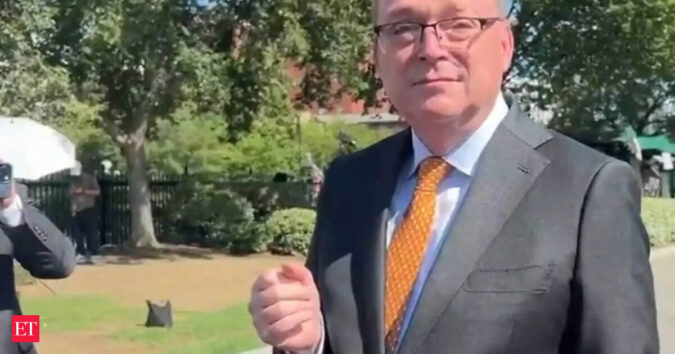
Kevin Hassett, director of the White House National Economic Council, was responding to a question from ANI when he was asked whether the proposed legislation would have any bearing on India-US trade talks.
Also Read: 100% tariff threat for India and others: US Senate advances Russia sanctions bill
“It’s up to the negotiators,” Hassett said, declining to elaborate further.
His remarks come as the US Senate moves closer to passing bipartisan legislation that could increase economic pressure on major buyers of Russian crude, including India and China.
Earlier this week, senators voted 86-12 to clear an initial procedural hurdle for the legislation, formally titled the Lindsey O. Graham Sanctioning Russia and Iran Act of 2026.
If enacted, the bill would authorise the US president to impose tariffs of up to 100% on imports from countries purchasing large volumes of Russian oil or gas. The tariffs would not apply automatically and would remain subject to legal and executive conditions. The legislation must still be approved by the House of Representatives before becoming law.Washington has said the proposed measure is aimed at curbing petroleum revenues that support Russia’s military campaign in Ukraine, identifying India, China, Slovakia, Hungary and Azerbaijan as major purchasers of Russian energy.
The proposed sanctions come at a time when India and the US are engaged in negotiations over a broader trade agreement, with tariff structures remaining a key area of discussion.
Also Read: US senators announce deal on new Russia, Iran Sanctions Bill
In February 2026, the two countries announced an interim trade understanding under which the US proposed lowering reciprocal tariffs on Indian exports to 18% in exchange for increased Indian purchases of US energy and technology.
However, implementation of the arrangement was disrupted after the US Supreme Court struck down the reciprocal tariff mechanism under the International Emergency Economic Powers Act (IEEPA), prompting the administration to temporarily rely on Section 122 provisions.
At present, under a subsequent Section 301 framework linked to forced-labour considerations, most Indian exports to the US face an additional 10% duty over standard Most-Favoured-Nation (MFN) tariff rates.
Despite the evolving tariff regime, both countries continue discussions on an interim trade arrangement aimed at reducing tariff barriers, expanding market access and strengthening economic ties.
Hassett has previously described the India-US relationship as “complicated” while expressing optimism that the two sides would be able to reach a trade agreement.