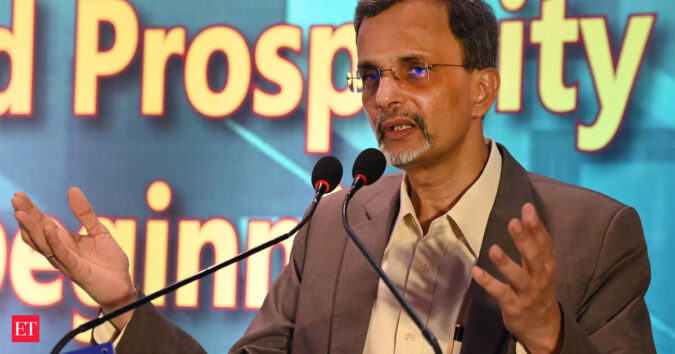
“To hit the USD 30 trillion mark by 2047, the country would require about 12 per cent growth (year-on-year) in dollar terms,” Nageswaran said.
He noted that the current GDP stands at approximately USD 3.91 trillion and is expected to reach USD 7.8 trillion within the next six years.
Speaking as the chief guest at the 67th Institute Day celebrations of the Indian Institute of Technology, Madras, Nageswaran highlighted that such a goal is doable but requires a deep understanding of the challenges present in a fraught geopolitical environment.
Frugal innovation, he pointed out, is India’s strength. “But the important point is we have to remember that we have to keep at it for the next generation,” he added.
“We have to generate frontier research in science and engineering. India’s universities and labs must be at the cutting-edge of the global knowledge ecosystem. We have to develop the capacity to acquire external technology and adapt it to Indian conditions, scale and cost constraints,” Nageswaran said.
He called for Indian universities and laboratories to remain at the cutting edge of the global knowledge ecosystem, developing the capacity to acquire and adapt external technology to local conditions, scale, and cost constraints. He added that moving from pilot projects to patents and economy-wide productivity gains in agriculture, manufacturing, and services is the primary challenge where premier institutes like IIT Madras play a vital role. The event, which was also attended by faculty, students, and alumni, served as a platform to honour extraordinary achievers. Among the alumni recognised during the ceremony were Srinivas Narayanan, Chief Technology Officer of OpenAI, and Aravind Srinivas, Co-Founder and CEO of Perplexity.ai.
Other prominent awardees included D K Sunil, Chairman and Managing Director of Hindustan Aeronautics Limited, and professors from international universities.
IIT Madras Director Prof V Kamakoti, delivering the presidential address, noted that the institute has been ranked as the number one engineering institution in the country for ten consecutive years from 2016 to 2025 in the NIRF rankings.
He highlighted the launch of IITM Global as a defining milestone, reflecting a vision to establish the institution as the world’s first multinational university. The international expansion includes the establishment of a campus in Zanzibar, Tanzania, in 2023.
Several academic and research awards were presented during the occasion, including the Srimathi Marti Annapurna Gurunath Award for Excellence in Teaching to Prof Srinivasa Rao and Prof Dhiman Chatterjee. The Institute Research and Development Awards for 2025-26 were conferred upon Dr Nagabhushana Rao Vadlamani and Prof Boby George for their contributions to their respective fields. PTI