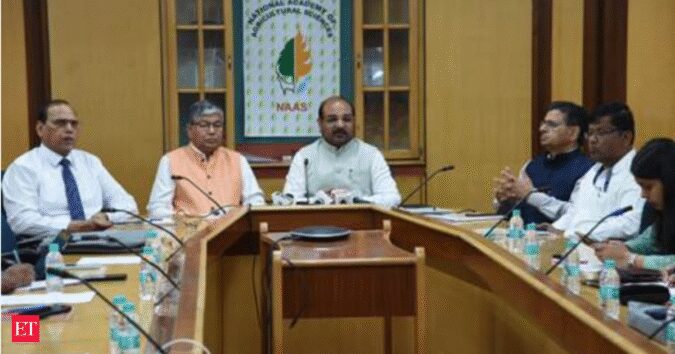
Addressing the gathering, Secretary, Department of Agricultural Research and Education (DARE), Director General of the Indian Council of Agricultural Research (ICAR), and President, NAAS, M L Jat, said India’s goal of becoming an Atmanirbhar Bharat by 2047 places agriculture at the center of this transformation. While fertilisers played a crucial role during the Green Revolution in enhancing productivity, he noted that the current challenge lies in their declining use efficiency and indiscriminate application.
He highlighted that India consumes nearly 33 million tonnes of fertilisers annually, with a substantial portion being imported, making it imperative to reduce import dependence. Achieving this, he said, calls for a comprehensive strategy encompassing short-, medium-, and long-term measures. Strengthening soil health initiatives, promoting balanced and need-based fertiliser use, and raising farmer awareness are key steps in this direction.
Jat further emphasised the need to harness advanced technologies such as precision nutrient management, artificial intelligence, and sensor-based systems to optimize fertiliser application. He also advocated crop diversification towards pulses and oilseeds, recycling organic waste under the Waste-to-Wealth initiative, and expanding the use of biological inputs to gradually reduce reliance on chemical fertilisers.
He noted that participants in the brainstorming session recommended a multi-pronged strategy encompassing short-, medium-, and long-term R&D goals, supported by enabling policy measures. The proposed roadmap emphasizes strengthening fertiliser research to develop smart alternative fertilizers; harnessing underutilised indigenous minerals such as glauconite, phosphate rock, mica, and polyhalite, along with industrial by-products; promoting greater use of biological inputs; leveraging the potential of the soil microbiome; and improving composting techniques. It also calls for crop breeding to enhance nutrient use efficiency (NUE), adoption of good agricultural practices (GAP) through precision nutrient management integrating fertilisers and organics, restoration of soil health, crop diversification, and recycling of crop residues.
It was also emphasised that there is a need to launch a Mission Mode Program to promote Integrated Nutrient Supply and Management (INSAM). The goal of the proposed mission would be to replace at least 25% of current mineral fertiliser use with organic manures in the next 3 years. An aggressive round-the-year technology transfer using digital tools such as AI platform Bharat VISTAAR would help largescale adoption of the proven technologies. Weak extension lays greater emphasis on increasing fertiliser use and not on its efficient use.