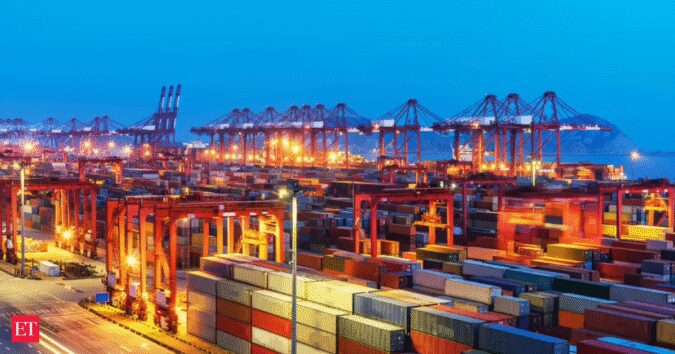
The latest ‘Flash Report on Central Sector Infrastructure Projects‘ showed that the revised cost of all 1,981 projects, each valued at Rs 150 crore or higher, monitored by the statistics ministry, stood at Rs 42,78,402 crore compared to their original cost of Rs 37,12,662 crore.
The report did not specify the actual number of projects that are facing cost overrun.
The Ministry of Statistics and Programme Implementation (MoSPI), in a press release on Monday, stated that as of April 2026, 1,981 ongoing infrastructure projects, with a total revised cost of Rs 42.78 lakh crore, are being monitored across 17 central ministries/departments.
The cumulative expenditure incurred on these projects stands at Rs 20.36 lakh crore, accounting for approximately 47.59 per cent of the revised project cost, indicating steady progress in project implementation.
A significant proportion of projects are at advanced stages, with 801 projects (40 per cent) achieving over 80 per cent physical progress, while 277 (14 per cent) have crossed 80 per cent financial completion.
The data also reflects a balanced pipeline, with projects distributed across early and advanced stages of implementation.The Transport & Logistics sector (as per the DEA’s Harmonized Master List) accounts for the highest number of ongoing projects (1,459 projects), with revised estimates of Rs 23.34 lakh crore underscoring priority to connectivity-driven infrastructure growth.
The total 1,981 ongoing infrastructure projects include 814 Mega projects (project cost of Rs 1,000 crore and above) with an original cost of Rs 31.63 lakh crore, and 1,167 major projects (project cost below Rs 1,000 crore and up to Rs 150 crore) amounting to Rs 5.49 lakh crore.
Physical and financial progress broadly move in tandem, with a large number of projects clustered at the initial (0-20 per cent) and advanced (81-100 per cent) stages, indicating a pipeline of newly-started projects alongside many nearing completions.
While physical progress exceeds financial progress in the 81-100 per cent range, financial progress is relatively higher in the early stages, reflecting upfront expenditure patterns in project implementation.
The Ministry of Road Transport & Highways accounts for the highest number of projects, with 1,137 projects (57 per cent), and also commands the largest share of total revised project cost of Rs 10.81 lakh crore (25 per cent), highlighting its central role in national infrastructure development.
The railways ministry is implementing 260 projects (13 per cent), and constitutes the second largest share of total revised project cost at Rs 8.69 lakh crore (20 per cent).
The Ministry of Coal accounts for implementing 128 projects (7 per cent), with a total revised project cost of Rs 2.49 lakh crore (6 per cent).
The Ministry of Petroleum & Natural Gas, Ministry of Power, Ministry of Housing & Urban Affairs, and Department of Water Resources, River Development and GR are implementing 112, 102, 51, and 48 projects, with associated revised costs of Rs 5.19 lakh crore, Rs 5.53 lakh crore, Rs 3.75 lakh crore, and Rs 2.25 lakh crore, respectively.
The remaining 143 projects (7 per cent), with a total revised cost of Rs 4.08 lakh crore (10 per cent), are distributed across various ministries/departments, including higher education, civil aviation, steel, telecommunications, labour & employment, ports, shipping & waterways, health & family welfare, mines, DPIIT, and sports.
Transport and logistics remain the dominant sector, accounting for 55 per cent of total revised cost (Rs 23.34 lakh crore) across 1,459 projects (74 per cent of the total Projects), underscoring the central role of roads and highways, railways, aviation, urban public transport, shipping, and inland waterways in economic integration and logistics efficiency.
The energy sector follows with 27 per cent of aggregated revised cost (Rs 11.30 lakh crore) across 221 projects, reflecting sustained emphasis on oil and gas infrastructure, electricity generation, transmission and distribution networks, and energy storage systems.
Communication infrastructure, with a revised cost of Rs 2.73 lakh crore (6 per cent) across 12 projects, represents targeted interventions aimed at strengthening digital connectivity.
Water and sanitation projects account for Rs 2.30 lakh crore (5 per cent) across 67 projects, highlighting continued focus on essential urban services.
Social and commercial infrastructure, comprising 77 projects with a revised cost of Rs 0.91 lakh crore (2 per cent), reflects selective investments in education, healthcare, real estate, and tourism, hospitality and wellness.
Projects classified under ‘Others’, amounting to Rs 2.21 lakh crore (5 per cent) across 145 projects, indicate diversification across sectors, such as coal, steel, metals, and mining.