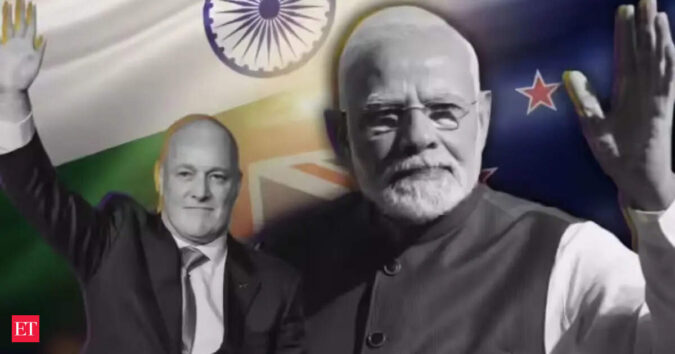
The free trade agreement (FTA) is being touted as “once-in-a-generation” and “landmark” pact.
ALSO READ | India-New Zealand FTA to give major boost to exports: Experts
For the second time in a trade deal, India has received foreign direct investment (FDI) commitment of $20 billion in over 15 years. A similar commitment of $100 billion was made by four-European nation bloc EFTA in its pact with India.
Prime Minister Narendra Modi said the FTA will greatly benefit farmers, youth, women, MSMEs, artisans, startups, students and innovators.
“The investment commitment of $20 billion by New Zealand will further strengthen our cooperation in agriculture, manufacturing, innovation and technology, paving the way for a more prosperous and dynamic future for both countries,” Modi said in a social media post.
Commerce and industry minister Piyush Goyal and New Zealand’s Trade and Investment Minister Todd McClay signed the FTA here.

“Today, the Indian Ocean feels a little smaller…As two nations that love cricket, this FTA is our shared pitch. Today, we open a new innings together,” Goyal said, adding that the entire negotiations were without any rancour, disagreement, jostling or difficult moments but done in a “good spirit of accommodation”.
Describing the FTA as a “once-in-a-generation agreement”, New Zealand’s Prime Minister Christopher Luxon said it would provide exporters with unprecedented access to 1.4 billion people and to an economy set to become the world’s third-largest.
Concluded in December after about nine months of talks, the pact is one of India’s fastest trade deals and aims to double bilateral trade in goods and services to $5 billion in five years, is expected to be implemented by the end of this year as it requires the approval of the New Zealand Parliament. In India, the Union cabinet approves a trade pact.
Total bilateral trade in goods and services reached $2.4 billion in 2024.
India’s exports include aviation fuel, pharmaceuticals, motor vehicles, petroleum products, readymade garments, and machinery; while imports include wood and wood products, iron and steel, raw wool, dairy products, scrap metals, coal and farm-linked inputs.
McClay, who is leading a 40-member delegation, said it is a high-quality FTA which reduces friction, provides certainty, sets clear rules and makes it easier for businesses to build relationships.
“An investment will be in very many ways from some of the areas that we’ve agreed in the FTA… to help increase production and productivity, and the horticulture sector and many others over a period of time,” McClay said, adding that products from New Zealand and India could be mixed together and then sold to other countries in the region as that is how “modern trade agreements work”.
The products that are kept in exclusion include dairy, animal products, other than sheep meat, agri goods, sugar, artificial honey, animal, vegetable or microbial fats and oils, arms and ammunition, gems and jewellery, copper and articles, aluminium and articles.
India will provide duty-free access to a number of goods from New Zealand such as wooden logs, coking coal, waste and scraps of metals, wood, sheep meat, and leather-raw hides.
On the pact promoting bilateral cooperation in financial services with innovative provisions on digital payments, Goyal said: “It is very complex process to align the two systems…but the long term benefits, particularly cost of remittances, the additional conversion and exchange rate losses that both sides suffered will come now very significantly, and that’s a big boost to competitiveness and possible growth in trade representations.”
Insisting that India has never opened the dairy sector, Goyal said: “Having said that, we are also wanting to encourage our exports. (It) is a part of our foreign trade policy in which any project or any product which is meant for re-export, can be brought to India, processed or further worth the ball, and we exported, but not sold in the Indian market”.
India’s gains
New Zealand products which enjoy tariff reductions include wine, pharmaceutical drugs, polymers, aluminium, iron and steel articles.
On certain products such as Manuka honey, apples, kiwi fruit, and albumins, including milk albumin, New Delhi has offered quota-based duty concessions with Minimum Import Price and other safeguards, ensuring quality imports and consumer choice while protecting domestic farmers.
All tariff rate quotas for apples, kiwifruit and Manuka are paired with delivery on “Agriculture Productivity Action Plans” which would be monitored by a Joint Agriculture Productivity Council, balancing market access with protection of sensitive domestic agricultural sectors.
The Confederation of Indian Industry said that key sectors such as transport and automotive, pharmaceuticals, plastics and rubber, electrical and electronic equipment, and mechanical machinery are poised to scale up exports, enhance competitiveness, and strengthen their presence in global markets.
“The signing of India-New Zealand FTA would be a game changer in bilateral trade relations. New Zealand offering 100% duty-free access will provide a big boost to range of India’s exportable products such as textile, pharma, leather, engineering goods etc. However, the real gain would be realised in services sector where under the FTA a new Temporary Employment Entry visa has been agreed for Indian professionals with a quota of 5000 work visa. New Zealand commitment to invest USD 20bn over a 15 years time would have positive impact on Food-Processing, energy and digital services sectors,” said Deep Kapuria, Chairman The Hi-Tech Group.
On the services side, India will get market access commitments by New Zealand in about 118 services sectors such as computer-related services, professional services, audiovisual, telecommunication, construction, education, environmental, financial services, tourism and travel.
The agreement removes caps on Indian students, allows part-time work during study, and provides extended post-study work opportunities of up to four years besides the option of joint degrees between institutions of the two countries.
It will provide easier access to New Zealand’s services market across many sectors, which can boost India’s services exports. Most-Favoured Nation commitment will be granted in about 139 sub-sectors to India.
The FTA also establishes a new temporary employment entry visa pathway for Indian professionals in skilled occupations, with a quota of 5,000 visas at any given time and a stay of up to three years.
This pathway covers Indian professions such as AYUSH practitioners, yoga instructors, Indian chefs, and music teachers, as well as high-demand sectors including IT, engineering, healthcare, education, and construction.
For the first time with any country, New Zealand has created a dedicated pathway for student mobility and post-study work visas with India.