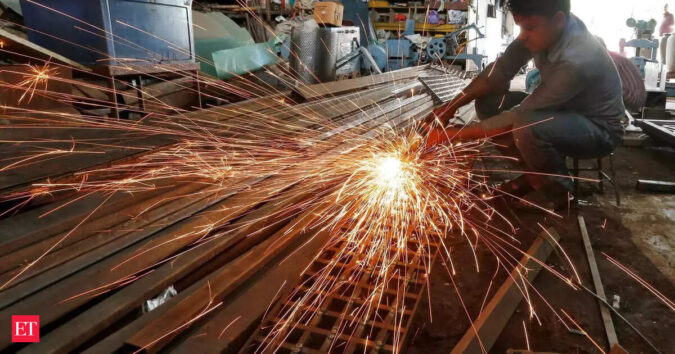
India’s average manufacturing growth rose from 3.44% in the pre-pandemic period (2016-19) to 4.15% in 2022-25, moving from below the global average to nearly two percentage points above the world benchmark, according to the ASSOCHAM report.
The analysis, which covers the world’s 10 largest manufacturing economies accounting for nearly 65% of global manufacturing output, found that India has emerged as one of the “Emerging Manufacturing Leaders” by significantly improving its manufacturing performance relative to the global average in the post-pandemic period.
Read more: India’s first export container marks break from decades of China dependence
According to the report, before the pandemic, only China, Mexico and Russia recorded manufacturing growth above the global average. In the post-pandemic period, India joined the United States, France, Germany, Italy and the United Kingdom in outperforming the global benchmark.
| Comparative Manufacturing Growth Performance pre- and post-Pandemic | |||||||
| Pre-Pandemic (2016-19) | Post-Pandemic (2022-25) | ||||||
| Country | Country Average | Gap vs world | Country Average | Gap vs world | |||
| China | 6.79 | 2.40 | -0.07 | -2.26 | |||
| United States | 4.08 | -0.31 | 3.81 | 1.62 | |||
| Germany | 2.05 | -2.34 | 2.63 | 0.44 | |||
| India | 3.44 | -0.95 | 4.15 | 1.96 | |||
| Republic of Korea | 2.39 | -2.00 | 0.30 | -1.89 | |||
| Italy | 2.75 | -1.64 | 3.54 | 1.35 | |||
| Mexico | 5.51 | 1.12 | 7.77 | 5.58 | |||
| Russian Federation | 14.24 | 9.85 | 10.86 | 8.67 | |||
| France | 2.48 | -1.91 | 4.52 | 2.33 | |||
| United Kingdom | 1.55 | -2.84 | 2.72 | 0.53 | |||
| Source: ASSOCHAM’s calculations using data from World Bank and FRED | |||||||
Read more: Why India’s manufacturing future needs more than jugaad
“The global manufacturing landscape is undergoing a gradual but important shift. Companies are no longer looking at efficiency alone; they are equally focused on resilience and diversification. India’s improving manufacturing performance reflects the impact of sustained reforms and growing investor confidence”, said Nirmal K Minda, President, ASSOCHAM.
What helped India?
India’s improved manufacturing performance has been driven by factors such as rising domestic demand, infrastructure expansion, better logistics, increased investor interest under the China+1 strategy, and government measures including the Production Linked Incentive (PLI) schemes, industrial corridor projects and PM Gati Shakti, said ASSOCHAM.
Despite higher input costs and geopolitical uncertainties, growth sentiment in India’s manufacturing sector remained positive in the fourth quarter of FY26, according to the latest FICCI survey for the January-March period of FY26, as India continues to strengthen its position as one of the world’s emerging manufacturing leaders. The survey found that capacity utilisation dipped slightly to nearly 72 per cent from the previous quarter. However, manufacturers remained optimistic about investment over the next six months.
The sentiment comes amid India’s economy expanding 7.7% in fiscal year 2025-26, up from 7.1% a year earlier. Growth in the January-March quarter stood at 7.8%, compared with 8% in the preceding quarter. The fourth-quarter figure exceeded the median estimate of 7.3% in a Bloomberg survey of economists and matched the pace recorded in the previous quarter.