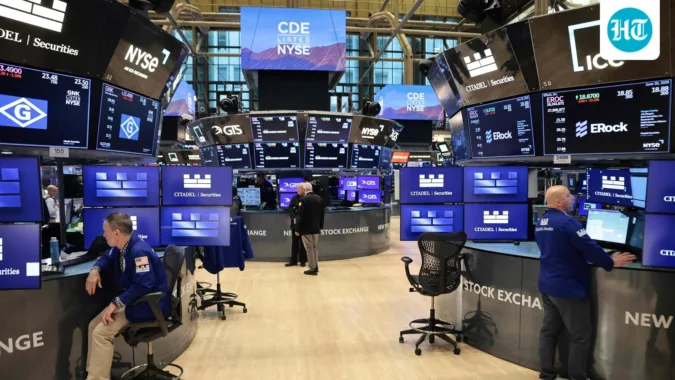
US stocks opened mixed on Monday as investors watched technology stocks, Treasury yields, oil prices and the Federal Reserve’s next move.
The Dow Jones Industrial Average fell 0.3% at the open, while the S&P 500 slipped 0.1%. The Nasdaq Composite rose 0.1%, helped by gains in technology stocks, according to Yahoo Finance.
The S&P 500 had gained for three straight weeks before Monday’s session, while the Nasdaq came off a relatively quiet week on Wall Street.
Fed rate decision in focus
Investors are now focused on the Federal Reserve and whether it could change interest rates in September. Traders have cut the odds of a September rate hike to below one-third ahead of the Fed’s Jackson Hole meeting, as recent inflation and jobs data have given mixed signals.
The Federal Open Market Committee meeting minutes, due Wednesday, could give investors more clues about what Fed officials think about inflation, jobs and interest rates.
Retail earnings to give clues on consumers
Investors are also waiting for a busy week of retail earnings. Major retailers including Walmart, Target, Lowe’s and Home Depot are scheduled to report quarterly results. These results could give Wall Street a better picture of US consumer spending, especially during the important back-to-school shopping season.
Goldman Sachs economist Jan Hatzius warned that strong consumer spending may slow in the coming months. Sales at the median S&P 500 consumer discretionary company rose 5.9% year over year in the second quarter, while sales at the median consumer staples company increased 3.9%, Hatzius said.
Goldman Sachs said the strength was broad-based, with same-store sales improving for companies serving both lower-income and higher-income consumers. However, Goldman expects real consumer spending growth to slow to 1%-1.5% in the second half of the year as household cash flow stops getting the same boost from higher tax refunds.
Also read: Warren Buffett, Greg Abel buy 8 stocks: Alphabet, Delta, Lennar, D.R. Horton among Berkshire bets
Oil prices and Treasury yields rise
Oil prices moved higher on Monday, adding another factor for investors and the Fed to watch. Brent crude, the international benchmark, traded around $88 a barrel, while West Texas Intermediate, the US benchmark, stood near $82 a barrel. Oil prices remain important for markets because higher energy costs can put more pressure on inflation.
Treasury yields also moved higher. The 10-year Treasury yield rose 1 basis point to 4.71%, while the 30-year yield gained 2 basis points to 5.28%. Longer-term bond yields have been rising as investors worry about the US government’s growing debt and spending.
Chip stocks jump as AI demand grows
Semiconductor stocks were among the strongest performers on Monday, with the iShares Semiconductor ETF rising more than 2.4%. Shares of major chip companies including Nvidia, Broadcom and Micron moved higher.
Micron was the standout, rising more than 5% and moving back above the important $1,000 level. The chip rally came after Bloomberg reported that AI company Anthropic’s preliminary quarterly revenue jumped to $11.5 billion, about 14 times last year’s figure.
The strong Anthropic revenue figure gave investors another sign that AI demand remains strong. The news also helped the wider AI trade, including companies that could benefit from higher spending on AI data centers and computing infrastructure.
Micron stock crosses $1,000 again
Micron shares crossed $1,000 in premarket trading, marking the first time the stock had reached that level since July 6, according to Yahoo Finance AlphaSpace data. The stock had fallen 25% between July 6 and July 29 as investors pulled back from expensive AI stocks. Micron has since recovered sharply, gaining about 36% from its July low. The stock is now up around 240% so far in 2026, according to Yahoo Finance.
Wall Street says AI spending is starting to pay off
Wall Street strategists are seeing signs that the huge amount of money being spent on AI is beginning to translate into stronger earnings. Keith Lerner, chief investment officer at Truist, told Yahoo Finance that there are signs that AI spending is leading to earnings growth.
JPMorgan recently raised its S&P 500 target to 8,000 from 7,800, pointing to strong earnings, better company guidance and strong demand for cloud services. Cloud companies are benefiting because businesses are increasingly paying to rent computing power and storage instead of building all the infrastructure themselves.
JPMorgan strategist Dubravko Lakos-Bujas said demand for cloud services is growing faster than spending for many major hyperscalers. Although free cash flow is expected to remain negative for most hyperscalers in fiscal 2027, the businesses they have already secured are growing faster than their spending, Lakos-Bujas said.
This could mean that AI companies may start making money from their investments faster, helping future revenue growth and easing concerns about whether huge AI spending will generate enough returns.
Gold continues to climb
Gold prices also moved higher on Monday, helped by rising long-term Treasury yields, concerns about US debt and lower expectations for a September Fed rate hike. Gold futures rose to around $4,442 per troy ounce and are up nearly 11% over the past month.
Bank of America strategist Michael Hartnett said gold remains a strong hedge against concerns including dollar weakness, bond market problems and rising asset prices. Bank of America’s weekly flows data showed that gold funds attracted $6.3 billion last week, their biggest weekly inflow since January.
US bond auction to test investor demand
Investors will also watch a $16 billion sale of 20-year US government bonds on Wednesday. Bloomberg reported that the auction will test demand for long-term US debt after several recent record-breaking bond auctions.
The 20-year bonds were showing a yield of around 5.27% in the when-issued market as of Friday. If the auction delivers a yield around that level, it would be the highest yield for the 20-year bond since it was brought back in 2020.
Higher yields show that investors are demanding more money to lend to the US government as concerns about inflation, government spending and the growing deficit increase. The 20-year yield was around 5.25% on Friday, while the yield curve continued to steepen.
Wall Street financial conditions get easier
US financial conditions have also become much easier in recent weeks, reversing a sharp tightening seen earlier. A Bloomberg gauge of US market conditions rose Thursday to its easiest level since 1996.
Financial conditions show how easy or difficult it is for companies and investors to take risks and raise money. Rising stocks, calmer markets and lower corporate borrowing costs generally make financial conditions easier. The latest move does not mean that mortgages or credit cards have suddenly become cheaper. Instead, it shows that conditions in Wall Street markets have become unusually loose.
Overall, investors are entering the week with several major issues to watch: Fed policy, retail earnings, consumer spending, oil prices, Treasury yields and the AI trade. For now, tech stocks are helping the market stay firm, while the Dow and S&P 500 are under pressure from higher yields and oil prices.