He said managing the current account credibly, financing it and preventing further currency depreciation are the central macroeconomic imperatives of FY27.
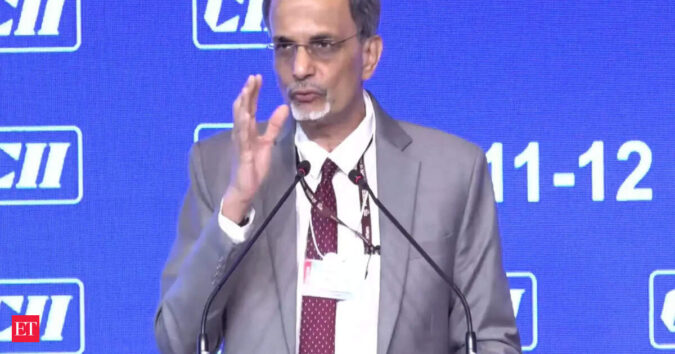
“The West Asia crisis, therefore, is not a foreign policy concern that occasionally bleeds into economic planning. It is a live balance of payments stress test, with direct consequences for inflation, the current account and the exchange rate,” he said at the CII Annual Business Summit Tuesday.
He highlighted that India imports 87% of its crude requirement, of which 46% is transiting through or near the Strait of Hormuz that remains effectively shut over the past two months.
Structural shift
Warning that the breakdown of the post-Cold War global economic order is exposing emerging markets to a new era of geopolitical fragmentation, technology rivalry and persistent external shocks, he said strategic context demands more than sound macro-management.
He noted that trade governed by comparative advantage, unrestricted capital mobility, technology diffusion through commercial integration and a rules-based multilateral system can no longer be taken for granted.”What we are experiencing is not a crisis within the system,” he said. “It is a structural challenge to the organising principles of the system itself… It demands a rethinking of how we position ourselves in a structurally altered world.”
Nageswaran said emerging economies that continue to plan on the assumption that the pre-2020 global economic architecture will reassert itself will be making a “strategic error”.
“India, given its scale, democratic legitimacy and the breadth of relationships, is better placed than most to help shape what comes next,” he noted.
What is required, he said, is strategic clarity to recognise that there is only a limited time window available to reposition trade relationships, technology partnerships, supply chain architecture and the coalition building that will shape the next international economic order.