Cognitive warmup. Norway intends to ban the use of generative AI tools by elementary school children, with Prime Minister Jonas Gahr Stoere warning (correctly, if I might add) that AI lets children skip crucial steps in their education and that schools should focus on teaching them how to read, write and do mathematics. These guidelines will be implemented with the new school year that starts sometime in August. Two parts to this. Students in Grade 1 to 7 will be completely banned from using AI, while teens between ages 14 to 16 years will be able to use generative tools with a teacher’s supervision. This is still in the works; expect to hear more soon.
PREVIOUSLY, ON NEURAL DISPATCH
Google DeepMind, and the right intent
Time and again, I’ve pointed out that amidst the usual ruckus by AI companies, there’s a contrast that holds fort. Google’s focus with AI goes much beyond what constitutes the typical AI ruckus these days (usage metrics, taking all human jobs nonsense and so on), with an intent to help AI become relevant for the masses. No, not the iPhone-totting ones or the greedy corporate boardroom audience, but people who genuinely could do with that helping hand. Our regular readers may remember a few weeks ago, I’d talked about Google DeepMind’s three AI model releases—Gemma 4, Gemini 3.1 Flash-Lite and Veo 3.1 Lite—focused on helping build what they call as India’s AI ambition. This is the sort of thing that creates more impact than noise.
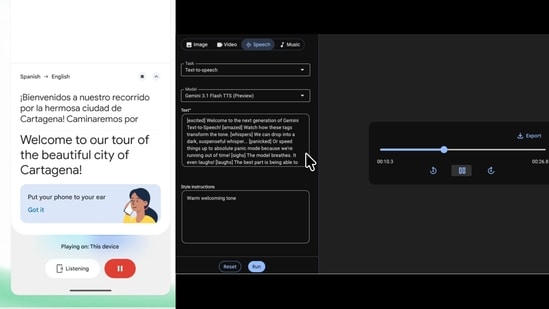
Google DeepMind isn’t slowing down on this mission. They believe that with the new Gemini 3.5 Live Translate and Gemini 3.1 Flash Text-to-Speech, there is scope to help. “ What excites me most is this new audio model’s ability to handle the fluid and unstructured way we naturally mix languages when we speak,” notes Manish Gupta, Senior Director, Google DeepMind.
With Gemini 3.5 Live Translate, they believe education platforms can integrate this into their online teaching modules to translate video and audio lectures for students. A key element of Gemini 3.5 Live Translate is its ability to translate tone of a sentence, and not just words—in other words, natural voice. Supported languages at this time include Hindi, Marathi, Telugu, Tamil, Gujarati, Malayalam, and English (India).
Then there is the Gemini 3.1 Flash TTS, the latest text-to-speech model, which can potentially be the foundation for the next generation of AI-speech applications. The latest version builds improvements for overall speech quality, with focus on natural tone and expressions. One of the use cases Google DeepMind points to the use of Gemini 3.1 Flash TTS in scriptwriting, which can help generate multi-cast audio content. The Indian language support scope includes Hindi, Tamil, Telugu, Marathi, Gujarati, Bengali, Kannada, Malayalam, and Urdu. In particular, Hindi language models don’t really get much better than this.
Google DeepMind makes it clear that all audio generated by these models will be watermarked using SynthID, which is woven directly into the audio output for machines to detect, and thereby distinguish AI-generated from a human voice.
Giving Indic languages, an AI voice
A collaboration between Google and the Indian Institute of Science (IISc) has given us something called Project Vaani. The intention to create an open-source speech dataset for Indic languages, has now successfully completed phase 2. Google says this marks the open sourcing of speech and image datasets for 109 Indic languages from 31 states and UTs, comprising of 1,56,000 speakers.
They detail three implementations in the Indian ecosystem. There is the Shillong-based mWire Labs that is using Project Vaani’s natural conversational speech dataset to train a highly accurate voice-recognition system for Garo, a low-resource language traditionally excluded from major AI models. Garo is a Tibeto-Burman language spoken by approximately 1.2 million people across Northeast India and Bangladesh, and interestingly enough, there are no digital speech tools for this.
Another instance where Project Vaani’s datasets are proving to be the building blocks for more building blocks, is with Indian tech company Shunya Labs—they’ve used this dataset to build voice AI models that put emphasis on speech-to-text accuracy across more than 200 languages and naturally understand mixed-language speech. For developers, the fact that this method reduces AI training time and computing costs by 1,000 times, cannot be understated.
“I am incredibly proud of how our long-term investments in Indic language research have been empowering local innovators, and helped lay the groundwork for local language models. The Indian ecosystem is uniquely positioned to drive global AI leadership, and we are excited to see what you build next,” Gupta says.
Meta’s theatre of the absurd
They probably spent all the vibe tokens with vibe coding, and now the vibes at Meta are totally off. Meta chief technology officer Andrew “Boz” Bosworth recently said during an internal conversation with employees that the morale “maybe not the worst it’s ever been in 20 years here, but it’s probably up there. It’s definitely up there.” This has been shared by people who were supposedly on that call with employees.
There are reasons (all Meta’s doing, by the way) for the culture being at a historic low, again. It all weaves together, if you look closely. Meta let go of a reported 10% of its global workforce already this year. The reason? Supposed billions of dollars of ‘AI investment’ that need balancing now, since that train isn’t getting anywhere fast. Then there’s Meta reassigning around 7,000 existing engineers into its newly created Applied AI division to train foundation models, which employees are believes to have described as a “draft” to do unfulfilling, menial data-labelling tasks, with some calling the unit a ‘gulag’.
Very recently, it was reported that Meta is monitoring employee key strokes and mouse movements in what is supposedly data to train its AI models. And then, Meta reported $56.31 billion in revenue and $26.8 billion in profit for Q1 of 2026, and the aforementioned job cuts came soon after. I’ve said it before corporate greed is a disease.