Opening thoughts. Snap Inc.’s smart glasses are coming. It is a more a question of when and not if. CEO Evan Spiegel recently said something many of us are thinking.
“I think Meta needed to partner with (Essilor) Luxottica because the Meta brand, I think, is not something people want anywhere near their face,” Spiegel said during a podcast with David Senra. Clearly, Meta’s reputation precedes anything it does—including the Ray-Ban Meta AI glasses. In fact, Spiegel went on to say that “It’s much more harmful for Luxottica than it is for Meta,” referring to this partnership.
In fact, a few weeks ago, I had noted my discomfort of living a life wearing AI glasses by Meta. “…to be fair, no one really knows where this data is otherwise going” — my exact words. In fact, I haven’t reviewed the Ray-Ban Meta Gen 2 glasses, staying true to my word (that’s fortunately or unfortunately, a habit).
EDITOR’S CORNER | Apple’s new era, looking @ 100
This was in the works, but no one really expected it anytime soon.
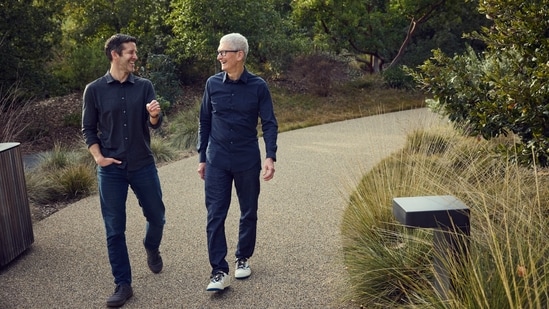
Tim Cook is stepping away after 14 years as Apple Inc. CEO (and 28 years at Apple)—a tenure punctuated by record iPhone sales, $100 billion in services revenue alone, and a market capitalisation in excess of $4 trillion. He hands the baton to John Ternus, senior vice president of hardware engineering and the brains behind some of the most exciting Apple products in recent years—the MacBook Neo and the iPhone Air, both standouts in more ways than one.
Cook leaves Apple in perfect shape for Ternus to build with—financially, product portfolio-wise and with momentum on diversification attempts.
Ternus understands the hard work that goes into every product, the hours and hours spent redoing things in the engineering labs, to get everything just right. Johny Srouji, who most recently served as senior vice president of hardware technologies, will assume an expanded role leading hardware engineering, which John Ternus most recently oversaw, as well as the hardware technologies organisation.
Ternus has an engineering degree from the University of Pennsylvania, and had joined Apple in 2001. He oversaw the Apple Silicon efforts, which marked a monumental transition from Intel processors to Apple’s own M-series chips in Macs and iPads. He saw through Cook’s vision with the entire AirPods line-up, and much before that, was instrumental in getting the original iPad out into the world. He is also why Apple Vision Pro, iPhone Air and MacBook Neo exists.
He knows gutsy experimentation, better than anyone. Not to forget the legendary Mac, iPad and iPhone reliability—a metric certainly not lost on consumers.
In late 2025, Ternus was given oversight of Apple’s Design teams—this made him the first executive since Jony Ive to unite hardware engineering and product design. Safe to say, it’ll be an interesting next few years at Apple. I feel there will be a sense of continuity because a lot doesn’t necessarily need to change for the sake of change, interspersed with some amount of bold experimentation.
TECH SPOTLIGHT | Stuffcool JetSet Pro and Giga Max
Those of you who read Wired Wisdom every week would have understood by now that I’m a bit of a stickler for pristine travel accessories. After all, that is not the time when you should be struggling with the tools to charge your phone, laptop or tablet.
Stuffcool’s latest travel-focused charging accessories are down the path of simplicity and versatility. The Jetset Pro universal world travel adapter ( ₹2,999) and the Giga Max 25,000 mAh power bank ( ₹5,299; though I usually avoid carrying power banks through airports in general) are ticking off the fast-charging, convenience and value checkboxes.
The Jetset Pro isn’t your regular travel adapter that lets you just switch between the EU, AUS, USA and UK plug types for your laptop or phone’s chargers. It does that and then adds three USB Type-C ports as well as a USB-A port, while also claiming to be the smallest device of its type so far. These ports are well spread out on the sides, which does give some flexibility based on cable length and ease of placement of the device being charged. These aren’t cursory options either, alongside the universal socket, with the C1 port topping a maximum of 75 Watts (C2 and C3 are 20 W each). In essence, you are sorted with a laptop, smartphone, a smartwatch and a couple of more gadgets, for charging during travels.
Equally impressive is the Giga Max, which Stuffcool insists is India’s “smallest and most portable high-capacity powerbank”. I wouldn’t necessarily argue with that, considering how compact this really is—the mammoth 25,000 mAh capacity provides the perspective. This has a battery capacity of 96.25 watt-hour, which is well within standard airline safety limits of 100 Wh (that’s typically around 27,000 mAh). There is a display too, which shows battery percentage remaining and charging specifics of devices connected. There’s a Type-C port rated at 100 W and a USB-A that tops out at 18 W (ideal for smartwatches, headphones and so on).
In essence, you’ve to divide the 25,000 mAh capacity with your phone’s battery specifics, and calculate how many times the Stuffcool Giga Max can charge it—from full discharge to full charge. An Apple iPhone 17 Pro Max with the 4,823 mAh battery can be fully charged five times over. A Xiaomi 17 Ultra’s 6,000 mAh battery, four times over. A Samsung Galaxy S26 Ultra’s 5,000 mAh battery almost five times.
For convenience, there is also an integrated USB-C cable that’s rated at 100 W. That’s good enough to power a MacBook Pro or a MacBook Air too for a sustained amount of time.
SECOND THOUGHTS | Realism of AI as a creative partner
First and foremost, it’s a nice(er) change. A subtle change from what AI companies including OpenAI, Nvidia and Anthropic keep telling the world, that AI will replace humans in creative workflows. It is pleasant to see creative platforms including Canva and Adobe don’t think that way.
Canva’s co-founder and CEO Melanie Perkins calls the new Canva AI 2.0 evolution a “true creative partner” and “with tools to turn ideas into complete outcomes”.
David Wadhwani, president – creativity & productivity business at Adobe, says this is a “new era of agentic creativity, where you direct how your work takes shape and your perspective, voice and taste become the most powerful creative instruments of all”. The human, it seems, is back in the spotlight.
I’m particularly impressed with how Canva’s approach to AI has remained over the years—also because it is a platform that’s oriented for a much wider demographic of users. In contrast to a very successful Adobe, which already had a large set of enterprises and professionals who were and still are recurring subscribers, Canva has mass appeal to the masses first, and the traction since has been tremendous—a different, but ultimately successful approach.
Here are some numbers for context. The 13-year old visual creative platform, which is now making a sensible pivot towards a broader workspace, has more than 265 million monthly active users of which more than 31 million are paying subscribers—up from 24 million last year. They have also reported $4 billion in annualised revenue, more than $500 million of which comes from the growing B2B business.
American venture capital firm Andreessen Horowitz (a16z) notes that Canva is behind only OpenAI’s ChatGPT and Google Gemini in global AI usage hierarchy, and ahead of Deepseek, Grok and Claude. Data by a16z and YipitData suggests that in terms of customer spends year on year, Canva with a 101% uptick leads globally, ahead of Replit (78%), Vercel (72%), Hubspot (63%), Box (60%) and Figma (47%).
Look at Canva’s approach to investing in in-house AI development, and that’s led us to three very specific models that are frugal compared with competition. Two important outcomes. Cameron Adams, who is Canva’s co-founder and chief product officer, calls this a “really critical unlock”. And even more crucial, as Cliff Obrecht, co-founder and chief operations officer, points out “this allows us to power a lot of our workspace for the free users”.
Canva AI 2.0 — An Analysis
Wired Wisdom peels away the glitz for a closer look at Technology & AI, with the hope to critically analyse how it impacts you, the human. Want this newsletter delivered to your inbox? Subscribe here.