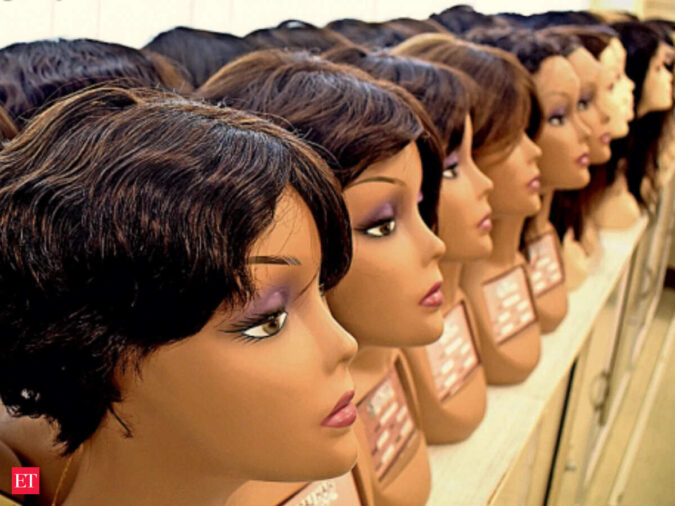
“Indian hair is valued across the world for its colour and quality,” says George Cherian, CEO of Raj Hair International.
The walls of his corporate office in Chennai have tresses in scores of shades rippling down the walls like a global catalogue. “We work with 47 international colours,” he says, adding that Indian black and brown hair is in great demand as it provides a versatile base—it can be transformed, coloured and blended into almost any shade for wigs, extensions and wefts.
SHOCK OF HAIR
Even though India has prized human hair, its wig industry is minuscule. And the handful of hair exporters are facing headwinds. Raw hair is becoming scarce as large quantities make their way through Myanmar to China—the wig route.
Also Read: Root of the matter: What to know before trying professional hair treatments

In FY2026, India exported around $940 million (over ₹9,000 crore) worth of human hair, including $287 million of raw or unprocessed hair and $652 million of semi-processed hair that is disentangled and straightened in the hands of thousands of workers, mostly women, in cottage industries and rural hubs across states like Tamil Nadu, Andhra Pradesh and West Bengal.

India’s processed hair industry is small, exporting just $1.35 million worth of wigs, extensions, wefts and related products.The wig exporters are bemoaning the shortage of raw hair. About 98% of raw hair is officially destined for Myanmar, where it is processed before making its way to the real market—Xuchang in China. The city in Henan province is often dubbed the wig capital of the world, producing nearly 60% of finished hair products.
However, Indian exporters say official numbers tell only part of the story. They allege that the actual volume of raw human hair leaving India is far higher—and that it is getting smuggled into China.
HERE TO THERE
About 90% of India’s hair exports is goli—balled-up hair that falls from our millions of heads or gets coiled in combs and is collected from homes, barbershops and salons, says Sathish Gandhi, director of Chennai-based exporting company Allure Hair Products.
The other 10% of exports is shorn hair that is donated by devotees in shrines like the Venkateswara temple in Tirupati.
These are high-quality locks known in the industry as Remy hair. To add stress to tresses, the auction prices of this hair have soared, pushing it beyond the reach of Indian wig makers.
“In September, we left midway through an online hair auction in Tirupati after we noticed some aggressive, even abnormal, bidding by some,” recalls Cherian.
The identities of bidders in this quarterly auction are kept confidential. “How can the price of hair rise to ₹85,000 a kilo?” he asks.
That was the price commanded by the finest, grade-1 black hair—27 inches or longer—donated by devotees. About 700 kg of this premium mane was up for auction last month.
Cherian and several other hair exporters in Chennai claim that Chinese interests may be behind some of these unnaturally high bids, possibly made by dummy exporters deployed to bargain and procure the finest Remy hair, which is available in substantial quantities in shrines like Tirupati and the Basilica of Our Lady of Good Health at Velankanni in Tamil Nadu.
China buys—and allegedly even smuggles—Indian hair, adds value to it, and sells finished wigs, extensions and wefts at premium prices in American and European markets. In other words, India has the hair, China adds value and the West pays a premium.
Meanwhile, India misses a flourishing industry that can bridge the astonishing gap between hair and there, where costly wigs are sold.
At the hilltop temple in Tirupati in Andhra Pradesh, where nearly 1 lakh pilgrims arrive every day, thousands—men, women and children—make a stop before proceeding for darshan.
They enter a hall called Kalyanakatta, collect a coupon and a blade, and join long queues in front of barbers who tonsure their heads. For them, it is an act of devotion. For the hair trade, not all offerings are equal.
“Two grades command the highest prices at auction—hair measuring 27 inches and above, and hair between 19 and 26 inches, that too black, not grey,” explains Gandhi.
The longer the hair, the higher its value. Coloured hair, by contrast, will fetch less. Hair shorter than 5 inches is largely used as fertiliser, he says.
Indian hair might have even reached Pyongyang. “As labour costs in China have risen in recent years, we have heard that some Chinese companies are sending raw hair from India to North Korea for processing,” says Gandhi.
The semi-processed hair from Pyongyang, he claims, is then brought back to China, where it is turned into finished products—wigs and extensions—before being shipped to the US and Europe.
MANE DEMAND
“We have been demanding that the government immediately ban the export of chutti or goli—raw human hair—so that it can be processed in India and create employment for more than a million people, mainly women,” says Benjamin Cherian, president, Human Hair & Hair Products Manufacturers and Exporters Association of India.
“The reality is that Chinese buyers come as tourists and purchase goli or chutti. They also work through local agents in several cities, including Gudiyatham and Vellore in Tamil Nadu,” he alleges, adding that the number of people buying and hoarding hair in India has gone up.
Cherian, an industry veteran who entered the business in the early 1980s by exporting salon-cut hair to the Japanese corporation Sumitomo for amino-acid production, lays out why Indian companies have to move up the value chain.
Raw goli fetches just $100–150 a kilo, while semi-processed or worked hair commands $200–250 a kilo. The same hair, transformed into wigs or other products, can be worth around $1,000 a kilo.
China’s ascent to the top of the global wig market began in the 1990s, gradually taking the reins from Italy and South Korea. While it has made an aggressive shift towards high-end, value-added products, India continues to largely remain a supplier.
According to MM Gupta, chairman of the Gupta Group, which manufactures and exports hair, the problem begins with the government policy that allows raw human hair to be exported at a minimum price of $65 a kg.
“That’s too low,” he says. “How can the export price be $65 a kg when the price in the domestic market is around $150?”
Gupta alleges that some of these Indian exporters are fronts for Chinese buyers.
Like several Indian export houses, Gupta’s company works on goli hair and exports semi-processed hair to Chinese manufacturing hubs. Around 30–40% of Gupta’s exports are destined for China.
For Indian exporters of finished wigs and extensions, the shortage and rising cost of raw hair are not the only clouds on the horizon.
A new threat is looming over the industry—a law passed by the US House of Representatives last month empowers President Donald Trump to impose tariffs of up to 100% on countries buying Russian oil and gas. For hair exporters heavily dependent on the US market, it is another potential shock.
After earlier tariff blows, some are already diversifying away from the US.
“Until 2024, 90% of our business was with US. We have brought that down to 60% and are now actively looking for new buyers in Europe, Africa, the Arab markets and India,” says Gandhi.
Tamil Nadu-based export house Nandalala Indian Hair, too, has been reducing its exposure to the US market.
“Now our main markets are UAE and Africa, with just 5-10% of our business coming from US,” say Radhika and Athira Kumaran, sisters and directors of Nandalala Indian Hair.
The Kumarans have around 100 employees, and “some of them earn salaries comparable to those of tech professionals,” they say.
Their next bet is home: India’s expanding domestic wig and hair-extension market, fuelled by women who are spending on hair products.
STRAND BY STRAND
On the shop floors of three hair-processing factories that ET visited in Tamil Nadu, workers—mostly women—move through a long sequence of work: sorting, grading and washing strands of hair before moving on to machine-wefting, hand-tying, colouring and bleaching.
It is a labour-intensive industry and can potentially create thousands of jobs in India. But the bigger question remains: can Chennai or Kolkata become the next Xuchang?
“We have a long way to go to catch up with China,” says Gandhi. “They have some 8,000 factories processing hair, with some employing as high as 2,000-3,000 workers.”
Even at Cosmoprof Worldwide, the annual beauty trade show in Bologna, Italy, you will find only 20–25 Indian hair companies, compared with more than 500 Chinese hair exporters exhibiting their products, he says.
Adds Gupta: “In India, we are still fighting for the basics—ban the export of raw hair and stop smuggling. Our question is simple: how can human hair be smuggled from Hyderabad to China on chartered flights when Indian manufacturers themselves are struggling with a shortage of raw material?”
The irony is obvious, like a shiny pate: India offers the hair, China turns it into big wig business.