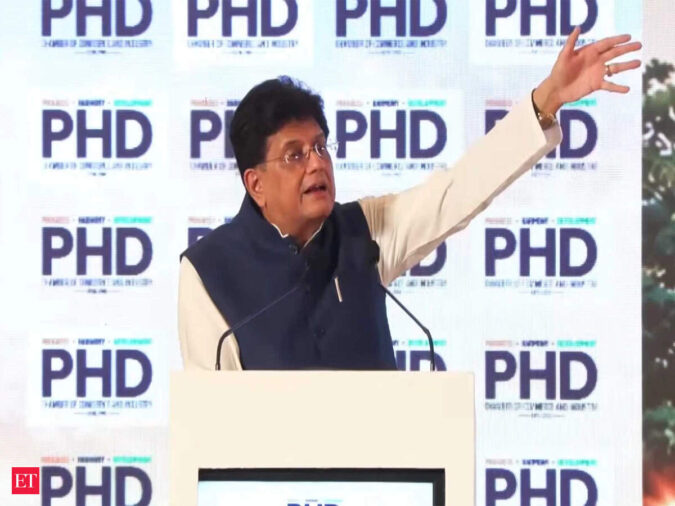
Speaking at the 121st Annual Session of the PHD Chamber of Commerce and Industry, the Union Minister stated that New Delhi has concluded nine trade pacts covering 38 developed economies over the past four to four and a half years, transforming the country into an attractive destination for international trade.
Read more: US trade deal to be finalised as ‘circumstances have changed’: Piyush Goyal
Emphasising the changing paradigm of global engagement, the Minister said, “When you see world leaders making up the line to engage with India to expand trading relations. After all, in the last 4 to 4.5 years, we have concluded 9 Free Trade Agreements. Collectively covering 38 developed nations.”
Contrast was drawn with the trade pacts executed prior to 2014, with Goyal pointing out that those older agreements provided preferential access to an aggregate global gross domestic product of merely USD 10 trillion. He noted that earlier pacts often failed to prioritise domestic competitive advantage.
Addressing ongoing bilateral and multilateral trade negotiations, the Minister highlighted substantial progress across key geographies.
Read more: India needs open trade, a stronger WTO and a more proactive global role: Experts“The UK process started on July 15th; the day after tomorrow their minister is coming, and we have a Joint Economic Commission. On the same day, perhaps the Canadian minister is also coming, or the next day on Tuesday. The UK is done; Canada is eager for us to hurry up,” he added. “The UAE and Oman are done; the remaining four Gulf countries, the GCC, have launched negotiations. All six of them as a group want to do a GCC FTA. Talks are going on with Israel; talks are going on with Chile. With Mexico, it will launch next week. Canada is moving forward rapidly. Eurasia, these Central Asian countries, talks are going on with them.”
Goyal explained that trade pacts are no longer finalised solely within bureaucratic corridors. Instead, stakeholder consultations remain central to every round of discussions.
“And these days, when an FTA is signed, it’s not done by government offices. It’s decided after talking to the industry. It’s decided after talking to farmers. The concerns of fishermen are heard. Keeping in mind the difficulties our MSMEs face and what matters to them,” Goyal said.
He affirmed that this inclusive mechanism ensures sensitive domestic sectors remain protected while opening up overseas demand.
“It’s done through discussions with the economic community, farmers, fishermen, and for the benefit of the country. An agreement is made. This ensures we get enough opportunities in large numbers. If we see a sensitive sector, we handle it carefully,” he mentioned.
Citing the leadership of Prime Minister Narendra Modi, Goyal said India has consistently turned domestic and external disruptions into strategic growth opportunities. Describing domestic businesses as the primary drivers of growth, he noted that the collective ambition of 1.4 billion citizens reinforces India’s position as a reliable international economic partner.