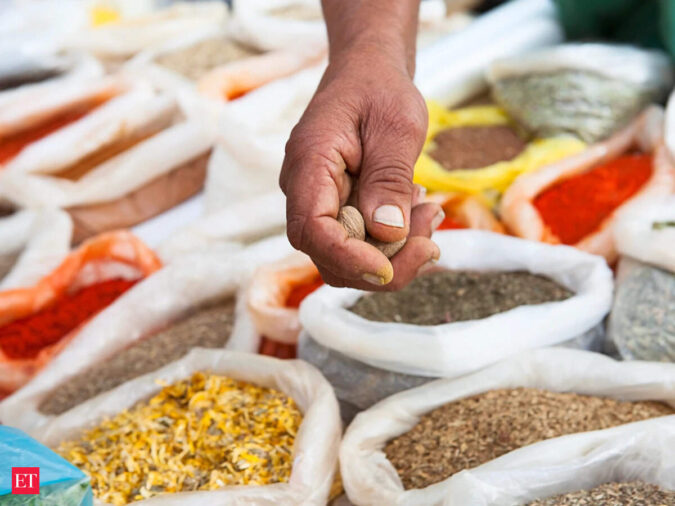
India was once the world’s largest producer of large cardamom. Unlike green cardamom, which grows in the Western Ghats and is used in chai and desserts, large cardamom grows under the shade of trees in the Eastern Himalayas. It is widely used in foods, beverages, perfumes and medicines.
For decades, India supplied nearly 85% of the world’s large cardamom, with Sikkim at the heart of production. In the early 2000s, India exported 5,000-6,000 tonnes annually to more than 20 countries. Pakistan, Afghanistan and West Asian countries accounted for nearly half the exports, while Bangladesh was a major market. Smaller quantities reached Europe, where prices were often 20-30% higher than in South Asia. At its peak, large cardamom exports earned India more than `1,200 crore annually.
Now India exports only around 1,200 tonnes of black cardamom annually, earning merely `150-180 crore. Export numbers have fallen significantly due to less surplus after meeting strong domestic demand.
SPICE ROUT
Sikkim’s plantations have been failing. A cardamom plant, under forest shade, should start producing after four years and live for 25-30 years. Instead, farmers are seeing plants drying up in five-six years, if not sooner. Because of crop losses from diseases, they could harvest only 60-65% of expected production. They are forced to plant all over again and then wait for the plants to start yielding.
Sikkim’s black cardamom production plummeted from 5,600 tonnes in 2003-04 to 2,500 tonnes in 2010. It went up to 5,591 tonnes in 2024-25, still behind FY2004 numbers.
While Sikkim struggled, Nepal has expanded its plantations and improved planting material. Today, Nepal produces nearly 68% of the world’s large cardamom, pushing India to second place with just 22% share of global production. Bhutan holds the remaining 8-10% share. Some Nepalese cardamom even enters India for re-trading, blending and onward exports.

The change has happened gradually, even as global demand continues to grow. Prices have increased to 2,300 per kg from about 400 per kg in the mid-2000s. By 2033, the global market could expand to $480 million from $250 million in 2025.
The opportunity remains, but India’s farmers are finding it hard to respond even as Nepal’s farms are also beginning to face disease- and climate-related pressures on its plantations.
WHY PLANTATIONS FAILED
Changing weather has played a major role in the decline of black cardamom plantations. Winters became warmer and rainfall less predictable, leaving plants vulnerable to disease.
“A prolonged drought in the mid-2000s weakened the crop so severely that normally harmless fungi inside the plant turned aggressive, triggering widespread disease,” says KB Subba, senior biotechnologist at Sikkim’s science and technology department.
Leaf blight, viral infections like chirkey and foorkey, and rhizome rot damaged plantations. In recent farmer surveys, nearly two-thirds identified crop disease as their biggest challenge.
“What we are seeing is not a single disease problem. It is a complex interaction between climate stress, soil health, plant genetics and microbial behaviour. That is why simple solutions have not worked,” says Subba.
The problem is exacerbated by decades of repeatedly cloning plants from the same genetic stock. This has reduced their ability to withstand disease and changing weather. Declining soil health, shrinking forest shade and limited irrigation have added to the stress. More than half the farms still depend entirely on rainfall.
Can Sikkim bring back its black gold?
Despite the losses, large cardamom remains important to Sikkim. About 21% of rural households grow the crop and, for nearly 80% of these, farming is the main source of income. In a good year, cardamom can contribute up to 70% of household earnings.
“Large cardamom is our backbone. It is how most families here earn their living. But in recent years, yields have clearly fallen. Government labs are beginning to support farmers with better planting material, but the help is still uneven as many farmers have yet to receive disease-resistant seeds,” says Dhan K Gurung, who heads a farmer community in North Sikkim’s cardamom belt.
Finding another crop is not easy. Few alternatives offer similar returns on steep, shaded mountain farms.
The Sikkim government’s Mero Alaichi, Mero Dhan (My Cardamom, My Wealth) mission aims to change this. Instead of simply distributing saplings, it focuses on understanding the problems affecting the entire crop, from soil and shade to disease, genetics, irrigation and farming practices.
Scientists are experimenting with seed-based propagation and controlled crossbreeding to develop stronger plants that can better withstand disease and drier conditions. The goal is to extend plant life to 12-15 years.
“The decline of large cardamom is not just an agricultural issue, it is a livelihood and ecological challenge that requires scientific, institutional and community-led solutions,” says Sandeep Tambe, principal secretary, Sikkim. “Revival will be sustainable only when farmers, researchers, markets and policy move in one direction, rather than work in isolation.”