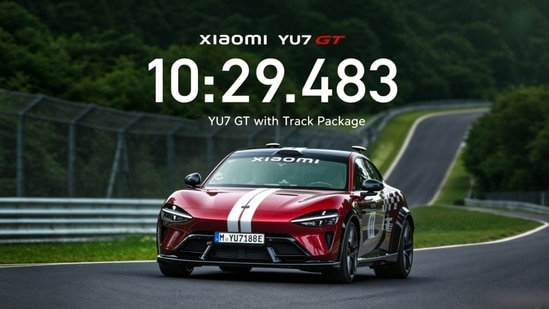
Opening thoughts. The iconic Nürburgring racetrack is where motoring worlds blend. Located in the Eifel mountains in Germany, it is the longest, most demanding, and most famous permanent racing complex in the world. Also called the ‘Green hell’ because it is lined by dense forests. An automotive playground for car enthusiasts, supercar and sports car owners and there are weekends when all that transcends into the background because this historic racing venue must host a serious race. It is also the ultimate testing ground for global car makers. A few days ago, a Xiaomi YU7 GT went around.
The time of the YU7 GT, 10 minutes and 29.483 seconds. Not a big deal, you may say? Well, the official road-legal production car lap record stands at 6:29.090 and a Porsche Taycan Turbo GT did the same lap in 6:55.533. The big deal is this—there was no human driver at the wheel. The YU7 GT, which Xiaomi had configured with the Track Package, became the first car to set an official driverless lap record at the Nürburgring racetrack. The whole lap, of this very tough track, on autopilot. This lays down the marker for automakers.
For a specs perspective, the YU7 GT electric SUV (its no lightweight stripped down trim either, this is massive) features Xiaomi’s proprietary “Super Motor V8s EVO” setup, generating a massive 1,003 horsepower (738 kW) and the company says this can rocket from 0 to 62 mph (100 km/h) in just 2.92 seconds. There is a advanced 897-volt silicon carbide high-voltage platform paired with a 101.7 kWh ternary lithium battery pack, with a specialised cooling architecture to protect the cells from overheating under intense acceleration and extreme lateral G-forces.
EDITOR’S MARGIN
A MATTER OF PRICE HIKES
Part reason is the avoidable West Asia conflict. Part of the reason is the equally avoidable AI hype. Phones, PCs, storage devices, and everything else is becoming more expensive. That is because key components including memory and storage now cost a lot more, and are in short supply. Some announced understandable price hikes in recent weeks—Samsung, Xiaomi, Nothing, Dell, Lenovo—pretty much everyone. Some announced, some directly reflecting on the shop floor.
Or in Sony’s case, months of what seems to be artificial shortage of the PlayStation 5 console because retailers seem to be expecting a further hike and likely holding stock for that moment.
Anyway, the reason to talk about this is Apple announcing price corrections across the Mac, iPad and Home line-ups. iPhones, not just yet. And this is where I expect other tech companies to go ahead with another round of pricing corrections, gaining some sort of umbrage from Apple finally pulling the trigger. The iPad, the 11th generation, is now ₹15,000 more expensive—and that’s a significant change for an entry-point product (this is now around ₹49,900 instead of ₹34,900). The base variant MacBook Neo will now set you back by ₹79,900 instead of ₹69,900. The iPad Pro sees as much as a ₹40,000 price jump while the MacBook Pro 16-inch will be dearer by as much as ₹1,00,000 and the Mac Studio with the M3 Ultra chip will now be ₹1,70,000 more expensive.
The big question is—what happens to the iPhone pricing? And that’s going to dictate the broader smartphone space, make no mistake. Research from Smart Analytics Global (SAG) suggests that Apple will still clock the forecasted 250 million iPhone shipments worldwide in 2026, with the caveat being Apple could maintain the launch pricing of the iPhone 17 lineup, while selectively increasing prices for the higher-end iPhone 18 Pro and Pro Max models in September 2026.
Tiered pricing is being talked about. “Price adjustments are likely to focus on the iPhone 18 Pro family and vary by memory configuration. We expect the 256GB models to see only modest increases, while 512GB and 1TB variants could increase by approximately US$100–200. The new 2TB iPhone 18 Pro Max is expected to command an even larger premium of around US$200–300. Apple is likely to maintain competitive pricing for the iPhone 17 family and other legacy models to support shipment volume,” they say.
SAG expects iPhone 18 Pro, iPhone 18 Pro Max and the foldable iPhone to account for approximately 21% of total iPhone shipments in 2026.
India has felt a slightly more powerful punch in terms of the price hike. While global prices rose around 15-20% due to the aforementioned component shortages, the recalibrate pricing in India sits in the 20-58% range. Some of it also has to do with currency exchange rates and factoring in import duties. I do not believe Apple considers pricing at $1= ₹100 anymore.
THE LATEST, ON NEURAL DISPATCH
TECH SPOTLIGHT
URBN 200W GaN POWER HUB
Those of you who are regular readers would know how much I love a good charging hub for the desk. The more powerful, the better. Some of the recent favourites include ones made by Acefast, as well as Stuffcool and UltraProlink. If a hub is good (staying cool when stressed to its theoretical maximum charge limits is important), there’s genuine utility to be found. A laptop, multiple phones, perhaps even a tablet, all can be powered and charged in parallel. Plus, the clutter is significantly reduced (and that is the ticket, in my book).
There’s a new hub that landed on my desk (its rightful place) a few days ago. The Urbn 200-watt GaN Power Hub, which costs a fair bit though at ₹6,999, has its own cradle if you’d like to place this vertically. That’s the first hint at the heavy duty nature of this charging solution. This is a 6-port design, with four USB-C ports and two USB-A ports. Build quality is perhaps best judged by the thickness of the 1.5-meter long power cord. Hidden out of sight is the multi-layered circuit protection.
The calculation of this hub works something like this—each of the USB-C ports can deliver up to 100-watt each (the USB-A are limited to 18-watt each), which means two drawing 100-watt each is entirely possible of that’s what your devices demand. For instance, powering a MacBook Pro 14-inch running the M5 Pro chip, and a Xiaomi 17 Ultra in simultaneous charge scenario. You could use all of the 200-watts available by using all four USB-C ports or a mix of the older USB-A port for smartwatches or headphones.
I’ve time and again pointed out that gallium nitride as the tech for fast charging, has been tremendous in making this gadget ecosystem relevant and useful. A key reason is reduced heat generation and better dissipation, which allows for faster charge speed delivery for a sustained period of time. That’s exactly what the Urbn 200-watt GaN Power Hub excels at. This can become the primary power source on your workstation. Urbn talks about the longevity potential as well for batteries that are being charged with this power hub. The multi-layer protection includes overcurrent protection and temperature monitoring.