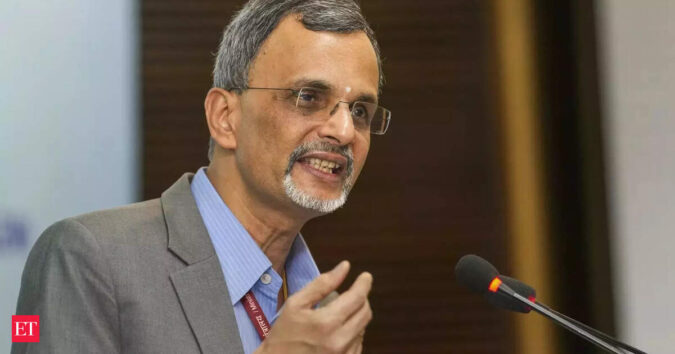
Speaking at the launch of NITI Aayog’s report, DPI@2047 for Viksit Bharat: A Strategic Roadmap to Enable Non-linear Inclusive Socio-Economic Growth, Nageswaran said such disruptions have sharpened a long-standing vulnerability in India’s growth story – its dependence on imported fossil fuels.
Read more: Weaker monsoon prediction, Iran war cloud growth outlook
With a population of 1.4 billion and energy demand already three times the global average, India relies on fuel imports whose prices it does not control and whose supply chains pass through some of the world’s most contested waters, he noted.
“We must offset the adverse economic impact of energy price shocks through productivity and competitiveness gains elsewhere,” he said, adding that Digital Public Infrastructure (DPI) will be key to achieving this.
NITI Aayog road map
The NITI Aayog roadmap outlines a two-phase strategy – DPI 2.0 (2025-35) and DPI 3.0 (2035-47) – aimed at building a broad-based, capable society and driving inclusive growth. It focuses on transforming sectors such as MSMEs, agriculture, education and health, alongside systemic enablers like credit access, decentralised energy markets and improved delivery of social benefits.Read more: Below-normal monsoon and West Asia conflict cloud India’s agriculture outlook: BoB
The report proposes a decentralised, state-led execution model, with the Centre and NITI Aayog acting as catalysts, and recommends two-year iterative transformation cycles. For the first cycle (2026-27), it suggests pilot projects in MSMEs and agriculture across six “champion” states and Union Territories, followed by wider rollouts.