
Founders and investors told ET that startups are simply following demand. Defence offers clearer budgets, faster procurement, and immediate revenue unlike commercial markets, which require scaling constellations. That takes time.
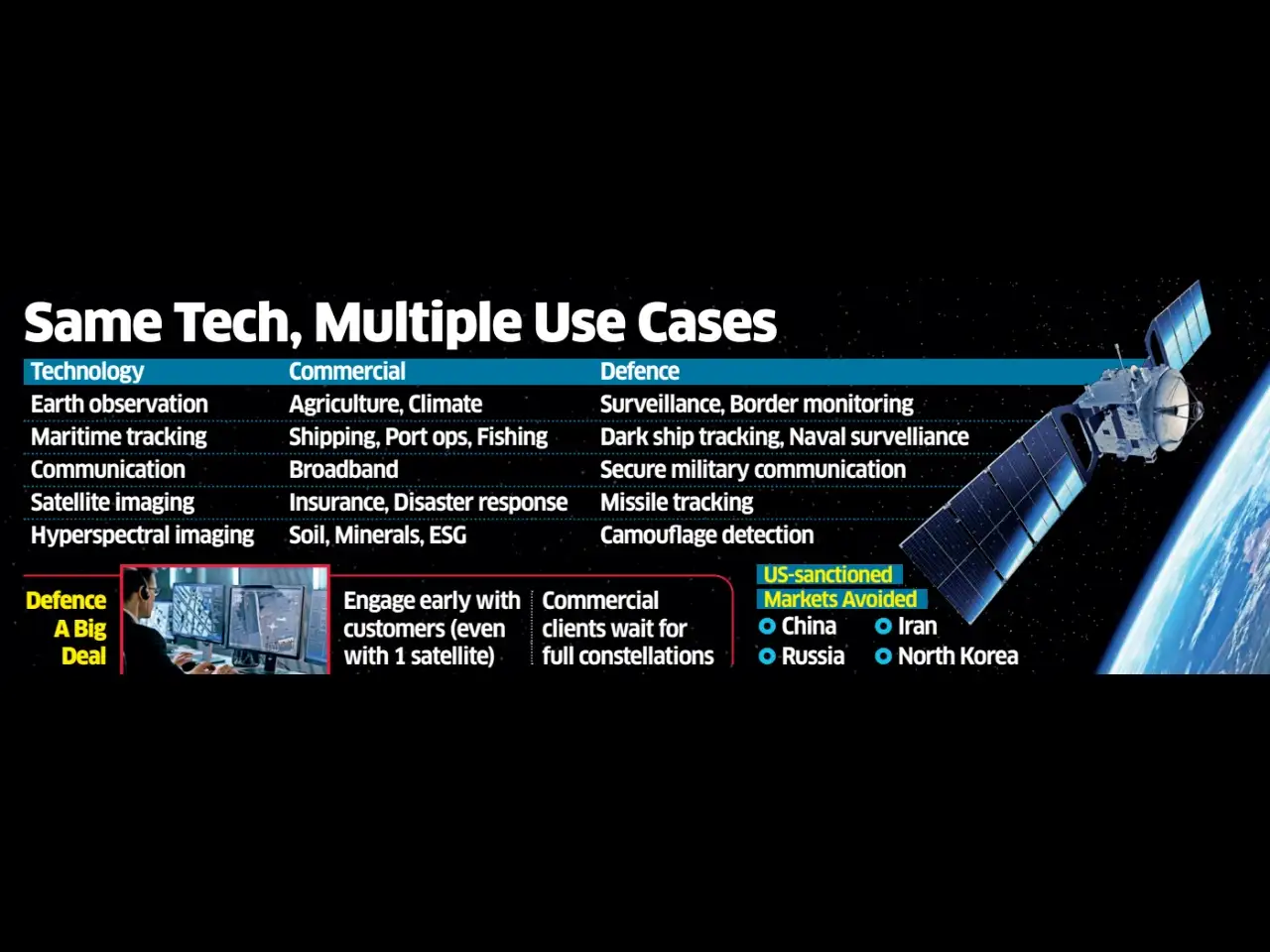
Companies have repositioned their technology and started research and development catering to newer use cases. Capabilities such as missile tracking, camouflage detection, maritime surveillance and border monitoring are now central to their offerings, even when the underlying tech remains unchanged. Bengaluru-based Digantara Industries, which began with space debris tracking, has expanded into surveillance and intelligence applications.
“Today, around 80% of our revenue comes from government and defence, with commercial only a small portion,” said cofounder Anirudh Sharma, adding that this started happening during the Russia-Ukraine war and continued with Operation Sindoor as demand for tracking space assets surged.
A similar trend is visible across other spacetech startups. Earth observation company GalaxEye now sees a 70:30 split between defence and commercial demand.
“Given the current geopolitical environment, we expect stronger demand from defence,” said cofounder Suyash Singh.
For PierSight, the shift is less about product and more about customers willing to pay early. Defence clients engage even with one satellite capacity, while commercial customers wait for full-scale deployment or constellations, said cofounder Gaurav Seth.
 ETtech
Pixxel has also evolved from a purely environmental-focused satellite startup and now serves defence customers. Its hyperspectral imaging capabilities allow camouflage detection, battle damage assessment and detection of illegal mining and soil disturbances, which can signal unauthorised activity in remote areas.
Industry experts said the pivot is less about technology and more about positioning. It mirrors global aerospace giants such as Lockheed Martin, Airbus, Boeing and Safran, which operate on both sides, defence and commercial.
“Everything that goes to space can be weaponised, be it remote sensing, communications, observation, AI, propulsion, energy systems, space-hardened hardware. Almost everything has dual-use potential,” said Arpit Agarwal, partner at Blume Ventures, adding that with emergency procurement and active government engagement, there is real revenue flowing into these companies.
Picking a side
Startups, however, pointed out that tapping defence demand comes with constraints.
“In defence and government work, you can’t operate across every market. You have to pick your battles. For us, working with a country, though a friendly nation to India, could limit access to the US, and that’s a much larger market,” Sharma said. Industry executives say this is becoming a reality across the ecosystem. One investor noted that while the Indian Space Research Organisation (ISRO) has historically tested engines in Russia, private startups cannot take the same route without risking access to Western markets. A company building rockets had to recently let go of testing opportunities in Russia so that it doesn’t get shut out of the US market. This also means avoiding countries such as China, North Korea, Iran and others. Most founders said they are prioritising opportunities in the US, UK and European Union.
To navigate these constraints, startups say they are restructuring operations across regions.