
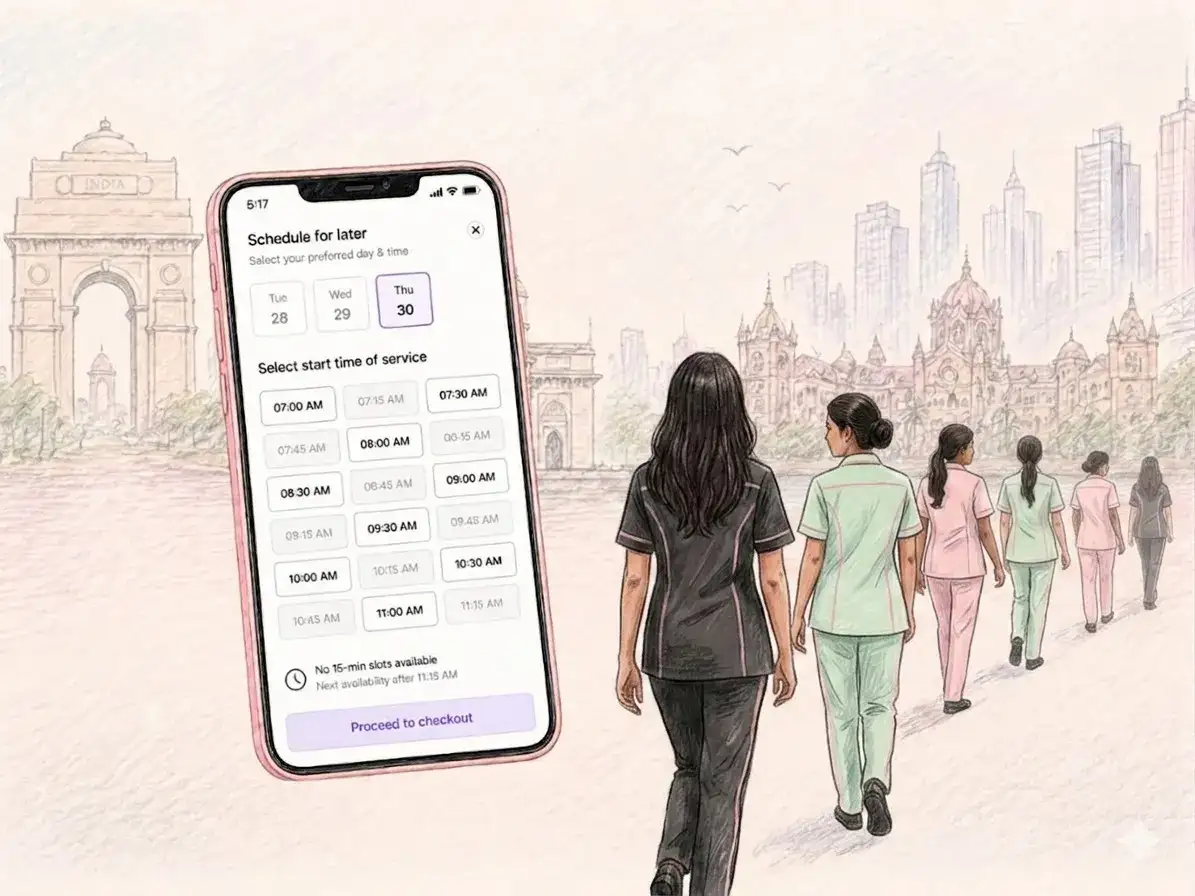
Across several micro-markets, 15-minute bookings have become unavailable for days and even near-term slots have turned grey.
While Snabbit flagged this as a seasonal disruption, Pronto said it is operating at full supply capacity and any regional unavailability is due to heavy bookings. Urban Company did not immediately respond to queries.
The segment, which started as an on-demand and ‘instant’ model, first saw an impact on some services in a few micro-markets as several workers returned home due to assembly elections in West Bengal, Assam, Tamil Nadu and Kerala, as well as for the harvest season in agrarian states.
The crunch comes amid surging traction for the segment, which clocked 10 million monthly users in March, according to a Morgan Stanley report.
“We are currently doing about 23,000 bookings a day on weekdays and about 26,000 on weekends. We are fully booked, which is why slots are unavailable in some regions,” said Anjali Sardana, founder of Pronto.
She said demand is increasing by 20% week-on-week. “We have a diverse supply base of professionals and we are continuing to add more supply to the platform,” Sardana added.
Typically, sectors like food delivery, quick commerce, ecommerce and logistics, which depend heavily on migrant populations for their last-mile services, face gig worker shortages during summer, harvest season and even the festive season when demand picks up.
Also Read: Quick commerce firms face heat as riders stay off peak hours
“Every platform is probably going through this (labour shortage) — competition is not the problem. We are seeing some challenges in some cities,” said Aayush Agarwal, founder of Snabbit. “When food delivery was being built, there were times when it was difficult to have enough delivery riders. But over time, through various mechanisms, the platforms have evolved and now that’s not an issue.”
He noted that the instant domestic help category is just two years old. “Over time, many seasonal fluctuations will start getting built into how we operate, it’s not a structural problem,” Agarwal added.
Startups in this space have been building war chests to fund their efforts to get ahead in the high-cash-burn segment. However, industry experts highlight that solving supply chain issues will be the integral part to scale efficiently.
Also Read: Househelp apps top 2 million monthly orders amid profitability questions
“Supply chain is an important yet difficult problem to solve in this sector. Workers usually go to their hometowns for economic incentives during the harvest season. Platforms need to build the right workforce and incentivise them properly to manage such situations,” said Rahul Taneja, partner at Lightspeed.
Snabbit recently raised $56 million in funding from Susquehanna Venture Capital, Unicorn Growth Fund, Bertelsmann India Investments and others, bringing its total funds raised to $112 million. The latest round almost doubled its valuation to $350 million from $180 million just six months ago.
ET reported last week that Pronto is in talks to raise $15-20 million from tech investor Lachy Groom, which is set to double its valuation to $200 million from $100 million in February.
“Competitive intensity in the instant services segment (requiring higher investments to gain market share) (is) a key concern for Urban Company,” the Morgan Stanley report noted.