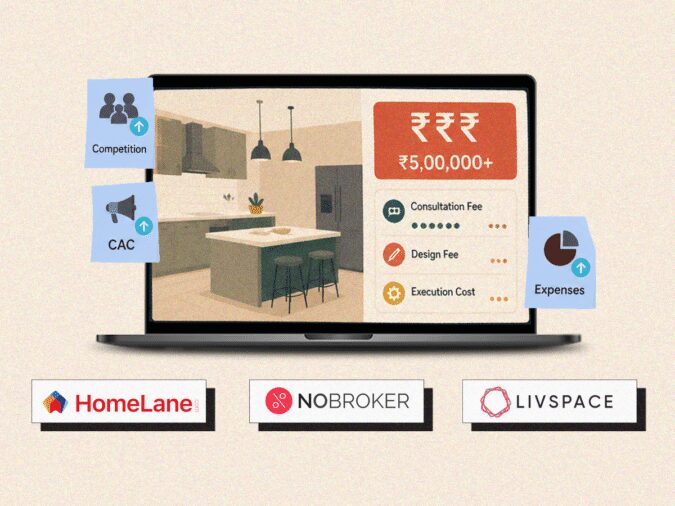
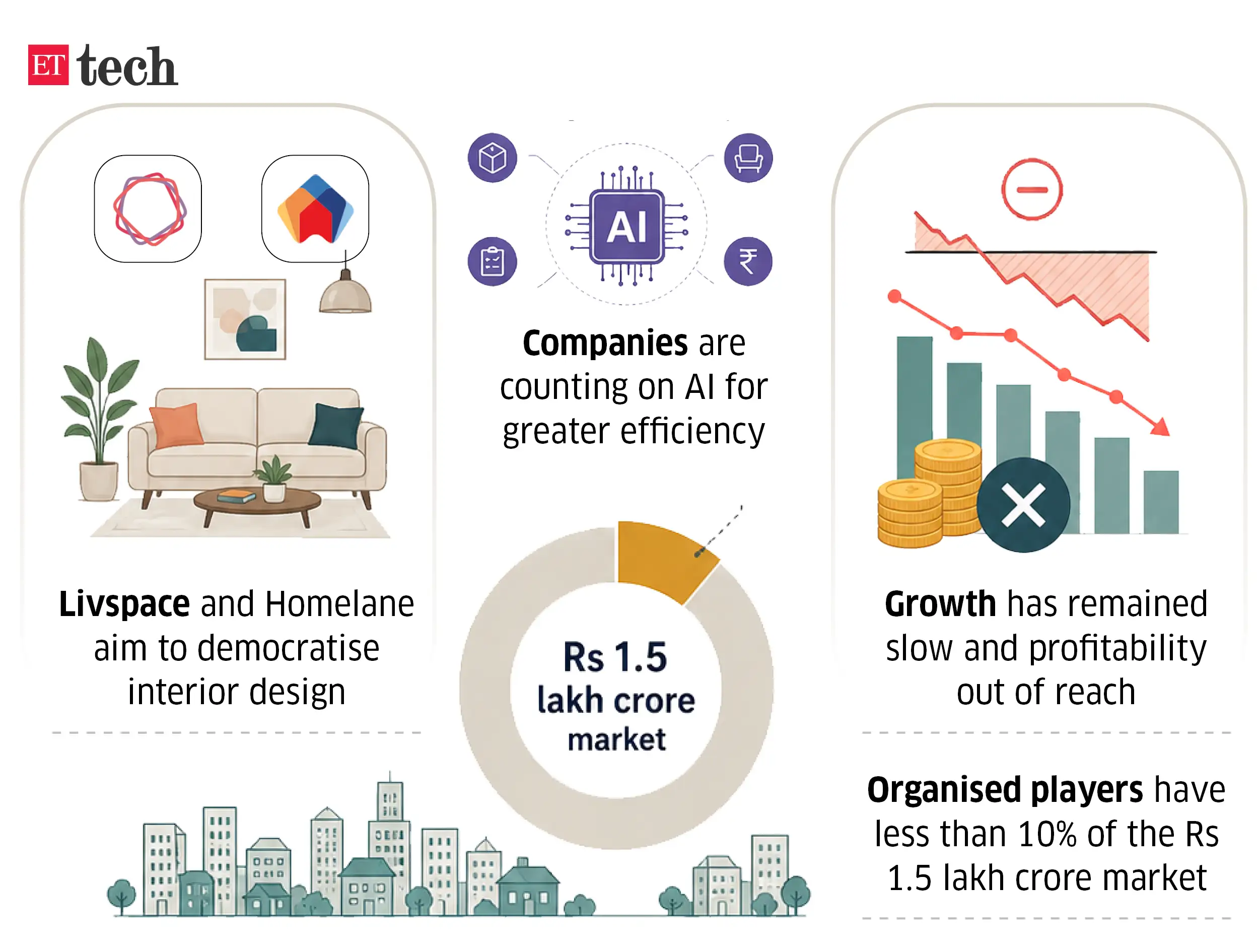
Players such as Homelane, NoBroker Home Interior and Livspace emerged with the promise of taking interior design to the masses, but growth has been slow and profits elusive.
To cope, some are leveraging AI to get leaner, improve productivity and cut costs.
Bengaluru-based Homelane has gone from 100 people in its tech team to 45, even as its product suite has expanded. Livspace laid off 1,000 employees in February 2026.
“Our design costs used to be 7.5% to 8% of our topline. We are using AI heavily in our tech and product to enable our designers to do more. Our designers now handle 50% more projects a month than they used to a year ago,” said Srikanth Iyer, chief executive officer and cofounder of Homelane.
The use of AI in the sector caught everyone’s attention when Livspace reduced its headcount by 12%. The company attributed this to greater deployment of resources in technology instead of manpower.
“We have integrated advanced AI agents and automation across our core functions — sales, operations, design, and marketing. In many areas, tasks that were previously manual are now handled by intelligent systems. Our teams are seeing their productivity supercharged,” a spokesperson for Livspace said.
 ETtech
These companies are counting on AI for greater efficiency. While investors are hopeful, a section of the industry feels the problem is deeper and questions the extent to which technology can solve the problems these players face.
Although they agree that AI can help somewhat, they feel that pricing challenges from the unorganised sector and customers’ heavy reliance on the service experience are the critical areas where technology cannot help.
Market share
Despite a boom in real estate, especially in metros, the organised home interior segment has continued to lag even after a decade, with less than 10% share of the Rs 1.5 lakh crore market. Even Asian Paints, which runs the Beautiful Homes franchise, has struggled to expand its market share.
“As far as decor is concerned, it’s a very fragmented market… and the organised market is very small… Therefore, I think there will always be pricing pressure in terms of the affordability of the customer,” said Amit Syngle, chief executive officer of Asian Paints, during an analyst call in December.
The Livspace spokesperson said, “The biggest hurdle is the deeply fragmented, contractor-led supply chain. Homeowners default to their neighbourhood carpenter or interior decorator because the cost of trying something new feels high.”
 ETtech
Quality vs cost
While the large brands focus on design and aesthetics, it is the carpenters who are entrusted with the actual execution.
ET spoke with multiple carpenters associated with large brands, and they all said they undercut the brands by offering similar products at a lower price.
“These companies are focussing on things like sticking to timelines, faster customer grievance settlement, and quick turnaround, but many consumers continue to be price conscious and often go for local players instead of big brands,” said a top executive at a home interiors firm.
Amit Kumar Agarwal, chief executive officer of NoBroker, said the company’s north star metric is the NPS (net promoter score). “When we started, our NPS was below 50; today it is above 50,” he said.
A top executive at a venture firm pointed out that the nature of the business is such that the time between order booking and revenue realisation is very long, sometimes as much as a year.
“In such cases, scalability becomes an issue. So, can this become mostly productised is the question. Currently, there is a lot of reliance on customised service, which is difficult to scale,” the investor said.
 ETtech
Iyer pointed out that 70% of the revenue goes to the product and 30% to services, but it is the latter which defines customer feedback, which is extremely critical in this business, as that determines customer referrals.
“The difference is in the quality of service—whether the carpenter comes on time, whether it’s the same person for two days so you don’t have to repeat instructions. that 30% service component decides whether 100% of the experience was okay or not,” Iyer said.
Which brings us back to: how much of this can be handed over to AI? And if human intervention is required to ensure that the service remains top-notch, then how does the business reduce costs.
High costs
Multiple industry insiders ET spoke with said the sector is ripe for innovation and growth, but costs are rather high, which means very few can actually crack the code.
“Indian cities are seeing a proliferation of big builders coming up with large-gated communities, which are well suited for players like Homelane and Livspace. So there is a massive opportunity opening up,” said a senior partner at a venture firm which has evaluated the sector.
The partner added that the customer acquisition cost is rather high and there is no retention business. Customers mostly engage with the platform once in their lifetime, which means there is hardly any lifetime value for a person who has been acquired after a lot of marketing spend.
Hence, marketing expenses are a large cost head for the sector. A founder of a Mumbai-based investment bank that’s worked closely with startups in this space pointed out that even after 10 years of brand building, these companies need to spend heavily on advertising, which hurts their balance sheet.
Said Agarwal, “Revenue is important, but high customer satisfaction is key because every happy customer leads to more referrals.”
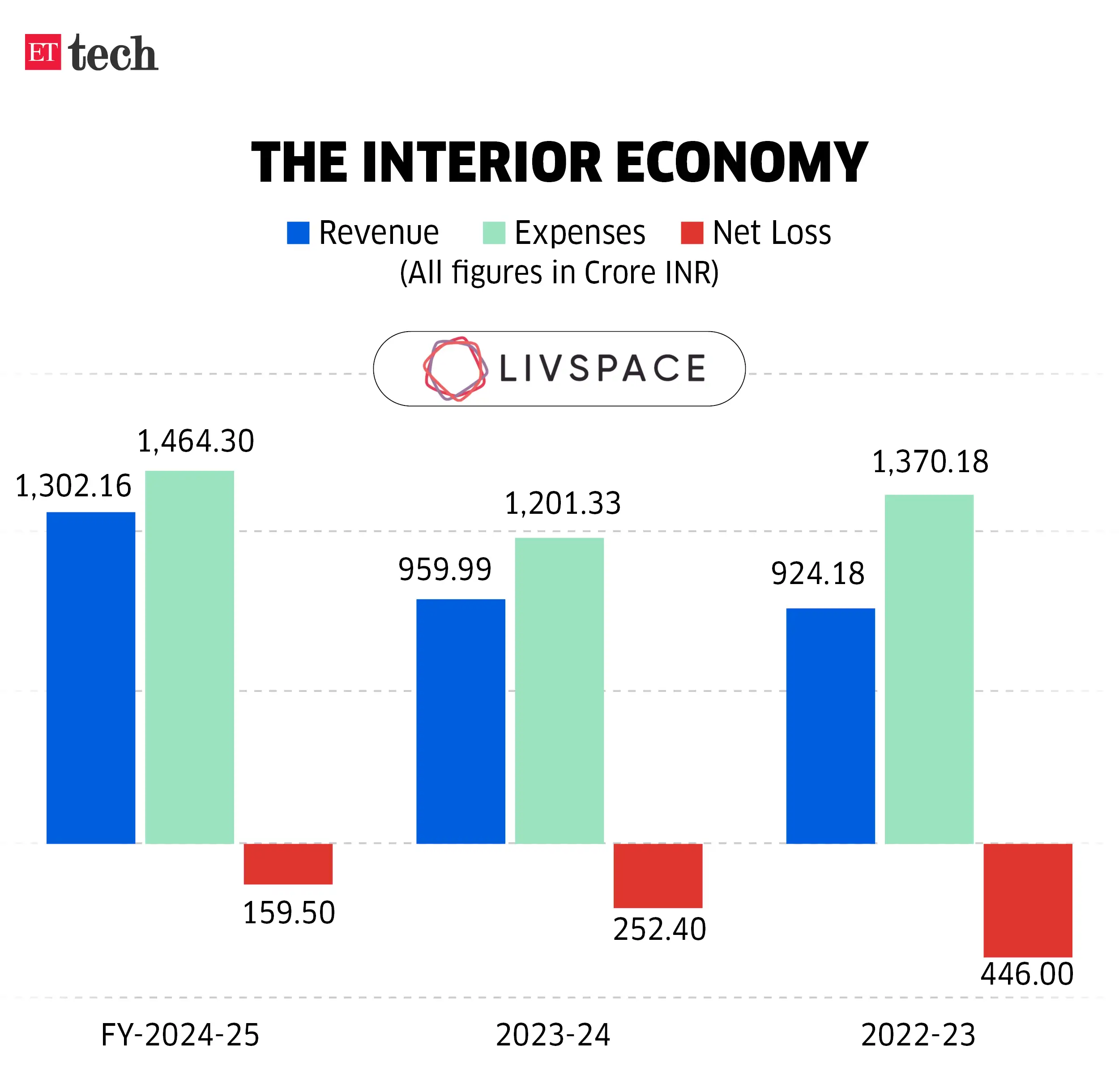
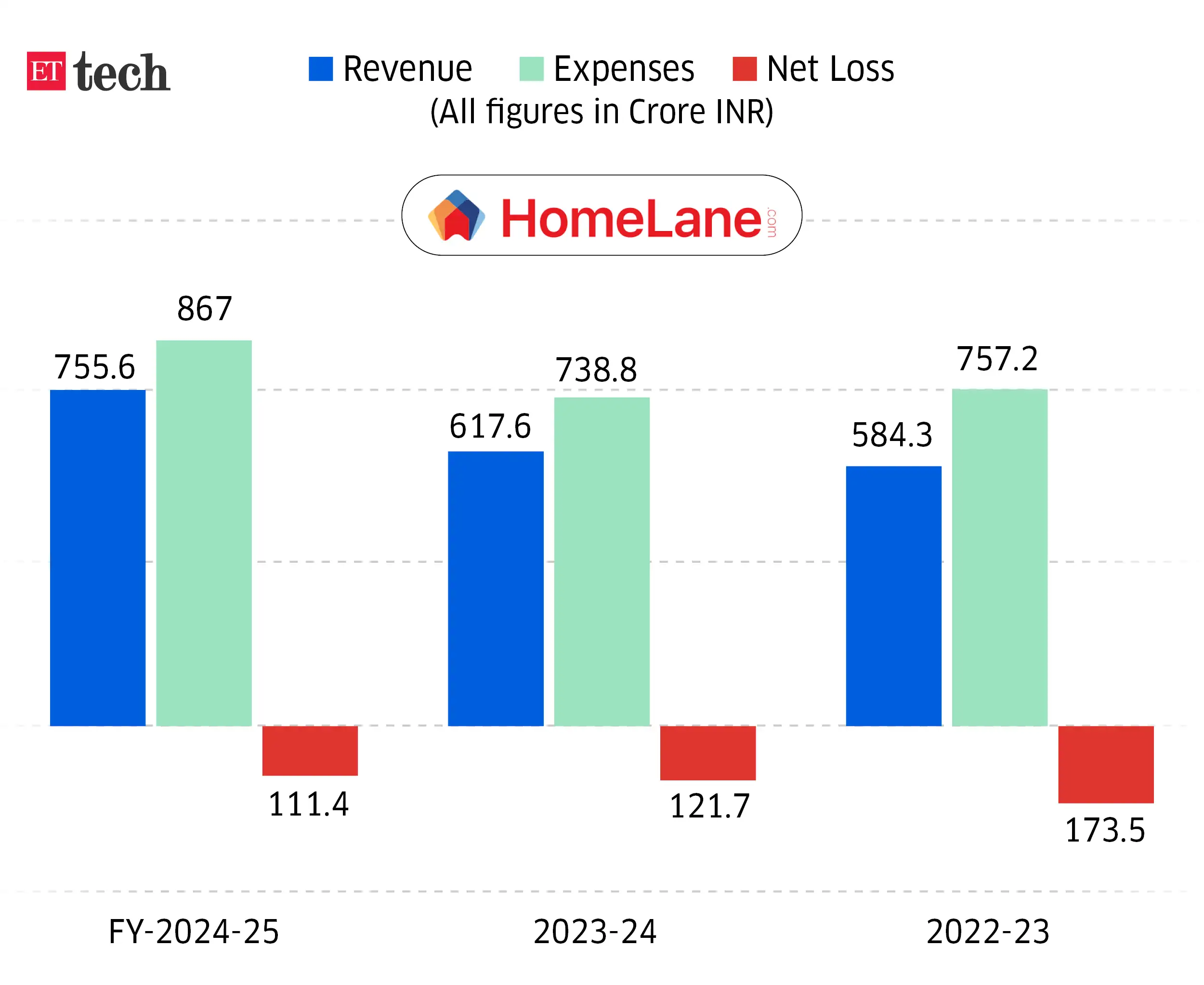
In FY25, as per filings with the corporate affairs ministry, Livspace reported expenses of Rs 1,464 crore on total earnings of Rs 1,302 crore, while Homelane had expenses of Rs 867 crore on earnings of Rs 755 crore. Employee benefits, advertising, and operating expenses like the cost of consumables comprised the bulk of the costs.
“We are inching towards overall breakeven; the target is Ebitda breakeven, our margins have seen an improvement of 3 to 4% in the past couple of quarters ,” said Iyer of Homelane. Iyer wants two to three quarters of consistent profitability before starting the initial public offering (IPO) process, which is likely in the next year or so.
The Livspace spokesperson said the company’s interiors business was profitable and it hopes to be able to sustain it.
Wild card
If a fragmented supply chain and competition from local carpenters was not enough, there are also other players trying to nibble into the market share of the organised home interiors industry. Recently-listed home services platform Urban Company is trying to launch home renovation services across multiple cities. NoBroker wants to leverage the fact that customers engage with them even before they buy a flat, which makes interiors a natural cross-sell for them.
“Earlier, about 10% of NoBroker flat buyers opted for our interior services; now we are at 20-30%. Our goal is to reach 80-90%. Even if the customer base doesn’t grow, we can triple our business just by better penetrating our internal audience,” said Agarwal.
He also believes that since the platform works with third party agents for multiple businesses, home furnishings are a logical extension for the firm. The company has outsourced its manufacturing completely.
“In home interiors, we do things a bit differently. While we use partners for execution (carpenters and factories), we keep the designers on our payroll,” Agarwal said.
In August 2025, Urban Company launched Revamp, a home improvement brand offering quick makeovers in select cities. Given the complexities of delivering this high average order value (AOV) and low-frequency service, the company has limited its offering to wall painting and wall panelling.
“The bigger challenge is the complexity in delivering a high AOV job. As a result, we have been sharply focussed for a few years on walls and not ventured beyond that… because we believe that is a very large market,” said the company’s CEO, Abhiraj Bhal, during the FY26 September-quarter analyst call.
There is no doubt that these startups have managed to democratise interior designing and help the middle class aspire to a well-designed house. But how will they expand the segment? At a time when home buyers are getting design ideas through ChatGPT and Gemini, can these startups create their own unique offerings and keep growing?
Can they use AI to change the rules of the game and upend competition from local carpenters? The next two to three years will be critical for this debate to settle.