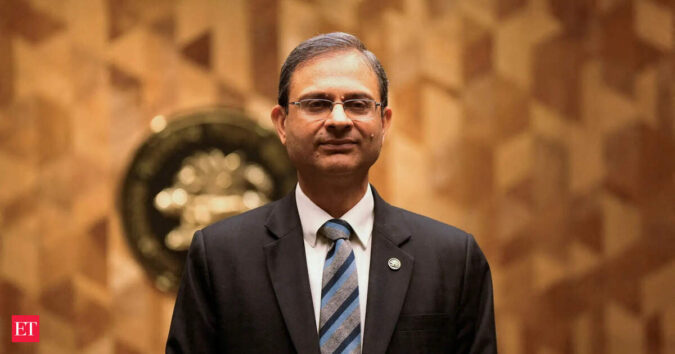
The six-member MPC, chaired by RBI Governor Sanjay Malhotra, also left the Standing Deposit Facility (SDF) rate unchanged at 5 per cent and the Marginal Standing Facility (MSF) rate and Bank Rate at 5.5 per cent. The committee decided to continue with the neutral policy stance, signalling flexibility to respond to evolving inflation and growth dynamics.
Announcing the decision after the three-day policy meeting, Malhotra said the global environment had deteriorated since the RBI’s last policy review in April, with the continuing geopolitical impasse in West Asia weighing on the economic outlook. “Faced with difficult trade-offs, monetary policy has turned more cautious,” he said.
The governor said sharply elevated energy prices and global supply chain disruptions were hindering economic activity worldwide, while risk-off sentiment and safe-haven demand were imparting volatility to foreign exchange markets. Despite the turbulent global backdrop, he noted that the Indian economy had entered the current phase of uncertainty in a much stronger position than during previous external shocks.
Ahead of the policy announcement, economists were largely expecting the MPC to remain on hold. Eleven of the 15 economists surveyed by ET anticipated no change in the repo rate, with State Bank of India Chairman CS Setty saying a pause would help “stabilize in terms of ensuring that the smooth growth rates are achieved.”
A separate Reuters poll conducted between May 22 and May 29 showed nearly 80 per cent of economists, or 44 of 56 respondents, expecting the MPC to leave the benchmark repo rate unchanged at 5.25 per cent.
The RBI entered the June policy review facing a difficult balancing act. Retail inflation stood at 3.48 per cent in April, remaining below the central bank’s medium-term target of 4 per cent. At the same time, wholesale inflation accelerated sharply to 8.3 per cent in April, global crude prices remained elevated, and the rupee weakened significantly amid foreign capital outflows and geopolitical tensions.While noting that CPI inflation had remained below target despite the global shock, Malhotra said the MPC saw “considerable risks” to its baseline assumptions on both growth and inflation. He said the pass-through of higher global prices to domestic inflation had so far been limited and underlying inflation pressures remained benign. However, baseline projections pointed to headline inflation firming up towards the upper tolerance level later this year.
The central bank sharply revised its macroeconomic projections, lowering its FY27 real GDP growth forecast to 6.6 per cent from 6.9 per cent projected in April, while raising its consumer price inflation estimate for the fiscal year to 5.1 per cent from 4.6 per cent earlier. The revisions underscore the RBI’s concerns over the impact of elevated crude oil prices, supply-chain disruptions and weather-related risks on the growth-inflation outlook.
The governor also cautioned that rising energy prices and supply constraints were beginning to leave a visible imprint on economic activity. “Overall, the economic situation has broadly exhibited resilience and withstood the conflict spillovers, although the impact of cost pressures is becoming visible,” he said.
Indian economy resilient amid global turbulence
Use these paras immediately after the introduction:
Malhotra said India had entered the current phase of global uncertainty from a position of relative strength, helping the economy absorb the spillovers from the West Asia conflict better than in previous episodes of external stress.
The MPC noted that while economic activity had remained resilient overall, there were emerging signs of moderation in some sectors as reflected in high-frequency indicators. Elevated energy prices coupled with supply constraints were increasingly weighing on economic activity, while rising input costs were beginning to affect businesses and consumers.
Reflecting these concerns, the RBI trimmed its FY27 real GDP growth projection to 6.6 per cent from 6.9 per cent estimated earlier. Malhotra said elevated energy prices and supply constraints were already having adverse spillovers on economic activity, while some high-frequency indicators pointed to an incipient moderation in certain sectors.
“Going ahead, the rise in prices of energy and other inputs coupled with supply disruptions is likely to weigh on economic activity,” the governor said, adding that policymakers would continue to closely monitor evolving global and domestic developments.
Monsoon uncertainty clouds inflation outlook
Apart from geopolitical risks, the RBI flagged weather-related concerns as another major source of uncertainty for the inflation outlook.
Malhotra said the food outlook remained uncertain due to forecasts of a sub-normal southwest monsoon and the risks associated with El Nino conditions. The MPC noted that these factors could have implications for food prices in the coming months, particularly if rainfall deficiencies affect agricultural output.
While inflation has so far remained below target despite the global shock, the central bank warned that weather-related risks and elevated energy prices could push headline inflation closer to the upper end of its tolerance band later this year.
Finance ministry flags inflation risks
Just days before the RBI’s policy decision, the finance ministry warned that policymakers needed to remain vigilant as multiple factors threatened to reignite inflationary pressures.
In its May economic review, the Department of Economic Affairs described the economy as “cautiously resilient” but cautioned that rising fuel prices, a depreciating rupee, increasing upstream cost pressures and the prospect of below-normal monsoon rainfall posed significant risks.
“The confluence of elevated global energy prices, a depreciating rupee, rising upstream cost pressures and the prospect of a below-normal monsoon calls for sustained policy vigilance,” the ministry said.
The review also stressed that policymakers would need to remain “agile across monetary, fiscal, and structural dimensions” to navigate what it described as a period of “compounded uncertainty, external and climatic, while keeping medium-term growth objectives firmly in view.”
West Asia war clouds inflation and growth outlook
The conflict in West Asia has emerged as one of the biggest risks confronting the RBI and the broader economy.
India imports nearly 90 per cent of its crude oil requirements, making it particularly vulnerable to sustained disruptions in global energy markets. Since the outbreak of the Iran conflict earlier this year, crude prices have remained significantly above pre-conflict levels, increasing pressure on inflation, the fiscal position and the current account balance.
The finance ministry identified disruption to shipping through the Strait of Hormuz as the most critical variable for India’s economic outlook.
“The duration of the Strait of Hormuz disruption remains the ‘single most consequential variable for India’s external and price outlook’,” the ministry said.
Economists have warned that prolonged elevated oil prices could force a reassessment of the inflation outlook. While many believe supply-driven inflation does not warrant an immediate rate response, a sustained pass-through of fuel and transportation costs into broader consumer prices could eventually compel policy action.
The RBI itself, in its latest annual report, acknowledged that a prolonged West Asia conflict could pose downside risks to growth while simultaneously creating upside risks for inflation through higher global fuel and commodity prices.
The sharp weakening of the rupee added another layer of complexity to the RBI’s policy calculus.
The Indian currency touched record lows against the US dollar earlier this year and remains among Asia’s weaker-performing currencies amid foreign fund outflows and higher oil import bills.
Rupee has declined more than 5 per cent this year, prompting the RBI to spend billions of dollars intervening in the foreign exchange market to curb volatility.