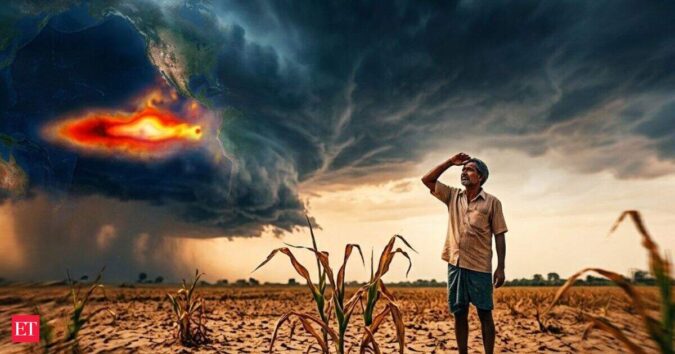
Deficient and uneven south-west monsoon amidst El Niño conditions poses some risks to the agriculture sector’s outlook and rural demand, said RBI Governor Sanjay Malhotra.
ALSO READ | Malhotra & Co trim FY27 inflation forecast to 5% as easing crude prices offer relief
Nevertheless, the government’s initiatives pertaining to crop diversification, including short-duration as well as climate-resilient crops, and water harvesting and conservation, among others, are expected to mitigate the impact, he stated in his monetary policy address.
“Furthermore, sustained momentum in services, continuing impact of GST rationalisation, and broadly stable employment conditions should continue to support urban demand.”
ALSO READ | Sanjay Malhotra & team keep repo rate at 5.25% as global risks linger with Iran war flare-up
A risk looms over the Indian economy
Malhotra said El Niño’s impact on the temporal and spatial distribution of rainfall remains a “key risk”, although proactive supply-side management and adequate foodgrain stocks are expected to provide a buffer.He also cautioned that global crude oil prices continue to be volatile, with sharp two-way movements driven by geopolitical developments, clouding the near-term outlook. While underlying inflationary pressures remain contained, the RBI warned that higher food, fuel and other input costs could still spill over into broader inflation.
RBI has lowered its inflation forecast for FY27 to 5% from 5.1% projected in its June meeting, reflecting recent softening in global crude oil prices and easing supply-side pressures.
Quarter-wise, it expects inflation at 4.1% in Q1 (down from 4.2% earlier), 4.7% in Q2 (revised from 5.1%), 5.9% in Q3 (unchanged), and 5.5% in Q4, slightly higher than the earlier estimate of 5.4%. The central bank said risks to the inflation outlook remain evenly balanced, with headline inflation expected to peak in the third quarter before moderating thereafter. The central bank also lowered its FY27 core inflation forecast to 4.3% from 4.7% projected earlier.
El Niño impact
Historically, strong El Niño events—marked by erratic rainfall and above-normal temperatures—have severely crimped the output of key kharif crops, particularly oilseeds and pulses. These concerns are mounting once again as the India Meteorological Department (IMD) forecasts below-normal monsoon rainfall at just 90% of the Long Period Average (LPA), heightening fears over crop yields this season.
This anxiety is rooted in past trends. An ET analysis of the last three major El Niño cycles (1991–92, 1997–98, and 2015–16) revealed an average 1.3% drop in kharif output. Quantifying this risk, HDFC Bank Principal Economist Sakshi Gupta notes that every percentage point shortfall in monsoon rainfall below the LPA typically reduces crop Gross Value Added (GVA) growth by roughly 0.4 percentage points.
Such disruptions carry heavy economic consequences. Agriculture remains central to India’s economy, sustaining nearly half the population while directly driving rural consumption, employment, and food prices. Consequently, weather shocks not only dent farm incomes and rural demand but also spike food inflation—making it increasingly difficult for the RBI to support economic growth while keeping inflation in check.
The government has placed agriculture at the core of its development agenda over the past decade. Notably, budgetary allocations to the sector have expanded nearly fivefold, rising from ₹27,662 crore prior to 2014 to ₹1.40 lakh crore today.
WMO forecast
Meanwhile, the World Meteorological Organization said there is an 80% probability of El Niño developing during the June-August period and a more than 90% chance that it will persist through November.
Typically, kharif sowing begins in June, coinciding with the arrival of the monsoon.
Among major crops, bajra, maize, tur, and groundnut are the most vulnerable to below normal monsoon. In contrast, rice is less susceptible due to a comparatively higher irrigation coverage area of around 70%. India also has record rice and wheat holdings in its granaries.
“The impact of El Niño has been reducing over the years as irrigation facilities have improved drastically,” said a senior government official. “We have also been using climate-resistant and short-duration varieties of seeds to counter rainfall deviations.”
Inflation risks and its impact
Inflation also tends to be higher during El Niño years. For instance, average inflation stood at 4.9% in 2015-16, while pulses inflation surged to 31.7%.
Lower farm productivity has a direct bearing on inflation as vegetable, pulses, and edible oils account for around 9% of the Consumer Price Index (CPI).
Beyond crops and prices, El Niño can have wider consequences for rural India. “El Niño can impact the rural economy by affecting production and livelihoods tied to agriculture,” said HDFC’s Gupta.