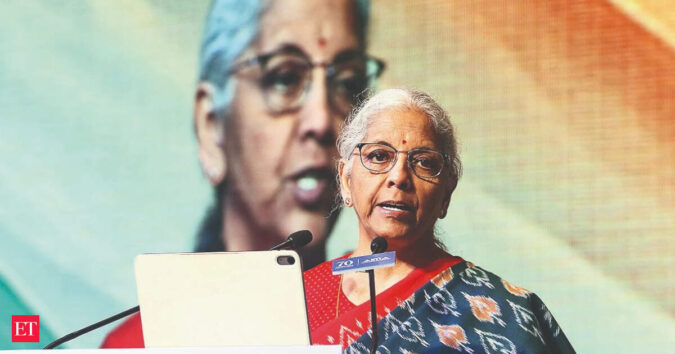
Reforms and rising incomes are reshaping demand, and the country stands at a “structural inflection” point, where the next phase of consumption will be driven by upward mobility into brackets where discretionary spending accelerates, Sitharaman said.
“India’s consumption base rests on working families across agriculture, rural construction, transport and informal enterprise,” the minister said, addressing the 53rd National Management Convention of the All India Management Association.
The next phase of growth will depend on broad-based consumption, sustained investment beyond metros and the ability to build professionally managed Indian companies that can innovate, scale and withstand global shocks, she added.
Private consumption, which accounts for more than half of GDP, grew 7.7% in fiscal 2026, Sitharaman said, pointing to the potential of the next leg of growth that will come from a widening consumption base rather than higher spending by existing affluent consumers.
Also Read: RBI weighs Anup Bagchi for HDFC top job
Referring to an unpredictable global economy, she said India’s response must be built around domestic capacity, fiscal strength and sustained capital expenditure rather than economic isolationism.Family businesses
Sitharaman made a strong pitch for better-governed family businesses and greater corporate spending on research and development. She said the next 20 years would require Indian businesses to move beyond the creation of startups towards building enterprises that could scale, professionalise and endure.
As companies grow, family promoters will need to put greater emphasis on succession planning, governance and professional management, she said. The shift would also require stronger capabilities in hiring, delegation, financial discipline, customer management, compliance and systems-building.
Also Read: Piyush Goyal plans 1,000-strong regional language network to handhold exporters
The objective, the minister said, is not simply to create bigger companies, but enterprises that are competitive, innovative, trusted and resilient enough to contribute to the country’s growth over the coming decades. “India today has the scale of the market, the entrepreneurial energy and the institutional capacity to aim much higher. Execution will determine how successfully we convert these strengths into lasting national capability,” she said.
That institutionalisation of enterprises is also central to the government’s broader objective of building greater domestic capacity to absorb external shocks without becoming less integrated with the world.
Investment beyond metros
The government has increased its FY27 capital expenditure target to more than Rs 12 lakh crore, while effective capital expenditure, including grants to states for creating capital assets, has crossed Rs 17 lakh crore, the minister said.
Gross fixed capital formation increased above 34% of GDP in the first quarter of FY27 and grew about 12% in real terms, she said.
The investment cycle is also spreading beyond the traditional metropolitan centres, with states competing to attract high-value economic activity. She cited Coimbatore, Vadodara, Visakhapatnam, Indore, Bhubaneswar and Jaipur as emerging investment locations.
The semiconductor programme, she said, provided a model in which central policy frameworks were combined with state-level execution. The approach could be extended to electronics components, biotechnology, advanced materials and green-energy ecosystems.
‘Imagined in India’
The next shift for industry, Sitharaman said, must be from manufacturing products to creating them. She called for higher corporate spending on R&D, either through in-house capabilities or collaboration with academia, saying industry needed to develop products that were conceived, designed and technologically developed domestically and then taken to global markets.