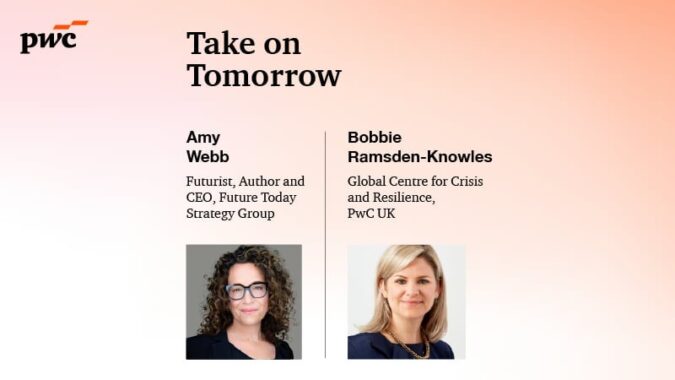
Amy Webb: There are tons of forces shaping the future of business and governing, and I would argue that the vast majority of them are overlooked.
Bobbie Ramsden-Knowles: You’ve gotta think about your ecosystem because no organisation is an island. And actually the attention and focus on that system’s resilience has become even more important now.
Amy Webb: Something I ask executives all the time: What is the one belief about your business that everybody in the company has and believes is permanent? And what would have to be true for that to be wrong?
Lizzie O’Leary: The old way of doing business is over.
Femi Oke: From disruptive technology like AI, to geopolitical tensions, business leaders need to be ready for change before it even happens. So how do you act, before you know what’s coming?
Femi Oke: I’m Femi Oke, a broadcaster and journalist.
Lizzie O’Leary: And I’m Lizzie O’Leary, a podcaster and journalist. And this is Take on Tomorrow, the podcast from PwC.
Femi Oke: And welcome to our new series, which looks at how to build momentum around bold ideas.
Lizzie O’Leary: Today… Is your business built to survive?
Lizzie O’Leary: Shortly we’ll hear from futurist Amy Webb on how she thinks business leaders should prepare for disruption.
Femi Oke: But first, to help us understand the challenges business leaders are facing, we are delighted to be joined by Bobbie Ramsden Knowles, a partner from PWC UK, who co-leads PwC’s Global Centre for Crisis and Resilience. Hello, Bobbie.
Bobbie Ramsden-Knowles: Hi there.
Femi Oke: So, Bobbie, organisations are facing so many disruptions right now. What are the main issues that leaders should be thinking about today?
Bobbie Ramsden-Knowles: I think firstly, actually, that we need to remind ourselves that we mustn’t make the assumption that the way things that today are going to look like that tomorrow, actually, organisations have been rewarded for building very lean organisations, lean supply chains, single technology platforms, and just in time operations.
And that made sense in a really stable world. But as the view described, we’re facing into really complex risks, whether that’s geopolitical or indeed a supply chain disruption, cyber, AI. These risks are not only overlapping and conflating out, but they’re causing real disruption for organisations.
And we have to work out how are we going to actually continue to grow and generate value as well as protect the business through these different disruptive events.
So one of the questions a lot of leadership teams are asking right now, and I’m encouraging them to ask themselves, is if we lost everything tomorrow, what do we actually have to keep running in our business that matters the most?
What actually really keeps our organisation viable to all that disruption?
And actually, it’s quite interesting when you ask that question at an executive level, the answers you get are very, very different. And that’s really where the real conversation around resilience starts, I think.
Lizzie O’Leary: Bobbie, you listed a number of different challenges and sort of periods of change that businesses are going through.
How well prepared do you think current businesses are to deal with all those challenges?
Bobbie Ramsden-Knowles: Organisations have taken really good steps to improve their resilience and their ability to respond to crisis events, right?
So a lot of organisations have built plans, they’ve tested crisis plans, they’ve got business continuity plans, disaster recovery. Some organisations have even appointed chief resilience officer. Question is, is that enough?
That is where it gets quite interesting because actually a plan when tested, as we’ve seen in the last couple of years where organisations have had to respond to cyber attacks or geopolitical risk and supply chain disruption, had those plans actually withstood the disruption they faced?
And the answer in some cases is no.
And I think it’s because actually the way we’ve built our resilience capabilities isn’t perhaps fit for what we need for the future. And by that I mean we perhaps haven’t always focused on protecting the things that matter the most to the organisation.
We’ve actually tried to make all of our organisation resilient rather than focusing on the most critical parts and pulling resilient strategies enable us to protect what we would call is your minimum viable company.
The smaller set part of your organisations, your services, your products that really mean that if you’re hit by disruption you will remain viable, you will remain compliant, you will maintain trust with your stakeholders.
And I think a lot of organisations have got a lot of work to do around that still.
Femi Oke: It sounds like business leaders may need to start thinking very differently about how they deal with risk and disruption.
Lizzie O’Leary: Exactly, Femi.
And to help us understand how to navigate all of these changes, I spoke to someone who spends a lot of her time thinking and speaking about this issue with the business world.
Amy Webb is a futurist author and the CEO of the Future Today Strategy Group. And we began by talking about how leaders should navigate disruptive events.
Amy Webb: There are tons of forces shaping the future of business and governing, and I would argue that the vast majority of them are overlooked.
So what I’m seeing happen is that leaders are treating every shock at this stage as a freak event, as like a one-off.
So whether it’s a chip shortage or a bank collapse or an election that goes in a direction people didn’t expect or a war that happens suddenly or a breakthrough in science or technology,
All of these different facets are really just one node each in a system that has itself been shifting for years.
So when leaders are reacting event by event, they are perpetually in a state of catch up or they are sticking their heads in the ground and hoping things will be better next quarter.
This is not the case if an executive is using strategic foresight, which is a discipline that requires you to assemble the right types of data and look for patterns in those data and systematically look at that alongside of uncertainties and build out plausible scenarios to get to strategic decisioning in the present.
And there are different degrees of doing strategic foresight.
Some of it’s very labor intensive, but at an executive level, it’s really about ingesting the right new information, having a way to think about it, and then using that in a flexible way to make decisions.
Lizzie O’Leary: So how do the most successful organisations do this in practice?
Amy Webb: The companies that do the best at this are the ones that have enough research that’s data-backed that they have an informed point of view on the farther future. So this is not speculation 10 years from now.
This is we have determined this is where the world is going, this is where value will be created, and this is how we are going to participate.
And a lot of leaders get that wrong. And one other important thing when it comes to technology specifically, the markets are still forming.
So if we go to something like a physical AI, any firm out there will be happy to give you a number of what that market looks like on whatever, pick a year.
There is no real way to make that calculation right now because there are too many variables in flux. So waiting to figure out before you’re willing to at least make a leadership decision that this is something we want to explore means you are already behind.
Lizzie O’Leary: Are there examples either from your professional business life where you feel like, okay, here’s an example of this being done right, or other people where you say like, oh, they did this, they saw around this corner.
I’m just curious what it looks like in practice.
Amy Webb: Yeah, so the answer is, sure, there are lots of companies that are good at seeing what’s coming. The hard part is taking action on whatever that is.
Lizzie O’Leary: This is the like, see disruption versus capacity to act.
Amy Webb: It’s not just capacity to act, it’s willingness to take a chance. And it’s harder when you’re a publicly traded company and you have both a board and the street to answer to.
It’s not a matter of having the skills to see the future.
You then have to translate that back to other parts of the organisation who may be incentivized against making any change whatsoever. So part of this is you have to incent every single person in the organisation to think differently about what the future might hold.
So it’s one thing to tell people, imagine the world of 2031 and where our customers fit in.
But if you’ve never done that before, that’s like giving somebody a blank canvas and asking them to come up with a masterpiece. And that’s tough for a lot of people.
There’s another piece of this, which is if you’re in a company where every single thing must be totally buttoned up before it’s shown to the leadership. So like that PowerPoint has to be awesome.
And you cannot even think about discussing an initial kernel of an idea. And a lot of organisations are like this. Then again, you’re going to have a problem.
So psychological safety plays a pretty significant role in organisations that can both see what’s coming and take action on it in the present.
Lizzie O’Leary: How do you see the path for organisations to build momentum for change in a way that is empowering?
Amy Webb: Yes, I can give you a personal example that has nothing at all to do with business or companies. And that is a bike race that I ride in every year.
So I’m a cyclist and I compete in this insane event called Unbound in Kansas. It is a gravel race. It’s professionals and amateurs, so I’m obviously an amateur, but pros come in from around the world.
And it is tough.
There is nobody out there to help you. It is self-supported.
So you have to have a way to take this incredibly challenging thing and make it something that’s achievable so that when things get tough, you’re not ready to throw in the towel and not finish.
This year, so I had the course map on my bike computer, but I printed it out and I put it on my bars. So I saw what the elevations were.
My coach and I went through and we had a plan for every segment and where I will be and how many watts to push. So I burn out all my matches before the end.
And that turned out to be really important because this year it rained so hard that there was so much mud that portions of it you could not ride. Only 10 miles.
We just started this thing. We all had to get off of our bikes and hike with our bikes hoisted up for 2 1/2 miles. And this year, a lot of people didn’t finish that race because they were like, what am I doing?
I had a plan.
So the point of this is there are always going to be uncertainties along the way that you can’t control, and, you have a strategy that helps you take action on whatever that is, and then you’ve got a plan to execute.
This is basic stuff in most companies.
I don’t see it happening often enough at a high enough level.
Lizzie O’Leary: So let’s say, okay, you get 90 seconds with the leadership team of a company that thinks it’s doing fine, right?
The margins are good, there are no obvious threats on the horizon.
What is the thing, the unsettling question or sort of the big interrogative moment that you leave them with?
Amy Webb: Sure, it’s actually something I ask executives all the time.
What is the one belief about your business that everybody in the company has and believes is permanent? And what would have to be true for that to be wrong?
And it’s a really hard question to answer because A, it forces everybody to confront their cherished beliefs about the organisation. B, it sets up the idea that the future necessarily will be different from today. And then C, it asks you to come up with some kind of point of view.
It’s tough to ask that question.
And honestly, to keep in your back pocket, what would it take for that to be true, is a good question just to have and to ask all the time.
Lizzie O’Leary: Amy Webb, thank you so much for your time.
Amy Webb: Sure thing. Thank you.
Femi Oke: So, Bobbie, Amy talked about questioning the assumptions your business takes for granted. In practice, how do you help leadership teams identify those blind spots before they actually become business risks?
Bobbie Ramsden-Knowles: Yeah, I think one of the most important things is starting out with actually what are the outcomes that we deliver as a business that we care the most about.
And once a business has really agreed and decided that at the executive and C-suite level, it is then really understanding how do we deliver those outcomes?
What are the business processes we require?
What are the dependencies?
What technology?
What suppliers do I rely on?
What data?
What people?
Understanding and mapping all of that uncovers vulnerabilities organisations didn’t know they had, single points of failure they didn’t know they had.
But it also enables them to actually find areas they can improve efficiency and potentially remove duplication.
So organisations are really now focusing on really understanding and interrogating how do I actually operate as a business.
Lizzie O’Leary: So what does that look like on a day-to-day basis?
Are there behaviors or capabilities that an organisation needs to sort of embed within itself so that it can be resilient and sort of, I guess, set the business apart from others?
Bobbie Ramsdon-Knowles: I think for me, the first thing is mindset and really starting to think about how do we embed resilience into our decision making so that whenever we’re making any kind of decision around whether we’re going to go with efficiency, resilience.
Yes, it might cost more, but actually we need to think about the benefit of us being able to be able to adapt and have that redundancy in the organisation.
If I go back to my earlier point, I think we’ve over many years, for good reason, chosen to take a more lean approach to organisations in driving efficiency as opposed to resilience.
I don’t think we have that luxury anymore, but that mindset, that ability to make those decisions from the bottom, the organisation to the top really has to come from the right tone. That resilience is being prioritized over being efficient.
The other thing I would say is that leadership needs to really set the tone around the fact that our people need to be resilient to be able to respond as well.
We can have the best plans, we can test our plans, we can exercise our teams, but actually what we’ve learned from organisations who have gone from through really significant crises and disruption.
It’s also your people who will manage that crisis and respond. And there’s a huge amount of pressure that is put onto them in the months of recovery.
I think there’s a real need now to think about how do we build personal resilience across our teams to manage that in a more effective way. We need to learn from those who have been through really long-term crises over weeks and months. And we just must not forget, ultimately, it will come down to your people.
Lizzie O’Leary: I think one of the things that is so interesting in this conversation is the assumptions that people and businesses and organisations carry that may not actually be borne out by evidence.
I wonder if there is something that organisations think makes them resilient, but actually would not be the thing that you point at that doesn’t actually hold true.
Bobbie Ramsden-Knowles: I think that the plan, having a plan for every single scenario, I often hear that we’ve got a crisis management plan, let’s just do another few scenario plans. And actually that gives us the confidence we can be able to respond.
Now, they provide good value, but they only go so far. They’re going to only take you through a certain period of that response.
And I think the type of disruption, because we’re seeing a lot of the risks and threats today conflate, a cyber threat conflicts that this happens at the same time as a significant weather event or national power outage that happens at the same time as a supply chain disruption.
That a few years ago we would have laughed at that type of scenario and I think that’s absolutely plausible now. It’s not just going to be about a KOSIS plan that’s going to make you resilient for that. You’ve got to think about your ecosystem because no organisation is an island.
We all exist in systems. And actually the attention and focus on that systems resilience has become even more important now.
And you talk about assumptions. Where I have seen gaps and when sometimes I get concerned is where organisations or sectors are making assumptions about their own dependencies between each other.
And of course, if we’re faced with some scenarios like a national power outage or a cyber attack that took out critical national infrastructure,
We could be very, very challenged because a lot of assumptions are being made between different organisations potentially.
Lizzie O’Leary: One of the things I hear you saying again and again is critical infrastructure. How those things link together and how they link to big systems, food, water.
I think the kind of things that regular people think of as just existing, maybe not being interlinked with big corporations. And I’m wondering where the result is for regular people and customers and society if businesses, did the resilience work more on the front end?
What difference does that make kind of rippling out towards society?
Bobbie Ramsden-Knowles: I think there’s benefits for everyone.
We are in a far more complex world and customers, the public, they expect to have access to services all the time. Critical large infrastructure has to be able to meet those demands and there’s changing demands, particularly as technology and AI change as well.
They’ve got to be able to continue those critical services, whether they’re in disruption or not. But the other thing I think there’s probably a role for all of us is actually there’s a requirement for the public to be more resilient and be more prepared for disruption as well.
And in some countries, Finland for example, have done a brilliant job of really getting their public as prepared as possible for disruption. So I think that is an area that increasingly we need to think about.
Femi Oke: Bobbie, a business leader is listening to our conversation right now.
What would be the top three actions you would recommend immediately to help them be ready for disruption?
Bobbie Ramsden-Knowles: Yeah, deciding what is critical because if everything is critical in your business, then nothing will be when you’re hit by disruption.
Be really clear on the capabilities you need to keep the organisation viable, including how does your workforce fit into that as well.
I say secondly, really challenge assumptions your organisation has made, but the challenges they’ve made within the broader ecosystem as well.
So think about your supply chain. Do we really know who the critical suppliers are? What if we lost one of our critical technology partners, for example?
And then test, but test to the point that we’re actually trying to potentially break things and actually have a culture where if something goes wrong, that is okay.
We want to understand where we can really improve, where we can see those vulnerabilities. This is not about promoting a culture where we want to see a green dashboard. We want to find where the problems are, the gaps are the vulnerabilities.
And thirdly, I think leaders need to really think differently about resilience now. It is a strategic discussion that has to happen at the executive level.I think it is about protecting your business, but also the wider ecosystem. But it’s also about growth.
We have to change, given the disruption and the opportunity that things like AI afford. So think about what that might mean from your business model, your business strategy as well.
Femi Oke: Bobbie Ramsdon-Knowles, thank you so much for joining us.
Bobbie Ramsden-Knowles: Thanks very much for having me.
Lizzie O’Leary: Femi, that was so interesting in terms of just thinking about how a company needs to plan for the unknown and their key business functions going offline.
And I guess what this sort of idea of the minimum viable company, which is a thread that runs through what Bobbie was saying and also what Amy Webb said in the sort of like, what are you not prepared for? What are you not thinking about?
That it requires some degree of just being willing to pivot immediately.
Femi Oke: There was one quote that kept on jumping out at me.
A US famous politician once said, there are unknown unknowns, the ones we don’t know, we don’t know. That’s resilience, isn’t it? That’s resilience and disaster preparation, crises management.
The ones we don’t know, we don’t know.
Lizzie O’Leary: That’s Donald Rumsfeld talking about the Iraq war, but it applies here.
Femi Oke: Oh yeah, absolutely.
Lizzie O’Leary: That’s it for this episode – if we inspired you to think about your business in a new way, please follow Take on Tomorrow wherever you listen to podcasts. For more, you can visit pwc.com/takeontomorrow
Femi Oke: Next time on Take on Tomorrow – we look at how AI Agents are transforming the way businesses operate – and people work
Guest: There’s like an entire class of problems that we didn’t think we’d get to address perhaps sometimes in our lifetime that, that are now possible, because we have these teams of agents that are at our disposal.
Femi Oke: Take on Tomorrow is brought to you by PwC. PwC refers to the PwC network and/or one or more of its member firms, each of which is a separate legal entity.