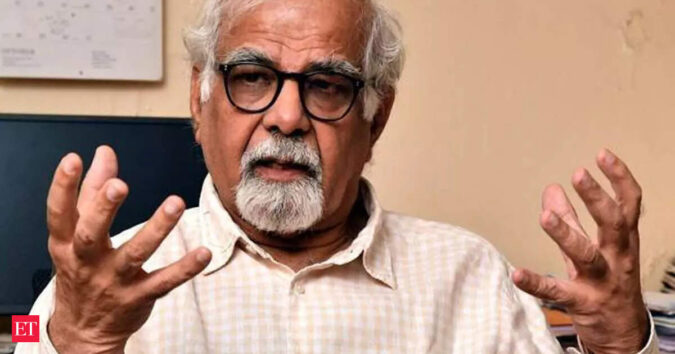
Bhalla argued that India needs to liberalise rules governing foreign direct investment, simplify dispute-resolution mechanisms and offer stronger tax incentives if it wants to restore investor confidence and sustain economic growth.
Also Read | RBI tightens scrutiny of overseas investments as outflows surge to $27 billion in FY26
“The investment climate is not exactly in great shape,” Bhalla told India Today in an interview, adding that India’s overall policy approach towards investors had become increasingly “restrictive”.
At the centre of his remark was India’s revised Bilateral Investment Treaty framework introduced in 2015, which requires foreign companies to exhaust local legal remedies before approaching international arbitration tribunals.
Also Read | Aditya Shah calls for complete removal of LTCG for foreign investors amid FPI outflows
According to the economist, the provision has created apprehension among global investors by delaying settlements and increasing legal uncertainty.He said the PM Modi-led Central government should revisit the treaty framework and consider returning to a more investor-friendly structure that existed before the changes were introduced.
Concerns over falling foreign investment
Bhalla’s remarks come at a time when India has witnessed a gradual decline in net foreign direct investment inflows in the last year.
Government data shows that FDI equity inflows fell from a peak of nearly $59.6 billion in 2020-21 to $47.8 billion during the April-December period of 2025-26.
Moreover, the slowdown has added to concerns surrounding India’s external financial position, particularly as rising crude oil prices increase the country’s import bill and put pressure on the rupee.
The Indian currency emerged as Asia’s worst-performing currency in 2025 and continues to remain under strain into 2026.
Bhalla argued that policy unpredictability has compounded investor anxiety.
He pointed to abrupt government interventions, including export bans and quality-control restrictions, as measures that have complicated long-term investment planning for global firms.
“Investors respond to incentives,” he said. “If you are getting good profitability, you’ll invest here.”
The economist also called for faster deregulation at the state level and lower taxation for foreign investors, saying India needed to create a more stable and profitable environment for capital inflows.
In a pointed observation on the government’s economic messaging, Bhalla also questioned repeated claims that India is the world’s fastest-growing economy.
“It’s factually incorrect,” he said, arguing that exaggerated narratives do little to help policymakers or investors assess the economy realistically. “The size of our GDP is less than that of California.”
Centre relaxes FDI rules for bordering nations
Bhalla’s remarks come even as the Centre has moved to relax key provisions under Press Note 3 (PN3), easing restrictions on foreign investments from countries sharing land borders with India — a step widely seen as opening the door for fresh Chinese investments after nearly six years of curbs.
Under the revised framework cleared by the Union Cabinet, investments from entities with less than 10% non-controlling beneficial ownership in neighbouring countries will now be allowed through the automatic route, subject to sectoral caps.
The Centre has said the changes were aimed at boosting investments into startups, deep-tech ventures and manufacturing while improving ease of doing business.
The revised norms also introduce a 60-day time-bound approval mechanism for investments in critical manufacturing sectors such as capital goods, electronic components, electronic capital goods, polysilicon and ingot wafers.
However, majority ownership and control will continue to remain with resident Indian entities.