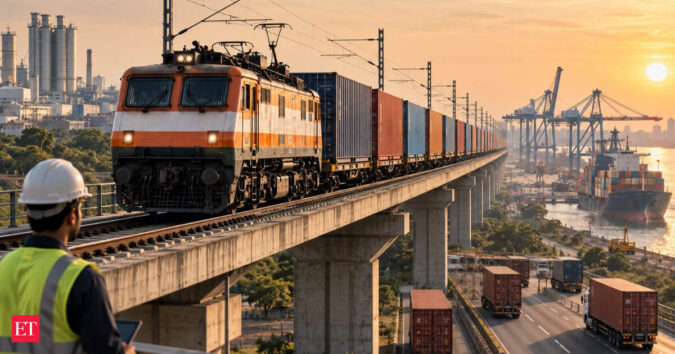
The immediate gain is lower transit time and better reliability, which can reduce the amount of money businesses have tied up in transport and inventory. The larger prize is what will follow — more competitive exports, a wider manufacturing base, cheaper movement of minerals and farm produce, and greater capacity on India’s existing railway and road networks.
Also Read: Western Freight Corridor to cut logistics cost to 7 pc; help India compete with China: Fadnavis
What exactly are the DFCs and how do they work?
The DFC project was designed to solve a simple problem that dogged the Indian economy for decades. India’s busiest railway routes carry passenger and freight trains on the same tracks. As traffic increased, freight trains had to wait for passenger services, and the railways could not run longer or heavier goods trains as efficiently as they wanted. The solution was to build separate freight-only railway lines, the most ambitious infrastructure project after the Golden Quadrilateral.
The Western DFC runs 1,506 km from Dadri in Uttar Pradesh to Jawaharlal Nehru Port near Mumbai. The Eastern DFC runs 1,337 km from Ludhiana in Punjab to Sonnagar in Bihar. Together, they pass through the country’s major manufacturing, agricultural, mineral and consumption belts. The entire network is now operational and was carrying 443 freight trains a day when the final Western sections were inaugurated.
These are not ordinary railway lines with passenger trains removed. They have double tracks, automatic signalling, stronger infrastructure, higher axle-load capability and double-stack trains. The Western corridor has high-clearance overhead electrification that permits double-stack containers, allowing containers to be placed one above another. Freight trains can consequently carry much more cargo in a single movement.
Indian Railways estimates that DFCs can handle more than 120 trains in each direction. The intention is to shift substantial freight from the conventional network and eventually from roads as well.Also Read: ‘Historic achievement for 21st-century India’: PM Modi inaugurates Rs 35,000 crore development projects in Vadodara
The economic significance lies in the combination of capacity, speed and predictability. A freight train does not have to compete with a passenger train for a path. It can carry a heavier load and maintain a much higher average speed.
Logistics time and cost: The biggest economic gain
For Indian businesses, the most important change is not that a train can reach its destination faster. It is that companies can start planning their supply chains around a more predictable journey.
On conventional railway routes, freight trains can take more than twice as long to cover the same distance. The average time for container trains on DFCs is about 2.44 hours per 100 km, against 5.25 hours on the conventional network. For coal trains, the corresponding figures are around 3.15 hours and 6.48 hours. This difference has consequences far beyond the railway freight bill.
A manufacturer normally carries inventory because deliveries are uncertain. If components can arrive reliably, the manufacturer needs less safety stock. A retailer can replenish warehouses more frequently. An exporter can send a container closer to its ship’s sailing time rather than moving it to a port days in advance to protect against delays. The saving therefore comes from inventory and working capital as much as from the freight charge.
The larger logistics-cost picture is also changing. A 2025 DPIIT-NCAER assessment estimated India’s logistics costs at 7.97% of GDP in 2023-24. It put rail’s logistics cost at about Rs 1.96 per tonne-km, against Rs 11.03 for road.
The DFCs cannot move every shipment to rail. High-value, small consignments will continue to use roads and air. But for heavy and long-distance cargo, a better rail option can alter the economics of the entire supply chain. That is why the corridors can have an effect well beyond their 2,843-km physical length.
For any economy that aims to excel in manufacturing and imports, logistics costs and speed matter a lot, as they infuse efficiency into business.
Exports: Getting Indian goods to ports faster
The Western DFC is particularly important for India’s export ambitions because it connects the northern manufacturing belt with the country’s western ports.
Dadri is already a major inland logistics centre. Its container depot handled more than 1.7 lakh TEUs of exports in 2025-26, including garments, food products, tractor parts, tyres, auto components and furniture. It also handled more than 1.5 lakh TEUs of imports. The DFC gives such inland cargo a direct high-capacity route towards Jawaharlal Nehru Port near Mumbai and the Gujarat port system.
This changes the geography of exporting. A factory does not necessarily have to be located close to a seaport if it has dependable rail access to one. That’s important for northern India, where large industrial clusters sit hundreds of kilometres from the coast.
For exporters, reliability can be more valuable than simply shaving a few rupees off the freight bill. Global buyers care about delivery schedules. A shipment that consistently reaches a port within a predictable window is easier to integrate into international production and shipping schedules.
The effect is particularly relevant as India tries to raise manufacturing exports and diversify its role in global supply chains. The DFC lowers one of the structural costs embedded in the price and delivery time of Indian goods.
Make in India: Bringing factories deeper into the country
The manufacturing implications go beyond exports. India’s industrialisation has traditionally been pulled towards ports and large metropolitan markets because moving raw materials and finished products over long distances was expensive and uncertain. DFCs weaken that constraint.
The Western corridor connects the northern hinterland to Gujarat and Maharashtra’s ports and industrial centres. The Eastern corridor reaches India’s coal and mineral belt and connects it to the industrial north.
This creates possibilities for factories to locate closer to labour, land and raw materials without losing efficient access to national and international markets.
The development of logistics parks, freight terminals and industrial corridors around the DFC routes can reinforce that effect. The government has explicitly envisaged industrial corridors alongside the freight network.
That could be particularly significant for smaller industrial towns. A manufacturing cluster does not need a seaport at its doorstep, but a dependable connection to a logistics network.
In that sense, the DFC can help India move from a manufacturing map centred on a few coastal and metropolitan clusters towards a more dispersed industrial geography.
Minerals: Cheaper movement of the raw materials economy
The Eastern DFC has a different economic role from the Western corridor because of its connection to India’s mineral and energy economy. Coal is particularly important. Indian Railways moves huge quantities of coal from eastern and central India towards power plants and industrial centres elsewhere. Steel, cement, fertiliser and other bulk commodities also depend heavily on rail.
A dedicated heavy-haul network allows larger loads to move without being held up by passenger traffic. That can reduce the cost of transporting a tonne of coal or other minerals over hundreds of kilometres.
The impact eventually appears in industrial costs. Cheaper coal transportation affects power generation. Cheaper movement of inputs affects steel and cement. Lower freight costs can then feed into construction costs.
This is one reason DFC economics cannot be assessed simply by looking at the revenue earned by the freight railway. The real benefit lies partly in lowering the cost structure of industries that use the railway.
Agriculture: Faster movement can also moderate food inflation
Agriculture presents another important use case because India’s food economy involves enormous movements between production and consumption centres. Food grains, fertilisers and other agricultural commodities are already carried by rail. Better freight capacity can make long-distance movement faster and more predictable.
The inflation connection is worth taking seriously. When transport becomes cheaper, the cost of moving a commodity from a surplus region to a deficit market falls. Faster movement can also reduce the period during which produce is sitting in transit or waiting for transport.
The DFC will not by itself solve India’s food inflation problem. Weather shocks, crop yields, storage capacity and global commodity prices remain much bigger variables. But transport infrastructure can reduce one layer of friction in the food supply chain.
Its biggest potential will come when rail is integrated with warehouses, cold chains, agricultural markets and road-based first- and last-mile transport.
More passenger railway capacity and fewer trucks on roads
There is another benefit that is easy to miss because it occurs outside the DFC itself. When freight moves onto dedicated tracks, capacity is released on the conventional railway network. Indian Railways can use that space for additional passenger services and for freight that does not need the DFC.
This is particularly valuable on routes that have been chronically congested. The DFC therefore amounts to capacity creation on two networks at once.
There is a similar effect on highways. If rail becomes sufficiently competitive, some long-distance bulk and container traffic can shift from trucks to trains. That can reduce highway congestion and the cost imposed by trucks on road infrastructure.
The environmental benefit follows from the modal shift. An official Indian Railways assessment estimates that the two DFCs could save about 457 million tonnes of CO2 emissions over 30 years. The corridors are also electrified, making the long-distance freight system progressively less dependent on diesel.
The real test of DFC starts now
The completion of the tracks is not the end of the economic story. It is the beginning of the utilisation phase. The DFCs have to be connected efficiently with ports, inland container depots, warehouses, industrial parks and ordinary railway lines. The difference between infrastructure potential and actual economic benefit will depend heavily on these connections.
There is already evidence that the network is attracting new users. Amazon, for example, began operating a daily service on the Western DFC in August, linking its logistics network across Delhi, Ahmedabad and Surat with onward connections towards Pune, Mumbai and Goa.
That is a small example of a much larger shift. Once businesses start designing supply chains around dedicated rail rather than merely using it as an alternative transport option, the productivity gains become larger.
India has spent decades trying to add capacity to a railway system that was being asked to carry both a growing passenger population and a rapidly expanding freight economy. The two DFCs do not solve that problem everywhere. They do, however, tackle it along some of the country’s most economically important freight axes.
Their greatest contribution may ultimately be invisible. It will show up in fewer hours spent moving a container, less capital locked up in inventory, a factory that can operate profitably farther from a port, a cheaper tonne of coal reaching a power plant and a more predictable supply of goods reaching a distant market.
That is the economic logic behind India’s new freight arteries — more lifeblood flows into the economy, making it stronger and supple.