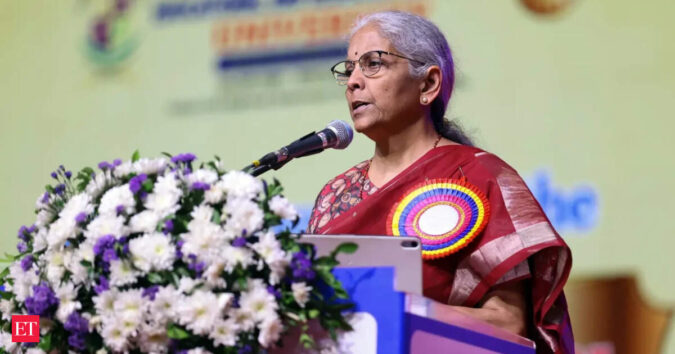
Addressing the International Tax Research and Analysis Foundation’s (ITRAF) 8th International Tax Conference in Bengaluru, Sitharaman said the government’s tax reforms were aimed at making compliance easier, reducing litigation and improving the efficiency of tax administration.
Also read: FM Sitharamran says AI researcher’s resignation raises questions over safeguards
She urged tax professionals, industry representatives and policy researchers to move beyond requests for exemptions and lower tax rates, and instead present workable, quantified proposals that can strengthen India’s economic framework and support the journey towards Viksit Bharat 2047.
“The philosophy is simple: make voluntary compliance easier and reserve enforcement capacity for cases that genuinely require it. We have aimed at reducing tax litigation rather than merely managing it,” Sitharaman said.
Tax reforms aimed at reducing disputes
The Finance Minister said the Centre’s approach to tax reform had focused on resolving disputes at their source rather than simply clearing pending cases.
She cited the Vivad se Vishwas schemes, which allowed taxpayers and the government to settle longstanding disputes, and the increase in 2024 of the monetary thresholds for departmental appeals. The limits were raised to Rs 60 lakh before the appellate tribunal, Rs 2 crore before high courts and Rs 5 crore before the Supreme Court.Sitharaman also pointed to the reduction of the corporate tax rate to 22% in 2019 and the rationalisation of individual income tax rates in 2025, under which an individual with an income of Rs 12 lakh pays no income tax.
The replacement of the Income Tax Act, 1961, with a shorter, plain-language code drafted in six months was another major reform, she said. The new code was prepared without changing the overall tax burden.
The consolidation of the Goods and Services Tax into essentially two primary rates in 2025 was also aimed at reducing litigation, Sitharaman said, as it curtailed disputes over the classification of goods and services.
She added that the government had rationalised tax deducted at source and tax collected at source provisions, while reducing unnecessary criminal consequences under tax laws.
Also read: India’s UPI MDR shake-up: What changes and why it matters
FM seeks evidence-based tax proposals
Sitharaman said pre-budget submissions from institutions often focused on demands for lower rates, exemptions or concessions. She called for representations that examine the wider consequences of proposed changes, including their impact on revenue, administration and other taxpayers.
“So, I wish to hear a submission that says, ‘here is a provision that no longer serves the tax system and ought to be removed even though we presently benefit from it’,” she said.
“If a provision is said to impose an excessive compliance burden, tell us how many taxpayers it affects, how much time or cost it imposes, and what an alternative would mean for revenue. If a change is proposed, show us not only who gains from it but also its consequences for the tax base itself, administration and other taxpayers,” she added.
The Finance Minister also asked tax professionals to identify potential unintended consequences of proposed reforms and put the broader national interest ahead of sectoral considerations.
On international taxation, Sitharaman recalled India’s renegotiation of tax treaties with Mauritius, Singapore and Cyprus to restore its right to tax capital gains at source. She also cited the implementation of General Anti-Avoidance Rules, the Multilateral Instrument and the expansion of the Advance Pricing Agreement programme, alongside new safe harbour provisions.
Sitharaman urged ITRAF to move from quiet commentary to visible, independent research that could contribute to public policy discussions. She referred to institutions such as the UK’s Institute for Fiscal Studies and the Netherlands-based IBFD as examples of research bodies that examine policy choices in depth.
Independent tax research, she said, should become part of public discourse and help inform the choices shaping India’s economic future.
(With inputs from agencies)