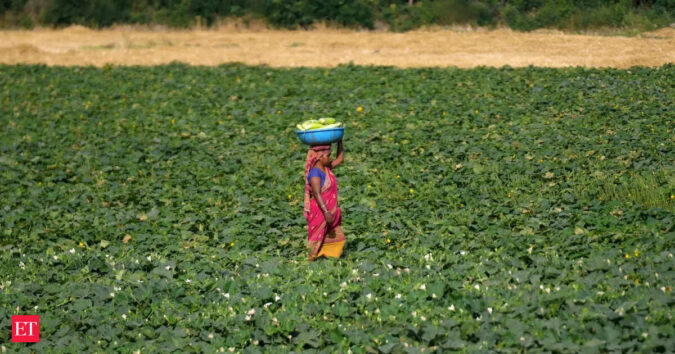
According to the report, while agriculture remains the country’s single largest employer, its grip on the workforce has weakened steadily over the past few decades. The share of workers dependent on farming and allied activities has dropped from 66% in 1987-88 to 43% in 2023-24, reflecting the long-term transformation underway in the economy.
The transition is in line with a broader changes in India’s growth trajectory, where industrial activity, infrastructure creation, digital services and manufacturing incentives are beginning to alter the composition of employment.
Economists, however, point out that the pace of change remains gradual compared with other large Asian economies that industrialised more rapidly.
Also read | Asia heat waves spell double trouble for economies hit by oil
Despite the decline, the study underlines that agriculture still absorbs nearly half of India’s workforce, highlighting the sector’s continuing role as a safety net, particularly in rural regions. The persistence of high dependence on agriculture also points to the challenge of generating sufficient non-farm jobs at scale.
The findings come at a time when policymakers are increasingly focusing on employment generation alongside economic growth. Recent Economic Times reports have highlighted concerns over the quality of jobs being created, the dominance of informal employment and the need for stronger labour-intensive manufacturing to absorb India’s expanding workforce.According to the SBI Research analysis, employment generation in larger enterprises has improved in recent years, aided partly by policy initiatives aimed at strengthening domestic manufacturing. Firms employing more than 20 workers now account for 13.7% of the workforce, up from 10.8% in 2024.
The increase coincides with the Centre’s continued emphasis on schemes such as the Production Linked Incentive (PLI) programme, which seeks to encourage domestic manufacturing across sectors including electronics, pharmaceuticals, automobiles, textiles and renewable energy equipment.
The report suggests that these initiatives are beginning to create opportunities in organised manufacturing, though the gains remain uneven across industries. Sectors such as electronics assembly and automotive manufacturing have witnessed stronger formal job creation, while labour-intensive segments including apparel, footwear and furniture continue to remain fragmented and dominated by smaller enterprises.
India’s labour ecosystem, according to the report, continues to be overwhelmingly informal. Non-agricultural enterprises employing fewer than 19 workers still account for more than 42% of total employment, underscoring the dominance of small businesses and household enterprises.
This fragmentation has long been identified as one of the key barriers to productivity growth and large-scale employment generation. Small firms often face constraints in accessing formal credit, technology, skilled labour and export markets, limiting their ability to expand operations and hire more workers.
Also read | MSME min scheme created 36 L jobs during FY22-26
The SBI Research study argues that India needs policy interventions that can channel higher levels of investment into employment-intensive sectors. Economists have repeatedly argued that while capital-intensive industries contribute to output growth, labour-intensive manufacturing is critical for absorbing millions entering the labour force every year.
The PLFS-based findings also shed light on labour force participation trends. The labour force participation rate (LFPR) for individuals aged 15 years and above stood at 59.3% in 2025. Male participation remained significantly higher at 79.1%, while female participation was recorded at 40%.
The improvement in female participation over recent years has been viewed positively by policymakers, although analysts caution that a large proportion of women remain engaged in informal or unpaid work, particularly in rural areas. Greater female workforce participation is considered essential for sustaining long-term economic growth and boosting household incomes.
Recent government data, cited in various ET reports, have shown that rising self-employment and rural work participation have contributed to improving headline labour indicators. However, experts continue to debate whether the increase reflects stronger employment opportunities or economic compulsions that push workers into low-paying informal activities.
Regional disparities in employment conditions also remain pronounced. According to the SBI Research report, states such as Gujarat, Madhya Pradesh, Karnataka and Chhattisgarh have recorded relatively lower unemployment levels, suggesting stronger labour market absorption and industrial activity.
These states have benefited from a mix of manufacturing growth, infrastructure investment, mining activity and expanding services sectors. Gujarat and Karnataka, in particular, have emerged as major investment destinations in sectors such as electronics, semiconductors, renewable energy and technology services.
On the other hand, several states continue to struggle with limited industrial diversification and weaker private investment, resulting in slower employment generation outside agriculture.
Informal employment remains another defining feature of India’s labour market. Agriculture continues to account for nearly 42% of the country’s informal workforce, reinforcing the dependence of millions on seasonal and low-productivity work.
The persistence of informality has broader implications for income security, social protection and productivity. Workers in informal jobs often lack access to written contracts, health insurance, retirement benefits and stable wages. Policymakers have increasingly sought to address these gaps through social security schemes, digital labour databases and skilling initiatives.
The report’s findings are based on PLFS 2025 data collected from more than 2.7 lakh households and covering nearly 11.48 lakh individuals across rural and urban India, making it one of the most comprehensive snapshots of the country’s employment landscape.
India’s labour market transformation is taking place alongside rapid changes in technology, global supply chains and consumption patterns. The rise of digital platforms, logistics networks, e-commerce and gig work is reshaping employment opportunities, particularly in urban centres.
At the same time, automation and artificial intelligence are expected to alter the future nature of work, placing greater emphasis on reskilling and workforce adaptability. ET had previously reported that companies across sectors are increasingly prioritising digital and technical skills even for entry-level hiring.
The broader challenge for India lies in ensuring that economic growth translates into sufficient high-quality employment opportunities. While headline indicators point to gradual progress, economists say the next phase of reforms must focus on scaling up labour-intensive industries, improving workforce skills and supporting enterprise growth.