Also Read: Plan afoot to create index for unincorporated enterprises
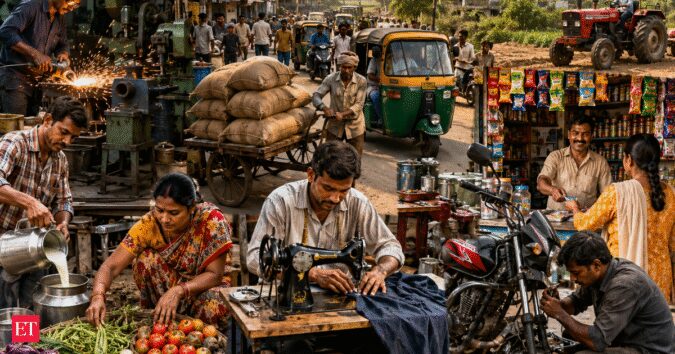
The proposal may appear technical, but it has the potential to reshape everything from monetary policy, GDP estimates and government planning to corporate decisions and equity investment by bringing into view a part of the economy that has long remained statistically underrepresented. The informal sector employs roughly 80% of India’s workers while contributing a little less than 50% to productivity. Yet it remains a blindspot for lack of tracking.
The informal economy is far larger than many think
When people hear the term “informal economy”, they often think of unregistered roadside vendors or tiny family businesses. In reality, the sector is much broader. MoSPI defines unincorporated enterprises as non-agricultural establishments that are not registered under the Companies Act. These include kirana stores, neighbourhood retailers, restaurants, transport operators, repair shops, small manufacturers, beauty salons, home-based businesses, traders, workshops and countless service providers. Many may be registered under GST or Udyam and comply with local regulations, but they are still classified as unincorporated because they are not companies.

The sheer scale of this ecosystem explains why it matters. According to MoSPI’s Annual Survey of Unincorporated Sector Enterprises (ASUSE) 2024-25, India had 79.2 million unincorporated establishments in 2025, up from 73.4 million in 2023-24. Employment in these enterprises increased from 120.6 million to 128.1 million during the same period. More recent quarterly estimates released by MoSPI show that the number of unregistered enterprises reached 91.7 million in the March quarter of FY26, employing 151.7 million people. No other segment of the Indian economy comes close to employing so many people.
Why India needs another economic index
India already has a rich set of high-frequency indicators. The Index of Industrial Production captures factory output. Consumer Price Index measures inflation. GST collections reflect formal business activity. PMI surveys provide early signals on manufacturing and services. Listed companies publish quarterly financial results. The problem is that almost all these indicators disproportionately reflect the organised or formal economy. If millions of small retailers, transporters or workshops experience a slowdown, policymakers may not know until annual surveys become available. As a result, official estimates often rely on indirect proxies to infer how the informal economy is performing.The proposed index seeks to close precisely this information gap by providing a regular reading of economic activity in India’s largest but least frequently measured business segment.

Impact on inflation management
Inflation is ultimately driven by demand and supply. But policymakers often struggle to judge whether inflation is accompanied by strong underlying demand or whether consumers are already cutting spending. Suppose food inflation remains elevated because of poor monsoons while the proposed index simultaneously shows that informal retail sales and small manufacturing activity are weakening. That would indicate that demand is soft even though prices remain high. The Reserve Bank of India (RBI) may then avoid tightening monetary policy too aggressively because raising interest rates would further weaken already fragile demand.
The opposite situation is equally important. If inflation is rising alongside strong growth across unincorporated businesses, policymakers would have greater confidence that demand remains robust and inflationary pressures are becoming broad-based. The index would improve the diagnosis rather than simply the inflation numbers.
Impact on RBI’s interest-rate decisions
One of the biggest beneficiaries of the index could be monetary policy. Today, the RBI relies heavily on indicators such as industrial production, bank credit, GST collections and corporate earnings to judge economic momentum. But these indicators sometimes paint an incomplete picture.
Large listed companies may continue reporting healthy profits because they have stronger balance sheets and pricing power. At the same time, neighbourhood retailers, transport operators or small manufacturers may already be experiencing falling orders. Without direct evidence from the informal economy, the RBI risks either overestimating or underestimating overall economic strength.
A high-frequency informal sector index would reduce this blind spot. If the index begins showing broad-based weakness among small businesses, the RBI could consider supporting growth through lower interest rates or a more accommodative policy stance. Conversely, if informal businesses are expanding rapidly despite higher borrowing costs, policymakers would know that economic momentum remains resilient.
A better early warning system for jobs
Employment losses rarely begin inside India’s largest corporations. They usually begin with smaller enterprises. A small workshop facing lower demand may first reduce overtime, then stop hiring and eventually let workers go. Thousands of such decisions across the country can significantly affect household incomes before the slowdown becomes visible in official employment statistics. Since unincorporated enterprises employ more than 150 million people according to the latest quarterly estimates, tracking their health regularly would provide policymakers with one of the earliest signals of labour market stress. This could allow governments to expand skilling programmes, accelerate infrastructure spending or strengthen employment support measures before unemployment rises sharply.
Impact on GDP estimates
India’s GDP already includes output generated by the informal sector. The challenge is measurement. Because detailed high-frequency data are unavailable, statisticians often estimate informal sector performance using organised sector indicators as proxies. That assumption does not always hold. For example, formal manufacturing may grow because large exporters perform well while thousands of domestic micro-enterprises struggle with weak local demand. A dedicated index would reduce the need for such extrapolations by providing direct evidence on how unincorporated businesses are actually performing. This would improve quarterly GDP estimates and enhance confidence in India’s national accounts among investors and global institutions.
Impact on corporates
The index would not only help governments. It could become an important business planning tool. Several sectors derive a significant share of their sales from households whose incomes depend on the informal economy. For FMCG companies such as Hindustan Unilever, ITC, Dabur, Britannia and Godrej Consumer Products, stronger informal business activity often translates into higher spending on packaged foods, personal care products and household essentials.
Tractor manufacturers including Mahindra & Mahindra and Escorts Kubota closely track rural incomes because demand for tractors depends heavily on farm incomes and non-farm rural earnings. A slowdown in rural transport, trading or small manufacturing often affects tractor purchases as well. Two-wheeler makers such as Hero MotoCorp and TVS Motor frequently cite rural demand as a key growth driver. Small retailers and self-employed workers also form a large customer base for entry-level motorcycles and scooters. Paint companies, cement manufacturers and building material producers benefit when informal businesses generate higher incomes that support home construction and renovation. Banks and NBFCs lending to MSMEs would also gain an additional indicator for assessing credit risks across sectors and regions.
Today these companies rely on fragmented indicators such as rural wage growth, monsoon forecasts, dealer feedback and management commentary. The proposed index could provide a nationally comparable measure of informal economic activity.
Impact on government spending
Governments often announce broad stimulus packages because they lack timely information on where economic weakness is emerging. Suppose the index reveals that transport operators are facing stress because of fuel prices while neighbourhood retail remains healthy. The government could then target credit support or tax relief towards transport operators instead of extending assistance across multiple sectors. Likewise, if the index identifies sustained weakness among textile clusters while engineering MSMEs continue growing, support measures can be directed where they are most needed. That improves the efficiency of public expenditure and reduces policy leakages.
Better forecasts for tax collections
Although much of the informal economy lies outside the corporate sector, it increasingly interacts with the formal economy through GST registrations, digital payments and supply chains. If the index begins showing persistent weakness among small retailers and manufacturers, the Finance Ministry may anticipate slower GST growth in subsequent months and revise revenue projections earlier. Similarly, stronger readings could signal improving consumption and healthier tax collections. That makes budget management more predictable.
Impact on investors
Domestic as well as foreign investors often face a peculiar challenge in India. Corporate earnings may be growing rapidly while millions of smaller businesses remain under pressure. Or the reverse may happen. A dedicated index would help investors judge whether economic growth is broad-based or concentrated among a handful of large firms. This would improve macroeconomic forecasting, equity research and long-term investment decisions. Rating agencies and multilateral institutions would also gain a better understanding of India’s domestic demand conditions.
Part of a larger data rejig
The proposed index fits into a broader effort by MoSPI to modernise India’s economic statistics. The ministry replaced the older unorganised enterprise surveys with ASUSE to generate more regular information on informal businesses. It has also begun publishing quarterly bulletins on unincorporated enterprises instead of relying only on annual surveys. Administrative databases such as GST, Udyam registrations, EPFO payrolls and digital payment data are increasingly being used to strengthen official statistics. The government is also set to launch the Index of Service Production with FY25 as the base year, adding another important high-frequency indicator for an economy where services account for more than half of gross value added.
The revised GDP series, which shifts the base year from 2011-12 to 2022-23, also overhauls how the informal and unincorporated sectors are measured. It replaces outdated proxies with granular data from the (ASUSE) and Periodic Labour Force Surveys (PLFS). All these initiatives represent an attempt to reduce India’s dependence on indirect proxies and improve the timeliness of economic measurement. An index of the informal economy will be a big data blindspot at the heart of India’s economy.