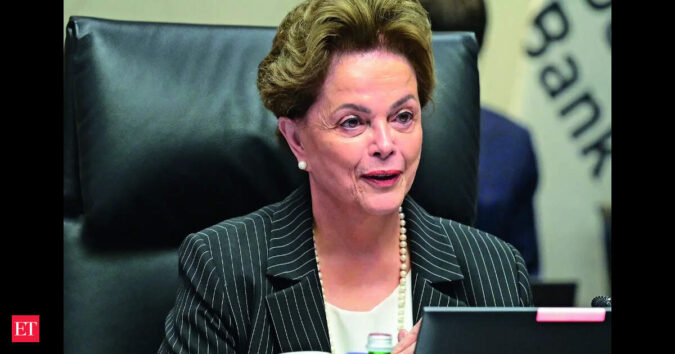
The proposed support includes $5 billion in sovereign lending and a planned $2.5 billion-equivalent rupee bond programme, NDB president Dilma Rousseff told ET. Rousseff is in the country for the BRICS finance ministers and central bank governors’ meeting under India’s presidency of the grouping.
NDB is a multilateral development bank established by Brazil, Russia, India, China and South Africa (BRICS) in 2015 to fund development in emerging markets and developing countries (EMDCs). The bank is preparing its General Strategy for 2027-2031, which will set out its lending priorities and country allocations. The planned rupee bond programme is aimed at deepening India’s domestic capital markets while allowing the NDB to finance projects in local currency and reduce exchange-rate risks for borrowers, Rousseff said.
“Local currency financing is an important part of this multipolar framework because it addresses one of the major vulnerabilities faced by emerging markets and developing economies, which is exchange-rate risk,” she added. The approach does not amount to a push to displace the US dollar, she said, rejecting the idea that greater use of local currencies necessarily means “de-dollarisation.”
“NDB does not pursue a policy of de-dollarisation, nor do we promote local currencies as an alternative to the US dollar,” Rousseff clarified, adding that the bank is seeking a more diversified and interconnected international financial architecture that provides countries with more financing options.
NDB is expanding the use of member currencies on both sides of its balance sheet, raising resources in domestic capital markets and deploying them for development financing in those currencies, she said. Greater monetary diversification can reduce exchange-rate exposure, mitigate currency mismatches and help deepen domestic capital markets, while giving emerging economies more flexibility to respond to external shocks, she said.
Rousseff said India’s development trajectory creates significant opportunities for NDB financing, particularly in transport, water security, clean energy and digital infrastructure. The bank intends to deepen its engagement with India’s private sector through financial institutions, infrastructure platforms and companies driving the country’s transition toward a more sustainable and connected economy, she added.Global challenges
The global economy is experiencing a cumulative process of instability that has been building for many years and is imposing extraordinary challenges on emerging markets and developing countries, the NDB chief said.
“We are therefore witnessing a situation in which countries that have pursued sound economic policies and achieved consistent economic performance over many years can be severely affected by external shocks that have little or nothing to do with their domestic policy choices,” she said, raising concerns over the recent developments and their implications for the global economy.
“We have seen attempts to reverse globalisation, the fragmentation of global value chains, technological blockades, the weaponisation of currencies and the increasing use of unilateral sanctions. More recently, tariff wars have emerged as an instrument to redefine trade relations,” Rousseff said. “All these factors are undermining the predictability and cooperation on which international trade, investment and development depend.”
She urged emerging markets and developing countries to strengthen their resilience, pointing out that technology and innovation are essential to this effort.
To reverse the fragmentation driven by geopolitical conflict and the weaponisation of economic and financial tools, these countries must in turn deepen cooperation, anchored in a coherent and purposeful multilateralism, Rousseff said. “The structural objective must be sustained, inclusive and long-term development, which requires peace and stability.”