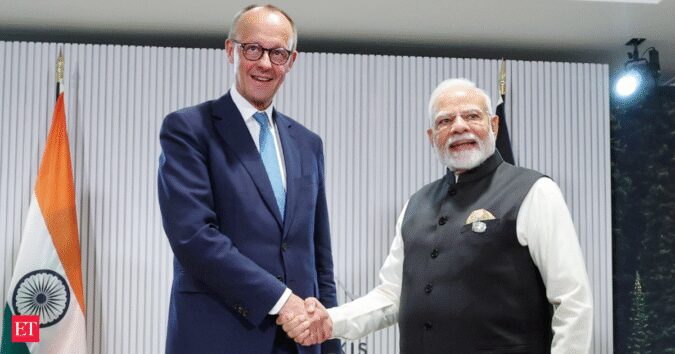
The agreement was one of the key outcomes of engagements between Prime Minister Narendra Modi and German Federal Chancellor Friedrich Merz during the latter’s official visit to India from January 12 to 13, the government said in a press release on Friday.
The JDI was signed by Telecom Secretary Amit Agrawal on behalf of India and German Ambassador to India Philipp Ackermann on behalf of the Federal Republic of Germany. It was concluded between the Department of Telecommunications (DoT) and Germany’s Federal Ministry for Digital Transformation and Government Modernisation.
According to Centre, the declaration reflects a shared intent to deepen bilateral cooperation in telecommunications and ICTs, building on what it described as the “strong momentum in India-Germany relations and sustained high-level engagements”.
Under the pact, both sides have agreed to step up cooperation through regular exchanges of information and best practices, promote collaboration in emerging and future technologies, and pursue joint efforts in areas such as “policy and regulatory frameworks, manufacturing, and facilitation of ease of doing business in the telecommunications and ICT sectors”.
The declaration establishes a framework for regular consultations and high-level annual meetings, supported by dedicated working groups and multi-stakeholder engagement involving government, industry, academia and research institutions. These mechanisms, the release said, are intended to ensure “structured, outcome-oriented cooperation”.
Both countries have also expressed their intention to jointly develop a work plan outlining specific goals and areas of mutual interest, ensuring alignment with national priorities. In addition, India and Germany said they would “work together closely in international fora to promote common understanding” and advance shared perspectives on telecommunications and digital development.The government said the signing of the JDI marks an important step in advancing India–Germany cooperation in telecom and ICTs and supports the shared objective of “inclusive and sustainable digital transformation”, at a time when both countries are looking to strengthen innovation-driven and resilient digital ecosystems.