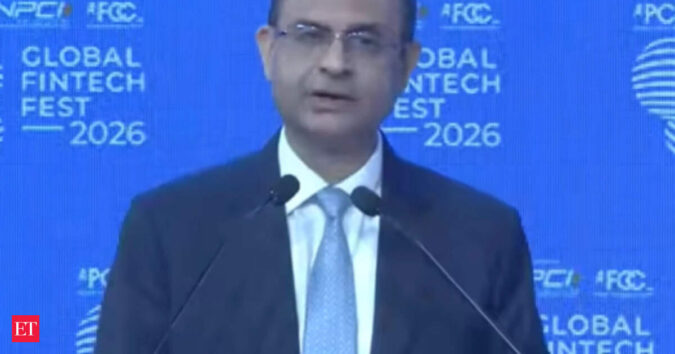
Malhotra said the GFF had evolved over the years from an industry forum into an important policy platform. RBI recognises the United FinTech Forum as the second fintech SRO, he said.
The Governor pointed out that the theme of this year’s festival placed financial inclusion, trust and global aspirations at the centre of discussions around building connected and trusted global systems for inclusive finance.
He said fintech’s potential could translate into meaningful impact only when innovation reached people who were not already well served by the financial system. At the same time, such innovation needed to remain firmly anchored in trust, he added.
The governor said the global dimension of fintech had become particularly relevant as India was now in a position to expand its ambitions.
Also read | Nandan Nilekani says millions of small firms can AI-proof jobs
He outlined four broad themes for his address — the potential of fintech as an essential partner in delivering the desired impact, the importance of trust in realising that potential, the scope for a stronger global vision, and the role of the Reserve Bank of India in supporting the fintech sector.Malhotra said the financial system had travelled a considerable distance over the past decade. Several developments that were once viewed largely as possibilities and aspirations had now become part of everyday financial life for thousands of millions of Indians.
The transformation, he observed, demonstrated how technological potential could become tangible impact when innovation was supported by inclusion and trust.
The governor’s remarks come as India’s fintech ecosystem continues to play a growing role in expanding access to financial services and connecting users with digital financial systems.
He said the next phase would require the sector to build on its existing capabilities while ensuring that innovation remained inclusive, trusted and capable of creating impact at a global scale.
The scale of this change is reflected in the reach of India’s financial inclusion programmes and the rapid adoption of digital payments, Malhotra said.
India’s fintech success story
There are now 57 crore Pradhan Mantri Jan Dhan Yojana accounts and over 20-85 crore microinsurance policies; the Pradhan Mantri Jeevan Jyoti Bima Yojana has 27 crore accounts, while the Pradhan Mantri Suraksha Bima Yojana has about 59 crore; more than 9 crore people are covered under the Atal Pension Yojana, while about 60 crore beneficiaries are covered under the PM Jan Arogya Yojana, he noted.
Digital payments have expanded at a remarkable pace, he said, highlighting that there were 280 billion annual transactions last year, while UPI recorded about 24 billion transactions a month, equivalent to around 80 crore transactions a day.
These figures point to one of the fastest shifts in financial behaviour witnessed anywhere in the world, he said. Yet, the more significant achievement is the way digital finance has moved from being an innovation to becoming an everyday utility for ordinary people, he added.
A street vendor or florist accepting payments through a QR code has become an unremarkable sight, the RBI Guv said, adding that such simple transactions underline the depth of financial inclusion achieved in India within a few years.
Malhotra said this transformation could not be attributed to technology, entrepreneurs, the government or the regulator alone. It was the result of a public-private partnership that enabled entrepreneurship and innovation while preserving public confidence and trust, he observed.
A lot of ground still to cover
However, he said the sector still had considerable ground to cover. Making financial services ubiquitous and ensuring the financial well-being of every citizen should remain among fintech’s most important objectives.
According to Mahotra, the challenge is particularly significant in serving the informal economy, through microinsurance, small pensions and small-ticket credit, as well as providing finance to women entrepreneurs, MSMEs and small and marginal farmers in villages and tier three and tier four towns. Traditional financial institutions often struggle to serve these segments economically.
Modern underwriting and credit assessment tools have made such lending commercially viable in ways that were difficult to imagine a generation ago. Yet, fintech activity remains heavily concentrated among customers who are already banked, digitally literate and visible to credit bureaus, he said.
The Governor urged the industry to keep the last person outside the financial system at the centre of innovation.
He also identified consumer service, meeting unmet credit and other financial needs, improving operational efficiency, cutting costs for financial intermediaries and reducing fraud as areas where AI could play a role. Fintech can use technologies such as quantum computing, AI and tokenisation to advance these objectives.
He cautioned, however, that these technologies should be treated as means rather than ends. Their value would ultimately depend on the broader purposes they serve and the impact they create.
Trust, he said, would be equally critical. It is built gradually through every transaction but can disappear within minutes after a single damaging episode.
Foundation of fintech success
While financial instruments and institutions have changed over centuries, trust has remained the foundation of finance. Malhotra cited the example of hundis, which enabled Indian merchants to conduct trade across long distances because communities trusted the reputation of merchants and the promises embodied in these instruments.
The same principle applies to modern finance. Money may now move within milliseconds, algorithms may support decisions and AI may reshape financial systems, but technology without trust will struggle to gain lasting acceptance.
For fintech firms, Malhotra highlighted the need to address risks linked to AI, including opacity, bias, exclusion, concentration, herding, cybersecurity, data privacy and security, and the erosion of human judgment.
He also urged fintech companies to treat data as a fiduciary responsibility rather than merely a business asset. Consumer financial and non-financial data should be collected for clearly defined purposes, used only with consent and protected appropriately.
The account aggregator framework, he said, was designed around this principle through consent-based and purpose-limited data sharing, while preventing any single entity, including the aggregator, from seeing or exploiting the underlying data.
As fintech firms grow, their responsibility must also expand. Operational resilience, business continuity and cybersecurity should not be viewed simply as costs. They are essential responsibilities for firms whose scale can affect the wider financial system.
Malhotra also cautioned firms against building businesses around regulatory gaps and seeking clarity only after scaling. The RBI’s sandbox and pilot mechanisms allow innovators to engage early, test their assumptions under supervision and help develop rules that support genuine innovation.
A transparent approach, he said, can provide fintech firms with a faster and more durable route to scale, while attempts to stay ahead of regulation could ultimately impose a much higher cost on both companies and consumer trust.