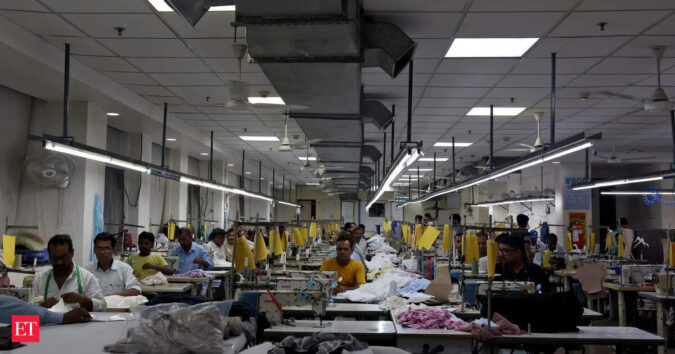
The gains, however, will take time to show up. Orders for the first two quarters of FY27 were already booked when tariffs were at their peak, and the improvement in revenue will only become visible from the third quarter starting October, industry executives and analysts said.
Also Read: Govt reduces jute stock limits to zero
The labour-intensive sector was one of the most affected when the Trump administration in the US increased tariffs on India to 50% in August. The tariffs currently are 10%, after US courts found country-specific tariffs illegal.
“The negative overhang on India from US customers has levelled off. More business has started looking at India more favourably, but all these things happen with a time lag,” said Gokaldas Exports chief executive Sivaramakrishnan Ganapathi. “When the tariff was 50%, we had already booked orders for the first quarter and second quarter of FY27,” he told ET.
The US accounts for nearly 70% of the exports for the Bengaluru-based supplier to retailers like Walmart.
The high tariffs had hurt the competitiveness of Indian products in the US market against supplies from countries like Bangladesh. That forced exporters to share the burden with buyers. Gokaldas absorbed up to 15% though price concessions, while Kitex Garments offered around 5%, squeezing margins that are now expected to recover as new orders come in at better prices.Also Read: India must make garments for all seasons: Giriraj Singh
Kitex Garments managing director Sabu M Jacob said the shift is already underway. “Whatever was diverted to Vietnam, Cambodia and Bangladesh has all come back to normal now,” he said. Orders being negotiated today, he added, will only go into execution from mid-September onwards, reflecting in third- and fourth-quarter revenues.
“Revenues of apparel exporters are expected to increase by 8-11% in FY2027, and margins are likely to recover by approximately 200 basis points (2 percentage points) year-on-year,” said K Srikumar, senior vice-president at ratings firm ICRA. He said a potential escalation in the West Asia conflict and non-extension of export incentives could weigh on the outlook.
The incentive scheme he was referring to was RoSCTL (Rebate of State and Central Levies and Taxes), which refunds exporters for taxes and levies paid during production. This scheme for apparel and ready-to-use garments is currently scheduled to end on September 30.
Exporters say uncertainty around its extension makes long-term planning difficult.
“The export incentive, these kinds of things you need to plan for longer. Any government support cannot be for six months. We already have booking beyond September. What happens in October. We need a little longer clarity on these things,” said Ganapathi.
Market shift
The tariff scare has accelerated a strategic rethink for exporters who had grown heavily reliant on one market.
Kerala-based Kitex, which ran near-total US dependence until last year, is now actively building its European and domestic business.
“We will bring down (the US share) from 100% to 30-35%, one-third to America, one-third to Europe and the UK, and one-third to the domestic market in the next two to three years,” said Jacob.
Gokaldas, too, is looking at Europe with fresh eyes, though meaningful volumes will only follow once trade agreements are in place. “United Kingdom business will not step up significantly until the free trade agreement kicks in,” said Ganapathi. “With the European Union and UK FTAs coming in, we may also see a little bit of pro-India sentiment in the European market,” he added.
The India-UK FTA, signed in July last year, will come into force from May, commerce secretary Rajesh Agrawal said last week. The India-EU FTA, concluded on January 27 this year, is currently in its final phase before implementation.
The structural challenge with Europe, however, is its fragmentation. “For the same revenue, I need two-three European customers as opposed to one US customer,” said Ganapathi. “But if there’s duty-free access to Europe, then Europe becomes attractive.”
Africa is also emerging as a growth avenue for Gokaldas, which operates five factories on the continent and expects the region to post 20% growth by FY27.
Cost pressures
Even as order flows improve, exporters are grappling with a surge in input costs stemming from the ongoing West Asia conflict.
Rising oil prices have pushed up the cost of polybags, dyes and chemicals by 20-25%. “That’s only temporary; it will be managed with the dollar price since the rupee has weakened,” said Jacob.
Production lines dependent on petroleum products such as LPG have also been affected, with costs rising and availability tightening.
“There are some production processes which require petroleum products, like LPG, oil, etc. Our costs are going up and availability is going down, so those lines are slowing down in production,” said Ganapathi.
Some lines are being switched to electric power, replacing gas-fired ovens with electric ones, with a few already operational, he said.