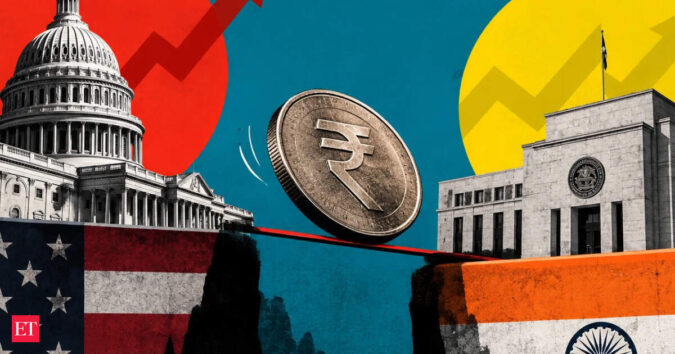
The rupee breached the 96-per-dollar mark on Thursday, trading around 96.03 after closing at 95.95 in the previous session, as the Fed’s first rate increase since 2023 strengthened the dollar and signalled that more tightening could follow.
Also Read: Explained: What US Fed’s first 25 bps rate hike in 3 years means for Indian stock market
As for the RBI, Emkay Global Financial Services sees a 25-basis-point increase in the repo rate in October as increasingly likely amid higher energy prices, firm domestic growth and inflation pressures.
HDFC Bank also expects calls for an RBI rate hike to strengthen following the Fed’s move, but believes the Indian central bank could wait until December to assess whether inflation pressures become broader and more persistent.
The divergence leaves India facing a familiar global monetary-policy dilemma: a hawkish Fed can put pressure on the rupee and capital flows, but the RBI must ultimately balance those external pressures against domestic inflation and growth.
“A 25bp hike in Oct-26 by the RBI looks more likely, but we also expect this to be a shallow hiking cycle (50-75bps) and will await more clarity at the Oct-26 review,” Emkay said.HDFC Bank takes a more patient view.
“While it remains a close call, we lean more towards the RBI delaying its rate hike decision to the December policy,” the bank said.
Why the Fed matters for India
The latest pressure comes after the Federal Open Market Committee unanimously raised the federal funds rate by 25 basis points to 3.75%-4.00% following its September 15-16 meeting, its first increase since 2023.
The decision itself was unanimous, with the FOMC voting 12-0 for the increase. The Fed said inflation remained elevated and that the move would support a “timelier return” to its 2% inflation goal.
More importantly for global markets, the Fed does not appear to be signalling that September was a one-off.
Also Read: Trump calls Fed board ‘very political’ and ‘doing the wrong thing’ after first rate hike in 3 years
Its latest projections show a median federal funds rate of 4.1% at the end of 2026, up from the 3.8% projected in June. That implies another 25-basis-point increase from the new 3.75%-4.00% range.
Economists broadly agree that the Fed may have more work to do, although they differ over how far rates ultimately need to rise.
Emkay expects another 25-basis-point increase in December. DBS Chief Economist Taimur Baig sees one more hike this year followed by another in early 2027, taking the policy rate to 4.5%. HDFC Bank believes the risks are tilted towards even more tightening than currently estimated if geopolitical tensions and inflation pressures persist.
“We will pencil in one more rate hike this year and one more early next year, taking the terminal rate of this short cycle to 4.5%,” Baig said.
Markets are moving faster. Futures imply roughly a 50% probability of another Fed increase as early as October, while three hikes in total are being priced into the current tightening cycle.
Rupee feels the immediate heat
For India, the currency market is where the consequences have become visible first.
Also Read: Hawkish Fed lifts dollar to 7-week high as focus turn to BOJ
The Fed hike pushed the dollar index above 100 to its highest level in more than a month, adding pressure on Asian currencies. The rupee, already weighed down by elevated crude oil prices and foreign portfolio outflows, subsequently weakened through the psychologically important 96-per-dollar level.
The RBI has been intervening in the foreign-exchange market to limit sharp moves in the currency. Potential flows associated with the NSE IPO could also offer support, while any sustained moderation in crude prices would ease some pressure.
But oil remains a major vulnerability for India. Brent crude has remained above $100 a barrel amid the conflict in West Asia, increasing concerns around the import bill and domestic inflation.
Before Thursday’s move, HDFC Bank had projected a near-term USD/INR range of 95.50-96.50 and said the currency could briefly move above 96.
Inflation brings rate hikes back
Behind the Fed’s shift is an inflation problem that has proved more persistent than policymakers expected.
Higher energy prices, tariffs and strong investment associated with the artificial intelligence boom have added to price pressures, leaving inflation well above the central bank’s 2% target.
“While inflation may be largely supply-side driven, there are enough risks to the inflation outlook to warrant more action in the coming months,” Baig said.
DBS sees three forces at work: the AI build-out adding to demand, the oil shock constraining supply and tariffs contributing another policy-driven inflationary impulse.
The US economy has also remained resilient enough to give the Fed room to focus on inflation.
The central bank raised its 2026 real GDP growth projection to 2.3% from 2.2% in June and its 2027 estimate to 2.4% from 2.3%. The unemployment-rate forecast for 2026 was lowered to 4.1% from 4.3%.
Inflation projections, however, have moved higher.
Core PCE inflation is now expected at 3.4% in 2026, compared with 3.3% projected in June. It is expected to fall to 2.5% in 2027 and 2.2% in 2028 before reaching 2% in 2029.
“We see the risk tilted towards rate hikes being higher than what is currently estimated, especially if the West Asia conflict lingers on,” HDFC Bank said.
Emkay sees a hawkish shift
Emkay sees two particularly hawkish signals from the Fed meeting: the unanimous vote and the breadth of support among policymakers for further tightening.
The median Fed projection now puts the policy rate at 4.1% at the end of both 2026 and 2027, followed by 3.9% in 2028 and 3.6% in 2029. Its longer-run estimate has risen to 3.2%.
That represents a significant change from June, when the median projection pointed to a 3.8% rate at the end of 2026 and 3.6% in 2027.
“However, we feel the underlying driver of this shift toward hiking is growing evidence that current policy rates may not be restrictive enough to contain a cyclical upturn and its pass-through to inflation,” Emkay said.
There is nevertheless an important assumption underpinning the Fed’s outlook: inflation is expected to fall substantially next year despite stronger economic growth and lower unemployment.
Core PCE inflation is projected to decline from 3.4% in 2026 to 2.5% in 2027.
Emkay said this “immaculate disinflation path puts a lot of weight on the transitory supply-side elements of inflation fading.”
If oil prices and tariffs remain elevated, or AI-related investment generates broader demand and wage pressures, inflation could prove more persistent.
How far could the Fed go?
Emkay’s base case is for another 25-basis-point increase in December, while DBS expects the tightening cycle to continue into early 2027 and take rates to 4.5%.
That trajectory, however, is far from guaranteed.
“A large market selloff, a public debt crisis, an AI-related cataclysmic event, slippage in the labour market, or a major worsening of the geopolitical environment could force the Fed to shift its focus from inflation to economic stablisation,” Baig said.
Risks also run in the opposite direction. DBS said continued fiscal slippage and stronger wage and price pressures associated with the AI boom could leave markets unconvinced even with rates at 4.5%.
October or December for RBI?
That leaves the RBI with its own balancing act.
Emkay’s call for an October RBI rate hike is not driven by the Fed alone. Higher-than-expected core inflation in August, hawkish MPC minutes, elevated energy prices and strong GDP growth have also increased the case for a rate hike in India.
HDFC Bank, however, believes waiting until December would give policymakers more time to determine whether inflation pressures are predominantly supply-driven or are spreading more broadly through the economy. Core inflation excluding gold remained below 4% in August, it noted.
India’s 10-year government bond yield closed around 7.05% following the Fed decision, with HDFC Bank expecting a near-term range of 7.00%-7.20%.
The immediate pressure, however, remains on the currency.
The rupee’s move beyond 96 shows how quickly a change in Washington can spill into Indian markets. Whether that pressure ultimately pushes the RBI towards an October hike will depend on domestic inflation and growth as much as the Fed.
But with US policymakers signalling more tightening, oil still elevated and the dollar strengthening, the RBI now heads into its next policy meeting with another global risk to weigh.