Opening thoughts. WD, formerly Western Digital, has done something rather interesting. They’ve made the industry’s first post-quantum cryptography (PQC) hard drives. These derives, called Ultrastar UltraSMR, are meant for AI compute focused infrastructure. They integrate what WD says is NIST-approved quantum-resistant algorithms, the idea being to make the firmware and device level security features more robust for enterprises. The threat perception has mapped quantum-era risks of “harvest now, decrypt later” (HNDL) attacks, which this methodology aims to thwart.
Contrary to general opinion (usually of experts on social media) that solid state drives (SSDs) are the future of compute infrastructure storage, it is in fact the return of the good old hard drive technology that’s figuring prominently—cost being one, per GB, alongside reliability and longevity of data. HDDs last longer than SSDs. “ As AI data compounds and becomes more valuable and long-lived, securing it for the future is no longer optional. Quantum computing represents one of the most significant technology transitions of our time, and it is advancing faster than many organisations anticipate. The security architectures that have protected enterprise storage for more than a decade will need to evolve,” says Dr. Xiaodong (Carl) Che, Chief Technology Officer and Senior Vice President at WD.
EDITOR’S CORNER
THE SPAM BLOCKING CONUNDRUM
This needs a serious rethink, and it should be since it’s a draft still. The Telecom Regulatory Authority of India (TRAI) Draft Telecom Commercial Communications Customer Preference (TCCCPR) Third Amendment, 2026 suggests that India’s telecom regulator wants call management apps such as Truecaller from blocking or filtering calls from two commercial series—140 for promotional messages (more often than not, spam) and the 1600 series which is reserved for service and transactional messages including from banks and airlines. This simply means that millions of users who rely on apps such as Truecaller to particularly block the 140 series numbers (these, in my experience, are more often than not top-notch spam generators) won’t be able to do so. Instead, they’ll have to rely on TRAI’s enforcement system in conjunction with telecom operators.
“Regulation 34A prohibits any call management app including phone diallers to tag, block, filter, or restrict incoming calls or messages originating from the designated number series assigned for commercial communications such 140 series and 1600 series, as well as communication sent by the Government. However, as the primary aim of mandating the registered senders and telemarketers to use special series numbers for calling is to protect the customers from fraudulent calls and enabling them to easily identify the type of commercial communication as well as selectively allow or block promotional communications based on their preferences,” the TRAI proposal says.
While the 1600 series mandate is understandable, since banking institutions regulated by RBI, SEBI, and PFRDA are supposed to use this numbering series to communicate with customers, but the 140 series is as it is strictly allocated for promotional and telemarketing voice communications. Those ones where they want you to buy a property or being told of exciting shopping offers by a robot-like voice (Paytm does that often too, from experience).
Truecaller has shared data with HT to suggest these numbering series aren’t entirely welcome for many users. “Our data clearly proves that whitelisting designated number series to drive consumer engagement and reduce unwanted communication is having the opposite effect: less engagement from consumers and increased unwanted calls. We have observed over 4 Lakh 140-series and 1.25 Lakh 1600-series calls being blocked every single day. This totals to nearly 7.4 crore individual blocking actions on this series recorded since October 2025, showing that a large set of consumers do not want to receive these calls,” Rishit Jhunjhunwala, CEO of Truecaller tells HT in a note.
Contrast that reality with the whitelisting that TRAI’s draft proposal suggests, which prevents any user including Truecaller users, from adding or correcting caller name information for other users to benefit from, or report any of these calls as spam or scam attempts—this is an important safeguard that’s potentially being removed, at a time when unsuspecting users (particularly senior citizens) are being targeted with sophisticated scam attempts via phone calls and messages.
At this point, I’d simply like to point out TRAI’s CNAP, or Caller Name Presentation initiative. Launched in October last year with early pilots and broader compatibility across 4G and 5G networks in the months after, I still do not see any network generated CNAP for (rough estimation here) 6 out of every 10 calls. That miss rate is far too high, for a service that’s supposedly crossed the mandatory deadline this March. Perhaps, a better option would be choice for the consumer, and collaboration with apps and platforms that do the call filtering job better than any telecom service provider has been able to thus far.
TECH SPOTLIGHT
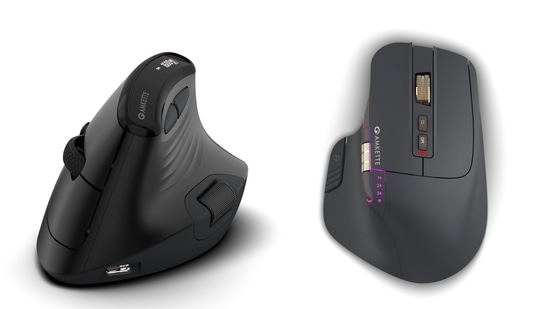
AMKETTE XS FLOW PLUS AND XS NATURAL PLUS
Mice as accessories aren’t always exciting, unless you’re paying top money for a gaming mouse. Indian tech company Amkette argues to change that reality. I’ve followed their fortunes for close to 20 years now, from an era of EVO TV media players, to more recently the EvoFox Game Box and EvoFox Deck. Constant is an undeniable intent to try something different. This time around, Amkette’s XS Flow Plus and XS Natural Plus wireless mice got my attention. Even more so because of the price tags— ₹2,299 and ₹2,199 respectively. A far cry in overall proposition from similar priced basic mouse options with HP or Dell branding selling dime a dozen on online shopping websites, inconsistent ones from the likes of Zebronics, and much more affordable than most options from Logitech.
Let’s talk first about the Amkette XS Natural Plus, even more so because of its unique contours. You’ll get used to this, and to be fair, that learning curve is a rather interesting passage of time—Amkette’s reasoning is it’s more attuned to a human hand’s natural form. You decide! A proper smart mouse this, with navigation buttons for forward and back depending on the app you are in at the time—I’d much prefer these to having to scroll over to the back button in the Chrome interface, for instance. The scrolling is almost as silent as the much more expensive Logi MX Master 3S, as are the right and left click keys. Just below the scroll wheel is the button for DPI, or dots per inch, cursory accuracy setting.
There is an OLED display on Amkette XS Natural Plus’ top view, which will display battery level, DPI settings (between 400 and 6400 levels) and active connection mode (this is relevant since it can connect to three devices with easy switching. I quite like the horizontal scroll wheels which falling easily to the thumb holding the mouse—this, on a Mac, can be configured to scroll between desktop windows too. There is a web-based software utility (bookmark this link, for your convenience) that can be accessed on Windows PCs as well as Mac computing devices, to configure finer settings, including button behaviour. I’d have preferred a slicker app.
The Amkette XS Flow Plus is a more conventional design mouse, but brilliant in its own right, particularly considering the price. At first, you may feel overwhelmed by the number of visible buttons on an XS Flow Plus, but the key is to approach it calmly. As you hold the mouse the way you’d do while using it, response quality from right and left click keys sounds very premium. As does the vertical scroll wheel, which generates a reassuring click-click sound you move it. This is where things begin to get serious, as Amkette makes it clear the XS Flow Plus has much more expensive mice in its sights.
Just where the thumb of your hand would be, is the horizontal scroll. As was with the XS Natural Plus, this can be configured for in-app behaviour. Further to its left, at the extended base area, is a key that is pre-configured for a one-click minimise of all open windows on the screen and return to a clean desktop. That said, the DPI keys, as well as device switch button could have done with a more recessed design to otherwise blend better into overall colour and contours. Also, the prominent device connection indicator needs to be subtle-er (also because very few people will actively keep switching between computing devices).
Wired Wisdom peels away the glitz for a closer look at Technology & AI, with the hope to critically analyse how it impacts you, the human. Want this newsletter delivered to your inbox. Subscribe here.