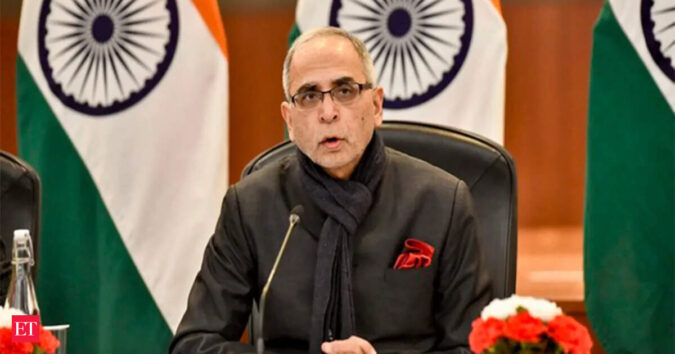
Addressing the USISPF Leadership Summit here, Kwatra said India has positioned itself as a preferred destination for companies seeking to diversify production and supply chains beyond traditional manufacturing hubs.
Also read: ‘It’s in last 1 or 2%’: US envoy Sergio Gor declares India-US trade pact nears finish line
He said India has stepped up investments in strategic sectors including semiconductors, electronics, artificial intelligence, clean energy and defence manufacturing, strengthening its role in global value chains.
Kwatra said that India, currently a USD 4.3 trillion economy, was on course to become a USD seven trillion economy by the end of the decade, around USD 14 trillion by the middle of the 2030s and between USD 25 trillion and USD 30 trillion by 2047.
He described India as an “indispensable anchor” of global economic growth and stability at a time of mounting geopolitical uncertainty and supply chain disruptions.
According to Kwatra, India’s economic transformation has placed it at the centre of the evolving global order, making it a trusted growth engine and strategic partner for both advanced and emerging economies.
“What that has meant domestically for us in India under the leadership of Prime Minister since 2014, has been a series of economically transformative measures on the ground, which have resulted in our consistently high growth of seven plus per cent, which is uniquely driven by domestic demand,” he said.
Kwatra said India’s economic rise is increasingly intertwined with global prosperity, making international partnerships more important than ever.
Referring to the government’s vision of Atmanirbhar Bharat, he said it is not an inward-looking policy but one aimed at creating globally competitive manufacturing and resilient supply chains.
“The prime minister has propounded… a mixture of self-reliance and self-sufficiency, but an ecosystem which has positive externalities, which is not insular in nature,” Kwatra said.