In an interview to ToI, Goenka said the moderation in global crude oil prices and improving economic conditions have helped sustain business momentum, even as some sectors continue to face profitability challenges.
Goenka said overall consumption trends remain healthy, with economic activity continuing to expand above earlier baseline levels. While higher input costs are expected to weigh on margins in parts of the manufacturing sector, he told ToI’s Sidhartha that the pressure is unlikely to be uniform across industries.
He pointed to automobiles, banking and telecommunications as sectors witnessing strong business activity, while the information technology industry continues to face a relatively weaker operating environment.
Also read | India-UK trade deal: Luxury cars get cheaper, but your Scotch will have to wait
Manufacturing companies, however, are expected to remain under pressure through the second quarter as inventories and cost-related issues continue to affect profitability.
On the external front, Goenka said India remains engaged in the final stages of discussions on tariff-related issues with the United States. Even if temporary tariff provisions expire, he expects other trade measures to continue imposing duties at comparable levels.According to him, India’s strategy is centred on maintaining its competitive edge while preserving access to its largest export destination.
He added that Indian exporters are simultaneously expanding into newer markets, supported by a growing network of bilateral trade agreements that are expected to reduce dependence on any single geography.
Also read | Modi pushes import-cut plan to shield India from global shocks
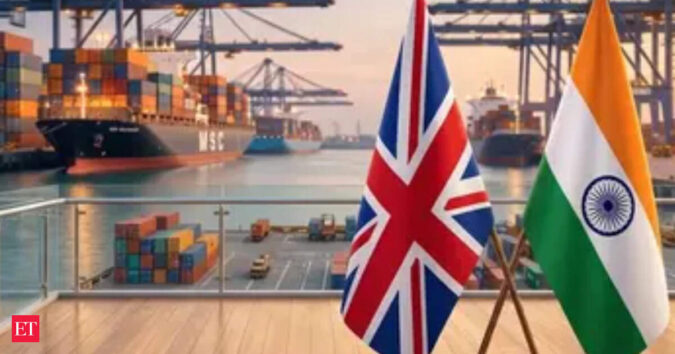
The recently implemented India-UK free trade agreement, along with similar pacts under negotiation, is expected to create significant export opportunities across sectors, Goenka said. He believes the agreements will encourage stronger business-to-business partnerships and deepen commercial engagement over time.
According to him, companies are unlikely to undertake fresh investments solely because of the signing of trade agreements. Instead, businesses typically expand production capacity once utilisation levels reach sustainable thresholds.
He said the immediate priority for industry is to strengthen customer relationships, improve product quality and position themselves to benefit from the market access created by these agreements.
Goenka noted that India’s share in the UK’s import basket remains modest, leaving considerable room for expansion in sectors such as textiles, footwear and several manufacturing segments.
He also described the UK agreement as broader than a conventional trade pact, highlighting its provisions covering mobility of professionals, social security, intellectual property protection and institutional review mechanisms.
On private investment, Goenka said corporate capital expenditure continues despite geopolitical uncertainties. He noted that companies are proceeding with expansion plans as underlying demand remains stronger than anticipated.
Drawing from his own group’s experience, he said business growth has accelerated faster than earlier projections, prompting investment plans to be scaled up ahead of schedule.
Addressing concerns over rising imports from China, Goenka said excess manufacturing capacity in the neighbouring country has resulted in increased instances of low-priced goods entering global markets, including India.
He observed that while investigations have established injury in several cases, many recommendations for trade-remedial action have not translated into policy measures.
He said industry would benefit from greater transparency on the rationale behind decisions where anti-dumping recommendations are not accepted, arguing that clearer communication would help businesses better understand the government’s approach to trade defence while planning future investments.