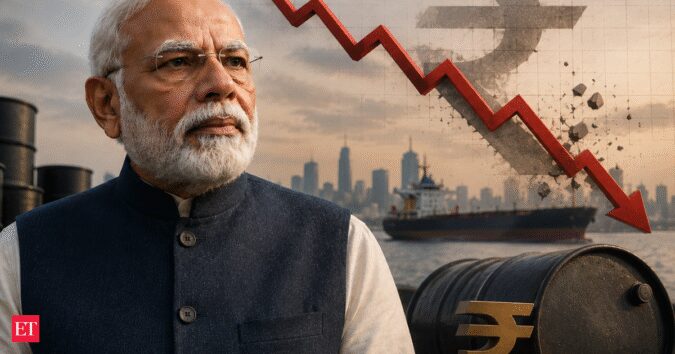
The rupee breached the psychologically crucial 95-per-dollar mark briefly on Monday after Brent crude surged as US President Donald Trump rejected Iran’s response to the US proposal to end the war,
PM Modi’s message was unusually direct. Consume less fuel by working from home, car pooling and using public transport. Delay discretionary gold purchases for a year. Avoid foreign holidays and destination weddings. Reduce edible oil use. Cut dependence on imported fertilisers. Buy Indian-made products. Use railways instead of trucks. Behind every one of those appeals lies a hard economic reality: India remains heavily dependent on imports for energy, gold, edible oil and fertilisers, all of which become more expensive when oil prices spike and the rupee weakens.
The market reaction suggested investors understood the gravity of the signal. The rupee briefly crossed 95 against the dollar on Monday while the Nifty and Sensex fell sharply amid fears of a widening current account deficit and prolonged energy disruption.
Also Read| Rs 1,600-1,700 cr a day, Rs 1 lakh cr in 10 weeks: Cost of insulating India from global energy shock
Modi’s austerity message and the return of crisis economics
In his Hyderabad speech, Modi repeatedly invoked the Covid years as a model for collective sacrifice. He urged Indians to shift to public transport, embrace carpooling, reduce unnecessary travel and revive work-from-home practices to conserve fuel. He also appealed to citizens to avoid non-essential foreign travel and postpone discretionary gold purchases for a year in order to preserve foreign exchange reserves.
The Prime Minister asked families to reduce edible oil consumption by half, saying it would improve both economic resilience and public health. Farmers were urged to cut chemical fertiliser use by 50 per cent, adopt natural farming and use solar-powered pumps instead of diesel pumps. Modi also called for a broader swadeshi push by encouraging citizens to buy locally manufactured goods instead of imported products.
The appeal was framed not as a partisan programme but as a national response to a global crisis. PM Modi warned that disruptions in the Strait of Hormuz and the wider West Asia conflict had sharply raised prices of petrol, diesel, LPG and fertilisers, increasing pressure on India’s import bill and forex reserves.
Why crude oil remains India’s biggest vulnerability
The most immediate trigger behind Modi’s speech is crude oil. India imports nearly 85 per cent of its crude requirement, making the economy acutely vulnerable to geopolitical disruptions in West Asia. Every sustained rise in crude prices widens the trade deficit, fuels imported inflation and weakens the rupee because more dollars are needed to pay for oil imports.
Reuters reported on Monday that Brent crude jumped more than 4 per cent to around $105.7 a barrel after Trump dismissed Iran’s response to the US peace proposal as “totally unacceptable”. The escalation renewed fears of prolonged disruption around the Strait of Hormuz through which roughly one-fifth of global oil flows.
The pressure is already visible in India’s domestic energy system. Indian Oil Corporation, Bharat Petroleum and Hindustan Petroleum are suffering under-recoveries of nearly Rs 30,000 crore every month in order to shield retail consumers from higher prices. However, commercial LPG prices have already been sharply raised while aviation turbine fuel for international flights has also become more expensive.
Reuters noted that since the outbreak of the Iran conflict in February, the rupee has weakened more than 4 per cent while bond yields and equity market volatility have risen sharply. If crude remains above $100 for a prolonged period, India’s macroeconomic stability will come under sustained pressure.
Also Read| Resilient, not shock-free: India charts path through war jitters
Gold buying and the drain on dollars
Modi’s appeal to postpone gold purchases for a year may have sounded unusual politically, but economically it reflects a familiar concern. Gold is one of India’s largest import items after crude oil. Since India produces very little gold domestically, rising consumer demand directly translates into higher dollar outflows. India consumes roughly 700-800 tonnes of gold annually while domestic production remains negligible, forcing the country to import over 90 per cent of its requirement. Gold accounts for nearly 9 per cent of India’s total import bill.
At the same time, gold has become increasingly important within India’s forex reserve strategy. India’s gold reserves have risen to 880.52 metric tonnes and more than 77 per cent of these reserves are now held domestically. The RBI’s foreign exchange reserves have fallen due to heavy intervention to support the rupee and a fall in gold reserves. In that context, discouraging discretionary gold buying is essentially an attempt to reduce non-essential dollar demand at a time when oil imports are already consuming more foreign exchange.
Economics of foreign holidays and destination weddings
Modi’s call to avoid overseas holidays and destination weddings reflects another often overlooked source of forex outflow, outbound tourism. When Indians travel abroad, they spend in dollars and other foreign currencies. In normal times this is manageable. During periods of external stress, however, rising outbound spending adds to pressure on the current account and the rupee. The significance of this outflow becomes larger when combined with high oil imports, elevated gold purchases and weakening capital inflows.
By considering foreign holidays and destination weddings as avoidable luxuries during a national economic challenge, Modi was effectively trying to reduce discretionary forex spending without imposing formal capital controls.
Edible oil imports and the inflation threat
The Prime Minister’s appeal to reduce edible oil consumption also has a clear economic rationale. India remains one of the world’s largest importers of edible oils, particularly palm oil, sunflower oil and soybean oil. Higher global commodity prices and shipping disruptions quickly translate into food inflation domestically.
The Russia-Ukraine conflict had earlier exposed India’s dependence on imported sunflower oil. The current West Asia crisis threatens another wave of supply disruptions and freight cost increases. By linking lower edible oil consumption with both health and national economic interest, Modi attempted to turn household consumption choices into a macroeconomic response mechanism.
Food inflation is especially sensitive politically because it directly affects household budgets. If crude prices remain elevated, transport and packaging costs also rise, creating a broader inflationary spiral.
Fertilisers, farmers and import dependence
Perhaps the most striking part of Modi’s speech was his request that farmers reduce chemical fertiliser use by half and move toward natural farming practices. India imports substantial quantities of fertiliser inputs including urea feedstock, phosphatic fertilisers and potash. Supply disruptions in West Asia and high energy prices immediately affect fertiliser costs because natural gas is a major input in fertiliser production. The government’s fertiliser subsidy bill for the 2026-27 fiscal is expected to exceed the budgetary allocation of Rs 1.71 lakh crore, with rising costs of imported urea and other fertilisers driven by the ongoing West Asia crisis, a senior official told PTI recently.
The Prime Minister linked fertiliser reduction directly with national economic resilience. He also urged farmers to adopt solar-powered irrigation pumps to reduce diesel consumption in agriculture.
The political significance is notable because fertiliser subsidies are deeply embedded in India’s rural economy. Asking farmers to voluntarily reduce usage signals the extent of concern within the government over import costs and subsidy pressures. A fertiliser ministry official said last month that India, the world’s largest importer of urea, has placed orders to import a record 2.5 million metric tons of the fertiliser at nearly double the price paid two months ago.
The renewed push for swadeshi
Modi’s emphasis on buying Indian-made goods fits into a larger attempt to reduce import dependence at a time of external vulnerability. The Prime Minister specifically referred to everyday products such as shoes, bags and accessories, arguing that citizens often unknowingly buy imported goods. The appeal revives the language of swadeshi but with a stronger macroeconomic objective. India’s merchandise imports continue to substantially exceed merchandise exports.
Reducing non-essential imports can help contain pressure on the trade deficit and support domestic manufacturing. But the challenge is that many sectors of Indian industry themselves remain dependent on imported components, energy and raw materials. Since these imports are crucial for India’s manufacturing growth, non-essential imports can be substituted with locally made goods.
The rupee’s future
The immediate outlook for the rupee will depend heavily on developments in West Asia and global crude markets. Reuters reported that the RBI has already intervened aggressively through state-run banks to prevent disorderly depreciation. But intervention alone cannot offset a prolonged surge in oil prices.
Brokerages and currency traders increasingly believe the rupee could remain under pressure if Brent sustains above $100 and if the Strait of Hormuz disruption continues. Higher oil prices would increase India’s import bill, worsen inflation and potentially force tighter monetary conditions. Equity markets could also remain volatile as foreign investors reassess emerging market risks.
What makes this moment politically significant is that Modi is no longer speaking merely as an election-winning leader promising growth and welfare expansion. His Hyderabad speech sounded more like a wartime economic appeal asking citizens to consciously alter consumption patterns in order to defend macroeconomic stability. For years, India’s economic story has been driven by rising consumption. Modi is now asking Indians to consume differently and in some cases consume less. Whether the public responds in meaningful numbers may ultimately determine how much pressure the rupee can withstand in the months ahead.