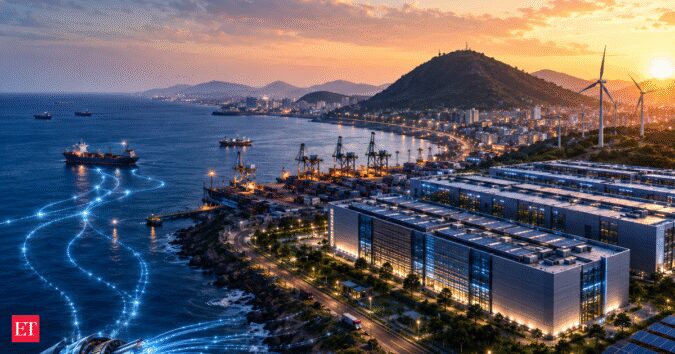
Google is investing $15 billion. Reliance-backed Digital Connexion has announced plans worth billions more. It has reportedly unveiled a Rs 98,000 crore (about $11 billion) AI infrastructure plan, while Meta is also said to be planning a significant presence in the city — all pointing to an unlikely destination for India’s next AI infrastructure boom: Visakhapatnam (Vizag).
What was once primarily known as a port city is now being seen as the foundation of a new kind of technology ecosystem: one built around data centres, subsea cables, power infrastructure and the computing capacity required to power artificial intelligence.
Google, which recently announced its multi-billion-dollar AI Hub in Visakhapatnam, said the city offers a rare combination of connectivity, clean energy potential and industrial capabilities that make it uniquely suited for the next phase of AI-driven growth.
Also read: Waka Waka! Indian consumer giants seek to roar louder in Africa
“Visakhapatnam has an extensive coastline that presents India with a distinct opportunity to strengthen the country’s connectivity and digital resilience. It also has significant potential for new clean energy, an established industrial supply chain, and a talented local workforce,” Alexander Smith, Principal, Global Infrastructure and Energy, Asia Pacific, Google, told ET Online in an emailed response.
“These strengths led us to see the shared opportunities for growth in Visakhapatnam and gave us confidence to apply principles of responsible AI infrastructure development in partnership with local industry and governments—in a way that both advances the region’s economic growth trajectory and meets Google’s global operational requirements,” he added.
Google is not alone in expanding its footprint in the city. Digital Connexion, a joint venture between Reliance Industries, Brookfield and Digital Realty, has also announced plans to invest Rs 98,000 crore by 2030 to establish a 1 GW AI-native data centre cluster across 400 acres in Visakhapatnam, ET had reported in November 2025.
The proposed campus is expected to feature high-density AI compute infrastructure, advanced liquid-cooling technology and dedicated renewable energy support, underscoring Vizag’s emergence as a next-generation AI infrastructure hub.
ET had also reported last November that Meta was planning a significant AI infrastructure presence in Visakhapatnam by leasing capacity at a proposed 500 MW hyperscale data centre being developed by Sify Technologies. The report said the facility would support Meta’s Waterworth subsea cable project, with the cable expected to land at Sify’s cable landing station in the city, further strengthening Vizag’s role as a global digital connectivity hub.
Meta and Reliance Industries had not yet responded to ET Online’s request for comments at the time of this report’s publication.
More than a data centre project
Google’s vision for Visakhapatnam extends far beyond a conventional data centre campus.
The company sees the city emerging as a critical connectivity gateway linking India to global AI networks through a combination of subsea and terrestrial cable infrastructure.
Through its America-India Connect initiative, Google plans to establish subsea routes connecting Visakhapatnam with Singapore, South Africa and Australia while also creating direct fibre connectivity to Chennai and Mumbai.
The objective, according to the company, is to turn the city into a bi-directional gateway capable of both bringing advanced AI services into India and allowing Indian developers, startups and enterprises to deploy products globally through high-speed digital infrastructure.
Google argued that such connectivity will become increasingly important as AI applications demand high-bandwidth, low-latency networks to support services such as Gemini and other frontier AI models. In Google’s view, data centres are only one piece of the puzzle; the cables connecting them are equally critical to creating an AI ecosystem.
Also read: Made in India, deployed abroad: The expanding map of India’s arms exports
The investment is also tied closely to energy infrastructure.
“Being additive to the grid and to India’s energy needs means investing in new projects that would not happen without Google’s involvement,” Smith said.
“We’re already actively working with partners on plans to build new transmission lines, clean energy generation, and energy storage solutions to ensure that India’s digital economy continues to grow alongside the goal of increasing the reliability and affordability of power for local communities.”
The company said it intends to support new clean energy generation, storage systems and transmission infrastructure in the region as part of its broader commitment to operate on carbon-free energy.
Why AI companies are suddenly looking at Vizag
Analysts say the city’s growing appeal reflects a broader shift in how technology infrastructure is being built in the AI era.
“AI is fundamentally changing infrastructure requirements,” said Vinish Bawa and Shubhojeet Chakravarty of PwC India.
“Traditional data centre racks operate at 5–15 kW, while AI-optimised racks can exceed 60–100 kW, increasing power density by up to 10x.”
That means power availability, cooling efficiency, land scalability and connectivity have become as important as talent pools and office space.
PwC said locations that can provide integrated access to power, land and network capacity are becoming increasingly valuable as AI workloads grow.
Aakash Agrawal, Associate Director, Digital and New Age Business at Anand Rathi Investment Banking, said established technology hubs are beginning to face the challenges that come with maturity.
“Most established technology cities in India are facing the challenges that come with success—higher costs, congestion and infrastructure constraints. Vizag offers something different. It still has room to build at scale,” he said.
Aniket Dani, Director, Crisil Intelligence, told ET Online that the city’s access to lower-cost land, renewable energy resources, port infrastructure and submarine cable connectivity gives it key advantages over more saturated technology hubs.
Google’s largest infrastructure investment outside the US
For Google, Visakhapatnam is not just another expansion project.
According to the company, the AI Hub represents Google’s largest infrastructure investment outside the United States to date and is designed to integrate computing infrastructure, connectivity, clean energy, workforce development and community engagement into a single ecosystem.
“Our multi-billion investment in the Google AI Hub is a long-term anchor commitment to bring the shared vision of India’s AI corridor in Visakhapatnam to life,” Smith said.
“Visakhapatnam will soon host some of the most advanced digital infrastructure in Asia, which promises to act as a catalyst for innovation that can enable local communities and businesses to be at the forefront of solving challenges once thought impossible.”
He added that establishing the AI Hub would involve “advanced and sustainable data centres, new connectivity, clean energy, responsible water stewardship, career pathways, and deep continuous engagement with the community.”
Google said the infrastructure being built in Visakhapatnam will eventually support users, businesses and developers not only across India but also South Asia and the wider Asia-Pacific region. The company also said it has begun skilling programmes for students, educators, women entrepreneurs and coastal fishing communities as part of its broader effort to build an AI ecosystem around the project.
The Andhra Pradesh factor
Industry experts say geography alone does not explain Vizag’s rise. A major reason the city has attracted large investments is the proactive role played by the Andhra Pradesh government.
Anjani Kumar, Partner at Deloitte India, said Andhra Pradesh has distinguished itself through a combination of competitive incentives, land allocation, faster approvals and infrastructure planning.
According to Kumar, the state has offered customised support packages for strategic projects, while also creating a policy framework that allows large data-centre operators greater flexibility in sourcing renewable power.
Kumar noted that around 600 acres had already been allocated across multiple locations around Visakhapatnam and that approvals were being driven through high-level government mechanisms to accelerate project execution.
BCG’s Sudhanshu Chawla echoed that assessment.
“The state role has been important—arguably one of the biggest variables so far,” Chawla said.
Agrawal of Anand Rathi said projects of this scale require confidence around land, approvals, power supply and long-term policy stability.
“Andhra Pradesh has been proactive in positioning Vizag as a destination for these investments, which is an important starting point,” he said.
Also read: The Next Frontier: LG’s future is not just the TV and fridge in your home
India’s chance to move up the AI value chain
Google believes the opportunity extends beyond hosting data centres.
“We see a generational opportunity for India not just to be an active participant in the AI economy, but to architect it,” Smith said.
“For India and Andhra Pradesh, the Google AI Hub in Visakhapatnam offers a secure and advanced backbone for digital innovation to continue to accelerate in line with India’s goals.”
According to Google, early construction activity is already creating opportunities for local manufacturers, clean energy developers and engineering talent. The company said Indian firms are increasingly building advanced cooling equipment and structural components for hyperscale data centres, while expertise in smart grids and energy storage is also expanding.
The company argues that these developments could help India evolve from being primarily a consumer of AI technologies into a producer and exporter of AI infrastructure capabilities.
Crisil Intelligence’s Dani added that a large domestic compute base could strengthen India’s technological self-reliance by reducing dependence on overseas compute infrastructure while improving access to AI resources for startups, enterprises, researchers and government agencies.
Similarly, Chawla of BCG said domestic large-scale capacity could support India’s sovereign AI ambitions and reduce reliance on foreign cloud infrastructure.
Can Vizag become India’s AI capital?
That remains the biggest question.
While enthusiasm around Visakhapatnam is growing, most analysts caution that the city is still at an early stage of development.
“Vizag is still an early-stage data-centre market, but is being positioned as ‘AI Patnam’,” Kumar of Deloitte said, noting that the city already has a data-centre pipeline exceeding 3.25 GW across roughly 10 sites.
Chawla struck a similarly cautious note.
“It’s too early to call Vizag a ‘capital,’ but the early signals are notable for a city that had little data-centre presence until recently,” he said.
For now, however, Visakhapatnam finds itself at the centre of a rare convergence of technology, energy and infrastructure investment.