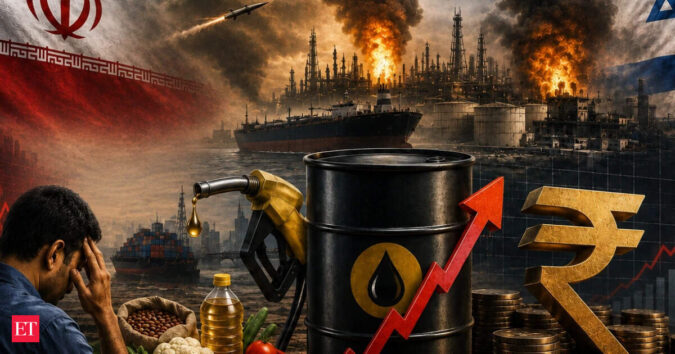
The fragile calm in the Middle East has collapsed once again as Iran and Israel have resumed an exchange of strikes, threatening to unravel the ceasefire that had held for over 100 days. Yemen’s Iran-backed Houthis fired missiles toward Israel, prompting retaliatory attacks. Israel also launched strikes on Iranian positions, claiming it was responding to missile threats. Diplomatic efforts, including US appeals for restraint, have so far failed to contain the escalation. Analysts warn that renewed hostilities could spiral into a wider regional conflict, putting additional pressure on global oil markets and supply chains. For India, which imports a significant share of its energy needs from the aregion, the consequences could be immediate and far-reaching.
Also Read: Inflation poses bigger risk than growth this fiscal as monsoon and crude weigh on rural demand: Nuvama
Slowing growth amid rising uncertainty
India’s economic growth, which had been resilient at 7.7% in FY26 and recorded a robust 7.8% in the final quarter, now faces new headwinds from external shocks and domestic pressures. The Reserve Bank of India (RBI) on June 6 left the repo rate unchanged at 5.25%, signalling caution rather than aggressive tightening, while revising the GDP forecast for FY27 downward to 6.6% from 6.9%. Governor Sanjay Malhotra highlighted the risk of inflation generalising beyond fuel and commodities if supply-side pressures persist, reflecting concerns that higher costs could spread economy-wide.
Rising oil prices and disrupted supply chains are already feeding into higher input costs. With the Middle East conflict reigniting, analysts expect the intensity and duration of the crisis to weigh on investment and consumption, slowing growth momentum. The RBI has opted to wait for clearer signals before tightening policy further, reflecting a cautious balancing act between supporting growth and containing inflation.
Consumers are becoming pessimistic
The May 2026 RBI Urban Consumer Confidence Survey paints a sobering picture of household sentiment. According to the survey of 6,086 respondents across 19 cities, consumer confidence deteriorated sharply between March and May. The current situation index fell to 90.7 from 95.7, marking the third consecutive decline and keeping it below the 100 threshold that separates optimism from pessimism. The future expectations index also slipped to 118.7 from 120.2, its lowest since September 2023.
Households reported worsening perceptions across multiple dimensions. The net response on the general economic situation fell to minus 16.5 from minus 8.6, while one-year-ahead expectations dropped to 19.5. Employment conditions also weakened, with current perceptions falling to minus 14.4 from minus 9.1, and future expectations easing to 21.8 from 25.2. Price pressures remained high, with around 91.6% of respondents reporting that prices had increased over the past year. Income growth showed signs of stagnation, with the net response on current income falling to 0.9 from 3.0, and overall spending sentiment moderating to 74.0 from 78.4.Also Read: Indians are growing more pessimistic about the economy. RBI Survey shows why
The decline in discretionary consumption was particularly notable. Non-essential spending perceptions turned negative at minus 0.8 from 0.8, even as essential spending remained stable. Professional forecasters mirrored this caution, lowering growth projections and revising macroeconomic assumptions, with real GDP growth for 2026-27 revised down to 6.5% from 6.9%. The most pronounced revision was a 60-basis-point reduction in capital formation, indicating that firms may slow expansion plans amid rising costs and uncertain demand. The survey highlights that consumer pessimism, coupled with inflationary and currency pressures, could dampen near-term demand and exacerbate the slowdown.
The survey indicated a 60-basis-point reduction in capital formation expectations, suggesting that firms may hold back expansion plans amid rising input costs and uncertain demand. Analysts warn that slowing private investment, if prolonged, could undermine growth in manufacturing and infrastructure sectors, which have been key drivers in recent years.
Inflation pressures begin to build up
India’s inflation likely rose to the Reserve Bank of India’s medium-term target of 4% in May, driven by a pickup in vegetable prices and higher fuel costs following the U.S. and Israel war against Iran, a Reuters poll of economists showed. Inflation has remained below the RBI’s 4% target for 15 consecutive months. But that benign trend is unlikely to continue, with state-owned fuel retailers raising fuel prices four times in May alone, pushing up transport costs, while food inflation continued to rise from last year’s low levels.
The June 3-8 poll of 38 economists forecast inflation, measured by the annual change in the consumer price index (CPI), rose to 4.0% in May from 3.48% in April. “May ’26 CPI likely crossed the 4% threshold … driven primarily by vegetables and transport inflation,” said Kanika Pasricha, chief economic adviser at Union Bank of India.
Government measures and policy response
The Centre is actively preparing to deploy a range of policy measures to insulate the economy from the impact of the West Asia conflict, according to a TOI report. Officials have told TOI that these steps will be phased rather than rushed, aiming to ensure the availability of goods, raw materials, inputs, and finished products to meet domestic demand, while also maintaining stability in currency and foreign exchange flows.
Unlike the coordinated policy approach during the Covid-19 pandemic, when the government and RBI announced a series of measures in batches, the current strategy focuses on responding to emerging issues as they arise. This week, for instance, the government coordinated with the RBI to step up overseas investment in government bonds and other instruments, while simultaneously clearing a package for airlines to shield them from the impact of high crude prices. State-owned oil companies are also being supported to absorb part of the surge in crude costs.
Supply-side concerns have been closely monitored. The government has addressed potential shortages in petrochemicals and cotton, ensuring that manufacturing is largely unaffected. In terms of exports, a previously announced package appears to be bearing fruit, with the first two months of the fiscal year recording double-digit growth. However, elevated oil and gold prices continue to exert pressure on the trade deficit.
Officials emphasised that the government is keeping a close watch on supply chains and domestic costs. While the current quarter appears manageable, subsidies for fertilisers and cooking gas remain a critical area of concern. Rising fertiliser prices, driven by global cost increases and import dependence, and escalating LPG costs for households, could put pressure on fiscal calculations. The government’s approach will likely involve targeted measures to maintain stability without destabilising its overall fiscal position.
Fiscal pressures are mounting
India’s fiscal framework faces an unprecedented test as subsidies, soaring oil costs, and a weak rupee threaten to disrupt budgetary calculations. A recent TOI report shows that fertiliser subsidies alone could reach Rs 3.8 lakh crore, more than double the budgeted level of Rs 1.7 lakh crore, while cooking gas subsidies are expected to exceed Rs 12,085 crore after a payout of Rs 26,000 crore last year. Rising global prices for urea, DAP, sulphur, and ammonia, combined with rupee depreciation, add to the strain on public finances.
The oil import bill is also set to surge if crude prices remain elevated due to Middle East tensions. With the rupee under pressure, the cost of importing essential commodities rises, potentially worsening the trade deficit and fuelling inflation further. The government has so far managed to ensure supplies, but higher retail prices could weigh on discretionary consumption, especially for non-essential goods.
The challenge for policymakers is to navigate these pressures without destabilising the fiscal deficit, budgeted at 4.3% of GDP. The government will need both agility and innovation in managing subsidies, rationing foreign exchange, and making smart policy interventions to shield vulnerable sectors. Flexible, targeted measures that respond to evolving global and domestic conditions will be critical in maintaining macroeconomic stability while sustaining growth momentum.
Preparing for the long haul
India’s policymakers face the dual challenge of supporting growth while containing inflationary pressures. Supply-side interventions, subsidy management, and careful fiscal planning will be critical in the coming months. The government is closely monitoring both domestic supply and external factors, indicating that further measures will be deployed if required. The speed and scale of these interventions could determine whether India weathers the economic shock of prolonged Middle East hostilities or faces broader macroeconomic stress.
The resumption of Iran-Israel hostilities can possibly prolong the Iran tensions, and shocks can quickly ripple through a globally connected economy. India’s economic resilience — strong consumption, robust capital expenditure, strategic fiscal measures, and policy interventions — will be tested in the months ahead, particularly as inflationary pressures mount, subsidy burdens rise, and consumer confidence weakens. Vigilance, nimble policy response, and careful fiscal management will be essential to safeguard the economy against a potentially prolonged crisis.