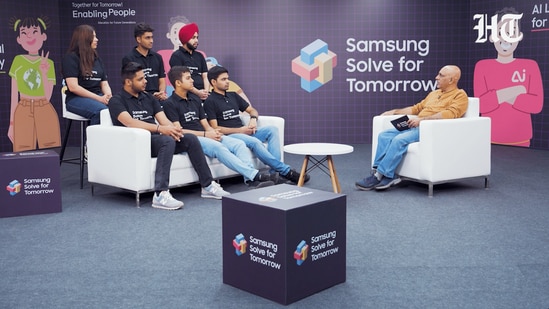
The energy at the Indian Institute of Technology (IIT) Delhi was palpable as winners from Samsung Solve for Tomorrow 2025 programme gathered to share with Leslie D’Monte, senior technology journalist and Consulting Editor, Mint, how a single spark of curiosity evolved into tangible technologies that solve real-world problems in a special podcast.
Now launching its fifth edition in India, Samsung Solve for Tomorrow programme is a global initiative that operates across 65 countries, transitioning from a youth innovation contest into a rigorous launchpad supported by regional headquarters and established Research & Development (R&D) centres. For Samsung, this milestone coincides with a deeper institutional anchor that marks 30 years of its operational and engineering presence in India.
The integration of Samsung Solve for Tomorrow into this three-decade legacy underscores how corporate R&D infrastructure can be leveraged to mentor the next generation of tech pioneers, providing students with direct access to advanced laboratories, patent guidance and industrial expertise necessary to move prototypes into the real world.
Click here to watch the full podcast:
Seeing with sound and speaking with AI
Among the standouts at the reunion was the solution by Tushar Shaw, the Karnataka-based creator of Percevia AI. Tushar has developed a sophisticated wearable system built into a pair of glasses designed to give visually impaired users autonomous navigation. This solution won the top spot in the theme of AI for Safer, Smarter and Inclusive Bharat.
Using a 3X3 spatial grid, real-time object detection and local Large Language Models (LLMs) that operate in five languages, the glasses translate a user’s surroundings into haptic vibrations and clear audio cues.
Sitting next to him was Pranet Khetan, a student from Haryana, who won the top entry in the Future of Health, Hygiene and Wellbeing in India theme for developing Paraspeak. This low-cost Internet of Things (IoT) device uses deep learning models to translate slurred speech or dysarthria caused by medical conditions like stroke, paralysis, cerebral palsy and Parkinson’s disease into clear audio.
Paraspeak holds the distinction of building the first and largest database of Hindi dysarthric speech. Talking about the accuracy levels of the speech detection, Pranet said: “In silico (computer testing), the accuracy is around 96.7%. In real life, it varies between 80 to 95% depending on severity, operating with a mere two-to-three-second latency that we are actively working to reduce.”
Smarter waste and democratic coaching
Best friends since childhood, Abhishek Dhanda and Prabhkirat Singh from Punjab, took on India’s organic waste problem. Under their company Prithvi Rakshak, they created VermiKendra, an automated vermicomposting system that uses IoT sensors to monitor pH values, temperature and moisture levels in the soil. This solution was the winner in the Environment & Sustainability via technology theme.
Their accompanying mobile application is already helping local farmers optimise their organic composting processes. “India generates 62 million tonnes of organic waste annually, and only 8% is recycled. We wanted to convert the manual drudgery of hard labour into an efficient robotic process to increase soil quality and clean up our environment,” Abhishek said.
Another duo, Bhagyashri Heeralal Meena and Aadish Abhijeet Shelke, both college students from Maharashtra, bagged the top spot in the Social Change through Sport & Tech: For Education and better futures theme for NextPlay.AI, which is India’s first AI-driven talent platform for athletes. As a national-level tennis player, Aadish experienced first-hand the lack of infrastructure and elite coaching available outside major metropolitan cities.
Their mobile-first platform allows young athletes anywhere in the country to upload videos of their performance. The AI model uses advanced pose detection to analyse their form and provide technical coaching feedback.
Lessons in grit
The road to success for these young innovators was paved with systemic challenges, failures and deep research at the ground-level. Tushar recalled the early days of cold-calling blind schools, where administrators regularly dismissed him as a random second-year college student. To get his prototypes tested, he frequently resorted to bluffing his way past security gates to pitch directly to school principals.
“You will face failures every single time. But if even one try out of a thousand works, that is enough,” Shaw said.
Abhishek and Prabhkirat recalled how their team faced many hurdles, routinely falling ill while gathering raw waste samples, some even containing faeces, at landfills to calibrate their sensors. Meanwhile, Pranet’s early speech-recognition prototypes suffered from mathematical error rates as high as 4,000 % before extensive field testing at care centres brought the metrics down to clinical readiness.
Building the future together
The 2026 edition of Samsung Solve for Tomorrow is now officially accepting applications. The national competition encourages young minds across the country to apply Science, Technology, Engineering and Mathematics (STEM) concepts directly to pressing socio-economic and environmental challenges and offers students easy access to financial grants, expert mentorship and official incubation support.
It is open to Indian residents aged between 14-22 years, who are keen to solve real-world challenges. Each applicant can submit one entry for any of the four themes, namely AI Living for India, Health and Education, Sport & Tech and Environmental Sustainability. Four winning teams will get a cumulative grant of ₹2 Crore and incubation at FITT-II Delhi. Applications are open till July 3, 2026. Click here to apply.
As part of the initiative, 2,40,000 cumulative hours of training will be delivered during the application phase, combining classroom guidance with applied learning opportunities. The design training workshops target 30,000 students across 100 cities via interactive workshops in schools and universities.