Tech Tonic | Ferrari Luce, Sir Jony Ive, and a subversion of ethos

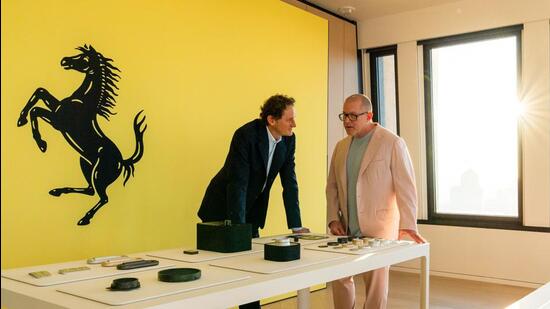
Ferrari executive chairman John Elkann with Sir Jony Ive. (Official image)


The first car from Sir Jonathan Paul Ive, or lovingly called Jony Ive, and his design firm is a Ferrari. Makes sense for this balance of history and personality. Luce, in Italian, means ‘light’. Perhaps the sort that’s presently steaming in through the window on a proper summer day, as I analyse this intersection. Ferrari Luce is Maranello’s first fully electric car. The Prancing Horse took its time with a methodology that is considered the future of mobility.

Ferrari executive chairman John Elkann with Sir Jony Ive. (Official image)

Ferrari announced its intention to partner with LoveFrom back in 2021. Since then, automotive purists and enthusiasts alike have wondered how the architects of the Apple iPhone would influence automobile design. The answer as it turns out, and rather ironically so, is a complete subversion of the very ethos that defined the iPhone (and all the modern smartphones since). This may well illustrate a moment when the design collaboration with LoveFrom, Sir Ive’s firm, sparks more conversations about the Luce than the car’s key specs.

Also Read:Tech Tonic | Musk v. Altman, and a reality of bickering adults holding AI’s keys

Speaking of which, the Luce has a rated power output of 1,050 cv (that’s around 1036 horse power; trust the Italians to add some flair), can accelerate to 100 km/h in 2.5 seconds, has a top speed of 310 km/h, and a range of 530km fully charged. The battery pack is rated at 122 kWh, an 800V architecture, and the car weighs 2,260kg. Ferrari developed a vehicle control unit, or VCU, that monitors everything. The motors at the front deliver 210kW to the axle, while the ones at the rear can do up to 620kW.

Ferrari notes that “Efficiency, energy density and thermal management have all been prioritised. The front engines can spin at up to 30,000rpm, and can go from zero to maximum in less than a second.” And of course it’s a Ferrari, so prices start at €550,000.

‘People are dying because of dumb design’. That’s essentially the thought process with which Sir Ive designed the Luce, and defines his approach to car designs in general. In an interview that I came across sometime back, he says this: “Multi-touch is wonderful for a phone because when you’re using a phone you’re looking at the phone. Multi-touch shouldn’t be in a car I believe, because if you’re having to do basic things, it requires of course by definition that you’re not looking where you’re going and you’re looking at a display.” That’s before he adds that multi-touch as a technology needs to be thoughtfully and appropriately used.

Carmakers haven’t done that. This is something I cribbed about a couple of weeks ago in my Tech Tonic column, pointing out that something as simple as outside rear view mirror adjustments requires you to stab on multiple layers of interface on a touchscreen in some cars now on sale in India. Sir Ive knows you cannot put a touchscreen tablet inside the car, stuff all controls on it for the sake of minimalism, and get away with thinking that’s a great idea.

Of course the Luce has a nice big touchscreen and an immersive binnacle. But there’s just the right use of mechanical buttons, toggles and switches where they are more intuitive than a touch interface. Though Sir Ive, LoveFrom, and Ferrari integrated the AC controls on the touchscreen infotainment system. But it isn’t just a touchscreen bolted on because it had to be done. This weighted design sits between the front seats and has an integrated grab handle built into the architecture. This allows the driver or passenger to steady their hand before interacting with a touch or a physical button interface.

A simple engagement that you wouldn’t even notice, acoustically and intuitively tuned for feedback, precision and consistency.

The instrument binnacle integrated into the steering column isn’t just any display. In fact, it uses multiple transparent OLED sheets stacked, paired with a physical motorised needle for that parallax effect while blending the modern with the conventional. “The binnacle and steering wheel are intimately connected. This is about driving, and everything else augments that experience. This is what’s essential to be able to drive, and all the controls are physical and mechanical. We stress tested these big organisational principles. We felt they were very important, but we also worked hard to verify the assumptions we were making. Fortunately, the best engineers in the world are at Ferrari,” says Sir Ive.

The design influence isn’t just inside, but outside too. The very insistence of aerodynamics to shape the 5-meter-long electric vehicle defines the Luce’s design. Ferrari says it has the lowest drag coefficient in its car-making history. There’s a ride-height logic that lowers the front by 10mm while cruising.

It is clear that the Ferrari Luce is a milestone moment for Maranello. A course discovery not just for Ferrari with a new powertrain defining mobility, but also for Sir Ive and LoveFrom. You’d have expected the Luce to be more and more like a really fast driving car in which the cabin felt like a wondrous world of tablets and touchscreens, but it is far from that. A good designer always knows how to craft an experience and wrap it in logic and safety. Turns out, the man who designed the iPhone all those years ago, knows that trick doesn’t work everywhere.

Vishal Mathur is the Technology Editor at HT. Tech Tonic is a weekly column that looks at the impact of personal technology on the way we live, and vice versa. The views expressed are personal.


Source link

Leave a Reply

Your email address will not be published. Required fields are marked *