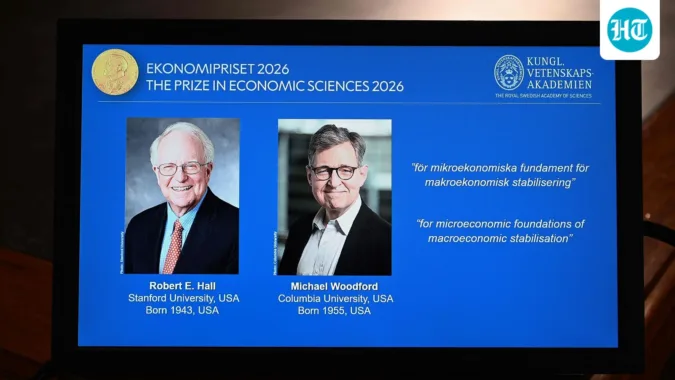
The 2026 Sveriges Riksbank Prize in Economic Sciences in Memory of Alfred Nobel, popularly known as the Economics Nobel Prize, has been awarded to Robert Hall and Michael Woodford. According to the press release, the award has been conferred for “microeconomic foundations of macroeconomic stabilisation”.
Woodford and Hall ask questions that are extremely important for public welfare. John Maynard Keynes had likened a broken economy to a car having a defective magneto. Just as a seemingly unimportant mechanical defect can stall a car, similarly small technical problems can ground the entire economy to a halt. If we truly understand the science and art of economic stabilisation, we will have solved this ‘magneto trouble’. However, as the Great Financial Crisis of 2007-08 demonstrated, we are still quite far from this kind of mastery over the economic system.
Woodford and Hall made important advances towards this goal, explaining why they received this year’s economics Nobel Prize.
Here’s how.
Serious academic investigation of the question of economic stability grew, in part, out of the theoretical challenge posed by the Great Depression. During the Depression, policymakers confronted the twin features of excess capacity and involuntary unemployment for a prolonged period. This was difficult to reconcile with the prevailing orthodox view that the economic system was self-stabilising.
Keynes in his magnum opus “The General Theory of Employment, Interest and Money” provided a coherent theoretical framework explaining the emergence of economic instabilities. Keynes explained the lack of economic stability through the circular relationship between current income and consumption. When the current income is high, consumption remains high. When income is low, consumption is low. This mutually reinforcing nature of current income and consumption makes aggregate variables potentially unstable.
Post-war economic management was deeply influenced by Keynesian theory.
However, as decades passed by, Keynesian theory was critiqued and extended in different ways. One major controversy concerned current income and permanent income. Suppose your salary is credited to your bank account on the last day of the month at 10am. Will you consume the entire amount instantaneously? That is unlikely. At the very least, you will spread it across the month’s expenses. This behaviour is known as “consumption smoothing”. But once one recognises that income can be spread across a month, what stops one from spreading it over a year, or even a lifetime? Critics of Keynesian economics, such as Milton Friedman, raised precisely this point. They championed another model of consumption: the permanent income hypothesis.
The permanent income hypothesis brought into sharp relief the role of expectations in economic decision-making. It is a common observation that economic agents — which means consumers, workers, businesspeople, and anyone else making economic decisions — have expectations about the future. Their present choices are, at least in part, determined by those expectations. The expectations themselves are unobservable.
In a seminal paper, Hall (1978) showed that, under the permanent-income hypothesis and rational expectations, marginal utility of consumption follows a statistical process close to a random walk — a process in which something moves step by step, with each step being determined by chance. In this setting, new information drives unexpected changes in marginal utility. A random walk does not mean that all future movements are unknowable. It means that, after allowing for any predictable trend, past information should not systematically predict the next unexpected change.
Further under plausible assumptions, consumption itself can also be said to follow a random walk.
Also Read | Nobel Prize in Chemistry 2026: How Kagan and Soai helped explain ‘one-handed’ molecules
Hall then showed that this empirical prediction — the unpredictability of consumption — could be tested against data. Using the University of Michigan’s Panel Study of Income Dynamics (PSID), covering food-consumption expenditure by 2,309 families between 1969 and 1975, Hall and Mishkin (1982) showed that food consumption was relatively more sensitive to permanent-income shocks than to temporary-income shocks for a large fraction of households. This was in line with the consumption smoothing inherent in the permanent income hypothesis.
The mathematical equations governing the consumption process developed by Hall has been central to mainstream macroeconomics. Indeed, a prominent textbook in the field states: “Modern macroeconomics records the fruits and frustrations of a long love-hate affair with the permanent income mechanism.” Hall turned this ‘hypothesis’ into a precise quantitative empirically testable proposition.
To overcome the methodological critique that aggregate behaviour was being studied as if it emerged from the optimising behaviour of a single rational, forward-looking consumer, Hall ventured into the study of labour markets, unemployment, and employment relationships. This brought the choices and constraints of individual workers and firms more directly into the analysis of macroeconomic fluctuations.
Michael Woodford’s main contribution in this area is what is known as the Neo-Keynesian model of the economy. To appreciate it, one must again start with the seminal work of John Maynard Keynes. Keynesian analysis was innovative and profound, but it was presented largely in literary exposition, leaving the exact model somewhat obscure. The first analytical model following Keynes’s arguments was John Hicks’s IS-LM model. This model shows the equilibrium in the market for goods and the market for money being determined simultaneously.
The supply side was later added to this framework through what became known as the Phillips curve. By the 1970s, the model was extended by incorporating expectations. Both the IS curve and the Phillips curve were expanded to include the expectations of consumers and businesses.
Furthermore, the LM curve was discarded for two reasons. First, central banks had moved away from setting the money supply and towards setting interest rates. Second, it was realised that central banks are price setters, rather than merely price takers. These two features lead to what is known as a central-bank reaction function, or the Taylor rule.
These three equations, a dynamic, expectations-augmented IS curve; an expectations-augmented Phillips curve; and a Taylor rule, provide a self-consistent system connecting output, employment, inflation, and interest rates. Interestingly, the Neo-Keynesian three equation model, and its numerous extensions, can be grounded in individual behaviour.
Economists are often fascinated with models that can explain aggregate phenomena like unemployment, output and inflation starting from individual behaviour, just like physicists like to explain the universe in terms of fundamental particles. Neo-Keynesian theory is able to provide this microfoundation by using sticky prices, wages and various forms of market imperfections. Needless to say, a number of institutions, from central banks to financial institutions, are interested in such models.
Another contribution of Woodford lies in fine tuning the instruments used by the Central Banks for stabilizing the economy. Michael Woodford provided a way to understand how central banks worked as they moved away from targeting monetary aggregates. The relationship between money aggregates, income and prices had become increasingly unstable and so monetary authorities began managing short-term interest rates.
Woodford revived the great Swedish economist Knut Wicksell’s emphasis on the relationship between the market rate and the ‘natural’ rate of interest, (or the rate of interest consistent with the economy operating at its equilibrium level of output).