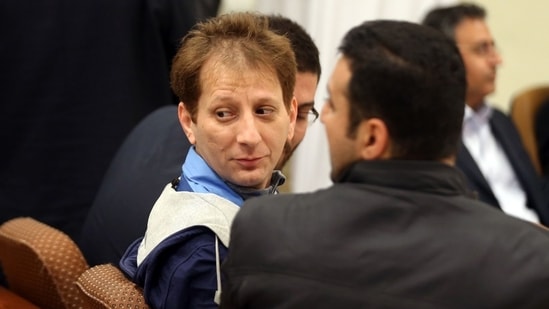
Babak Zanjani had been on death row for years before Iranian authorities suddenly decided to release him last year. He had talents that would soon be put to use.
Before his arrest for alleged corruption, Zanjani had become one of Iran’s wealthiest men and its most famous sanctions buster by helping the Islamic Revolutionary Guard Corps evade restrictions to sell billions of dollars of oil and bring the proceeds back home—often in the form of gold bullion.
Now, the 55-year-old Zanjani has again emerged at the forefront of Iranian efforts to skirt sanctions, accused by U.S. authorities of using cryptocurrency and international connections to move money for the regime and help fund its regional militias.
Two crypto exchanges connected to Zanjani—called Zedcex and Zedxion—have processed over $94 billion in transactions since 2022, including for wallets linked to the Revolutionary Guard, according to the U.S. Treasury, which imposed sanctions on him in January. Zanjani has denied the allegations.
The Treasury also designated the two exchanges “terror assets” and said Zanjani had laundered money and provided funding for Revolutionary Guard projects.
Zanjani has spoken openly on social media and in interviews about helping Iran skirt Western sanctions, casting himself as an “economic soldier” for the regime. “Even a small economic structure is more powerful than any warship,” Zanjani said on X recently. “But today it has become clear that structuring the economy…can put a country on par with the superpowers.”
Asked for comment for this article, Zanjani denied that he was using cryptocurrency exchanges to transfer money to the Revolutionary Guard, calling it a “fake report.”
Zanjani’s story is a rags-to-riches tale of a man who amassed extraordinary wealth as a shrewd operator for a pressured Iranian regime. He then fell quickly from grace, before resurfacing last year as if his demise had never happened.
Born into a working-class family in southern Tehran, he made his first paycheck selling jewelry in the bazaar, according to a 2013 interview he gave to the Iranian Aseman newspaper. He later became a driver for the central bank governor and started dealing in currency, making up to $17,000 a day on cuts from deals due to the discrepancy between official and market rates, he said.
Zanjani established an import-export business, selling among other goods sheepskins to Turkey, and has said he later used his international connections to secure oil sales of up to $90 million for the Revolutionary Guard’s engineering arm, Khatam al-Anbiya. His talents won the attention of the head of that organization, Rostam Ghasemi, who later became oil minister under President Mahmoud Ahmadinejad.
Soon Zanjani was running the biggest publicly known money-laundering scheme in modern Iranian history, pulling billions of badly needed dollars into Iran’s struggling banking system. Before turning 40, he controlled a web of some 60 companies, including banks, airlines and cosmetics. Many of them were shell companies to obfuscate the trail of oil and money.
“That is my job: anti-sanction operations,” he said in 2013. “I worked for the country.”
Ferrety and clean-shaven, Zanjani never served in the military, but he ingratiated himself with the Revolutionary Guard. He cast himself as an “economic Basij,” referring to the Guard’s voluntary militia.
During his heyday, he sold oil using the Malaysian island of Labuan, a tax haven where Iranian ships transferred oil to tankers leased by shell companies and sailing under other countries’ flags. He acquired controlling stakes in a bank in Malaysia and founded one in Tajikistan, according to the U.S. Treasury. The banks allowed him to transfer money to Turkey, where cash was converted into gold and smuggled into Iran.
In a country where corruption is rife but ostentatious displays of wealth are frowned upon, Zanjani attracted ire among many. He appeared in media reports posing with Rolex watches, with luxury cars and in a private jet, while profiting from sanctions that squeezed ordinary Iranians. The European Union sanctioned him in 2012, followed by the U.S. in 2013.
Yet, he also inspired admiration. Readers of two Iranian newspapers in 2013 voted him third in Person of the Year polls, trailing only then-President Hassan Rouhani and his foreign minister, Javad Zarif.
Later that year, after Rouhani was elected on promises to clean up corruption, Zanjani was arrested, accused of withholding $2.7 billion in state money. Zanjani said international sanctions prevented him from paying the money back. In 2016, he was sentenced to death for alleged “corruption on earth,” a charge not usually used for financial corruption but for alleged enemies of the state.
In 2024, the judiciary commuted Zanjani’s death sentence to 20 years in prison, saying he had cooperated in returning the assets he owed. The decision came as Iran prepared for a possible second Trump term and for European countries to reimpose sanctions lifted under the 2015 nuclear deal. Around the same time, ownership of his conglomerate, the Sorinet Group, was transferred to the National Iranian Oil Company, according to Iranian corporate filings obtained by risk data firm Kharon. The following year Zanjani was released.
Zanjani’s crypto exchanges have helped Iran sustain support for militias abroad, handling the transfer of over $10 million to a Yemeni businessman sanctioned by the U.S. for operating a smuggling network to finance the Houthi rebels, according to TRM Labs, a blockchain intelligence company that works with U.S. authorities.
Of the large sums processed in recent years by Zanjani’s two exchanges, TRM tracked approximately $1 billion moved between 2024 and 2025, plus minor amounts in 2023. Roughly 56% of the tracked transactions were linked to the Revolutionary Guard, TRM said.
Zedxion was registered in 2021 to a central London address with Zanjani as director, under his middle name Morteza, according to Companies House, the U.K.’s company register. Zedcex was registered to the same address in 2022. The dates suggest he was already doing work for the Iranian regime from prison, though the money flows were minimal until 2024. Since the sanctions listing, Companies House has moved to forcibly dissolve the exchanges.
Iran’s use of cryptocurrencies illustrates the “whack-a-mole nature of sanctions,” said Afshon Ostovar, an expert on Iran’s Revolutionary Guard at the Naval Postgraduate School in Monterey, Calif. He said the vast military-commercial empire makes the Islamic Republic resilient to outside pressure.
“It makes it difficult to simply turn over the regime, because the regime is not just an individual, not just a clique of military officers,” Ostovar said. “It is this layered system of individuals and institutions and bank accounts and foreign partners and crypto wallets and all these other things.”
In recent months, much like in the past, Zanjani has drawn attention to himself, flaunting business deals on social media and speaking out in a way that is unusual for pro-regime figures in Iran. He has criticized Iran’s “crony parallel systems” for failing to acknowledge the pain of people protesting, and neglecting advice from experts. On Monday, he criticized the regime’s internet restrictions for hurting businesses.
Zanjani’s business dealings go beyond crypto. Months after his release, he announced an $800 million deal with the state railroad company, calling it “the largest private sector investment in the history of Iranian railways.”
His new holding company, DotOne, purports to be involved in cryptocurrency, logistics, transportation, aviation and telecommunications, according to Kharon. It lists several companies in Dubai, including an investment firm, DotOne Gold, and a taxi service, DotOne Trip.
Executives for DotOne Gold didn’t respond to requests for comment.
Despite his falling out with the regime a decade ago, Zanjani’s release shows that he still has value to Iran, perhaps now more than ever, as it faces intense U.S. and Israeli economic pressure, said Emanuele Ottolenghi, senior research fellow with the Center for Research of Terror Financing think tank, who followed Zanjani closely for years.
“You need people like Zanjani to break the siege,” Ottolenghi said.
“Having somebody who has got the skills, talent and clearly is able to catch up quickly to new technology, makes a lot of sense for them,” he said. “That’s why they retrieved him from the dungeon.”
Write to Sune Engel Rasmussen at sune.rasmussen@wsj.com