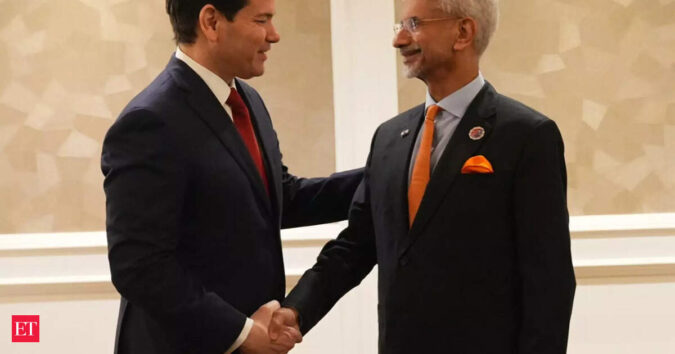
In a post on X, Jaishankar said the two sides “reviewed the entire spectrum” of bilateral ties, covering “trade & energy, defence & security, critical minerals & AI, nuclear & people-to-people, counter-terror & counter-narcotics cooperation.”
Also read: A $500 billion question hangs over Rubio’s India trade claim as original tariff bargain loses its footing
The discussions also covered regional, global and multilateral issues of mutual interest, he said, indicating the continuing strategic convergence between New Delhi and Washington across emerging technologies, energy security and geopolitical coordination.
Jaishankar added that a detailed readout of the talks would be shared at a press conference later.
The external affairs minister also said he was looking forward to joining Rubio and counterparts from Australia and Japan for the Quad Foreign Ministers’ meeting scheduled for Tuesday.
Mobility, migration concerns raised
In a high-level meeting and media interaction in New Delhi earlier in the day, Jaishankar and Rubio had reaffirmed the strength of the India-US strategic partnership, with discussions focusing on mobility, regional security and global stability.
Jaishankar stressed that people-to-people ties remain the foundation of the bilateral relationship and raised concerns over difficulties faced by legitimate Indian travellers in securing US visas amid changes in American immigration rules.
While acknowledging the need for cooperation against illegal and irregular migration, Jaishankar said such efforts should not impact genuine mobility. “Our expectation is that legal mobility would not be adversely impacted as a consequence,” he said, describing it as critical for business, technology and research sectors.
The remarks come after the US Department of Homeland Security announced changes to Green Card processing rules, under which domestic Adjustment of Status applications would only be granted under “extraordinary circumstances”, requiring many applicants to undergo consular processing in their home countries.
Responding to concerns over H-1B, F-1 and J-1 visas, Rubio said the changes were part of a broader global “modernisation” of the US immigration system and were “not India-specific”.
Also read: PM Modi gets invite to White House, holds talks with Marco Rubio
“Anytime you undertake a reform… there’s going to be a period of transition that’s going to create some friction points,” Rubio said, while expressing confidence that the system would eventually become more efficient.
Rubio also highlighted the contribution of the Indian diaspora and businesses to the American economy, noting that Indian companies have invested more than $20 billion in the US.
Counter-terror, Indo-Pacific in focus
Security cooperation figured prominently in the talks, with both sides reiterating their commitment to counter-terrorism cooperation and regional stability.
Jaishankar said India and the United States face “shared challenges”, particularly terrorism, and reaffirmed New Delhi’s policy of “zero tolerance” against terror.
He also referred to the extradition of Tahawwur Rana, accused in the 26/11 Mumbai terror attacks, from the US to India last year, calling it a reflection of strong inter-agency cooperation between the two countries.
“Our two countries will intensify cooperation bilaterally and in relevant international forums and will continue to collaborate closely on countering illegal trade in narcotics,” Jaishankar said.
The minister added that discussions later in the day would also focus on developments in the Gulf region, the Ukraine conflict and the Indo-Pacific.
Reiterating India’s broader strategic outlook, Jaishankar said New Delhi continues to advocate dialogue and diplomacy in global conflicts, safe and unimpeded maritime commerce, respect for international law, resilient supply chains and opposition to the weaponisation of market access and resources.