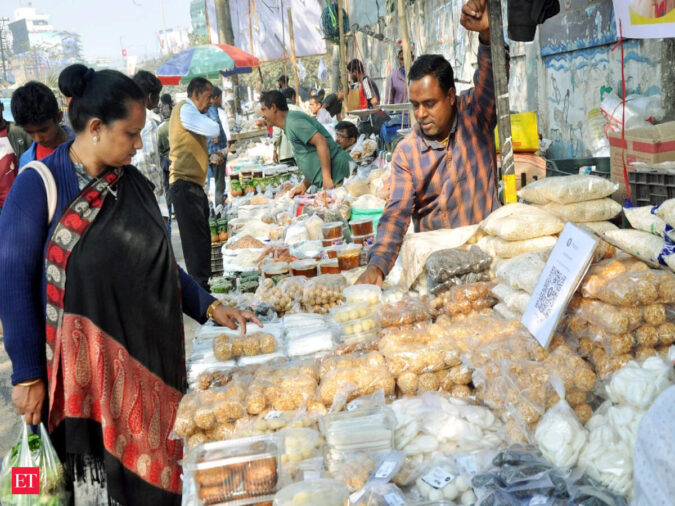
Food expenditure accounts for around 32.82 per cent of total household consumption expenditure, while non-food items and services together constitute nearly 67 per cent, indicating a gradual shift towards a more diversified consumption basket, the report titled ‘India’s Consumption Journey‘ said.
The report, based on the Household Consumption Expenditure Survey (HCES) 2023-24 conducted by the National Statistics Office (NSO), analysed data from 2,61,953 households across rural and urban India.
It highlighted a growing preference for protein-rich foods, vegetables and fruits across households, irrespective of income categories, although considerable regional differences persist.
Among states, Sikkim recorded the highest average household expenditure on selected protein-rich food items at Rs 1,776, followed by Goa at Rs 1,711 and Haryana at Rs 1,649. Odisha reported the lowest expenditure at Rs 656, followed by West Bengal at Rs 745 and Chhattisgarh at Rs 729.
The report also found that household food preferences are influenced by demographic composition. Families with a higher proportion of elderly members tend to allocate relatively more towards milk, fruits and vegetables, while households with a larger share of children spend more on milk products, served food and packaged food.
Geographical variations were also evident in food consumption. Milk and milk products accounted for 28.6 per cent of food expenditure in Haryana, while cereals constituted 38.6 per cent in Jharkhand. Chhattisgarh recorded the highest expenditure shares for pulses at 20.5 per cent and vegetables at 14.3 per cent.Meanwhile, the report highlighted that food consumption patterns remain heterogeneous even among households with similar expenditure levels. Differences were particularly pronounced in cereals and pulses.
SBI Research said the findings indicate a gradual movement towards more balanced dietary patterns, although disparities in protein consumption across states and gender groups remain significant.
The report suggests that India’s consumption journey is increasingly being shaped by changing household needs, demographic factors and diversification of spending beyond essential food items.