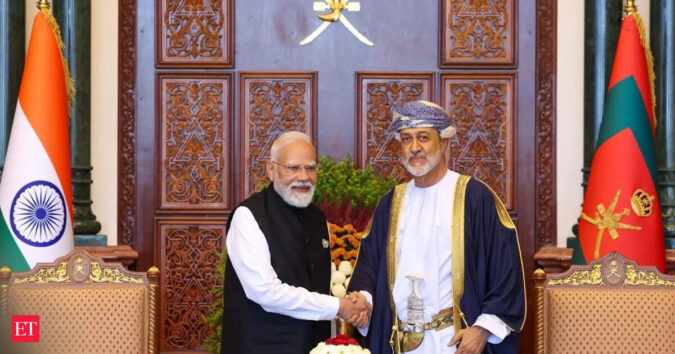
The report described the agreement as “strategically important” as it deepens India’s economic integration with the Gulf region through tariff reductions, improved market access and stronger investment cooperation.
Notably, Oman’s importance in India’s energy ecosystem has increased sharply in recent years. India’s imports of petroleum gases from Oman nearly doubled from about USD 0.7 billion in FY2022 to around USD 1.4 billion in FY2026, highlighting the Gulf nation’s growing role in India’s energy basket.
Also read: CEPA upgrade talks: India, South Korea agree to address widening trade deficit
The report noted that following disruptions around the Strait of Hormuz, Oman emerged as India’s single largest LNG supplier during March and April 2026, accounting for nearly 30-31 per cent of India’s total LNG imports.
“This development further reinforces Oman’s strategic importance in India’s evolving energy security architecture and highlights the rationale behind deeper institutional economic integration through the India-Oman CEPA,” the report said.
According to the report, the agreement also aligns with India’s long-term connectivity and energy diversification plans, particularly the proposed Middle East-India Deepwater Pipeline (MEIDP) linking Oman to Gujarat.The proposed 2,000-km subsea pipeline, estimated to cost around USD 4.7-4.8 billion, is expected to supply nearly 31 mmscmd of gas directly to Gujarat while bypassing the geopolitically sensitive Strait of Hormuz.
“Once operational, the Middle East-India Deepwater Pipeline (MEIDP) is expected to significantly strengthen India’s long-term energy security and supply diversification strategy,” the report stated.
Also read: India, Canada launch trade and investment forum to strengthen economic partnership
The CEPA is also expected to improve trade momentum between the two countries. Bilateral goods trade between India and Oman rose 5.7 per cent year-on-year to USD 11.2 billion in FY2026, outperforming most GCC peers.
Rubix said the agreement “is expected to help revive trade momentum by improving market access, reducing tariffs, and encouraging greater investment and supply-chain integration.”
Under the pact, India will secure 100 per cent duty-free market access in Oman across 98.08 per cent of tariff lines, covering 99.38 per cent of India’s export value.
The report highlighted strong export potential for Indian sectors such as engineering goods, pharmaceuticals, marine products, textiles, electronics, chemicals and plastics.
Engineering exports to Oman are projected to rise to USD 1.3-1.6 billion by 2030, driven by tariff elimination on machinery, iron and steel products and motor vehicles.
The agreement is also expected to provide a major boost to India’s textile sector, with products that earlier faced duties of around 5 per cent now receiving zero-duty access.
In agriculture and processed food, India currently accounts for 10.24 per cent of Oman’s agricultural imports and is already Oman’s second-largest supplier. Duty-free access for products such as rice, meat, eggs and seafood feed is expected to further improve India’s competitiveness.
The report also noted that Oman is increasingly emerging as a strategic logistics and trade gateway for India amid ongoing geopolitical tensions in West Asia.
Ports such as Sohar and Salalah, located outside the Strait of Hormuz, are being explored as alternative hubs for Indian agricultural exports to the Gulf region.
“The CEPA and the proposed MEIDP gas corridor position Oman as a trade partner and, more importantly, a critical gateway for India’s future energy connectivity and resilient supply-chain strategy in the Gulf region,” the report added.