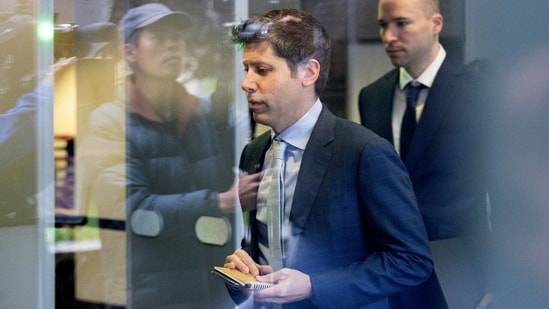
The lore of Sam Altman is being tested.
He was such a natural-born winner that the legendary Silicon Valley investor Paul Graham once said about Altman: “You could parachute him into an island full of cannibals and come back in five years and he’d be the king.”
Now, the cannibals are at the gate.
Altman’s leadership as chief executive officer of OpenAI is in the spotlight; the growth story of the company he built is facing scrutiny ahead of an IPO; and his home in San Francisco was recently under attack. Bringing it all to a head: a civil trial began last week in a federal court where Elon Musk was trying to oust Altman, his former partner, and gunk up OpenAI’s going-public ambitions.
What happens in the weeks and months to come will define Altman’s legacy. Will he be remembered as the Musk of his era, a glass-eating founder who overcame great obstacles to prove everyone wrong? Or will he become like Travis Kalanick, a talented entrepreneur who flamed out in the midst of scandals before Uber Technologies could go public and reward investors who had worried that he wasn’t the guy to land the plane despite everything already accomplished.
It’s a strange juncture for Altman, a man who just a few months ago seemingly orchestrated making OpenAI, through many interconnected tech-industry deals, too big to fail.
The would-be master of the universe was even having a hard time managing his own schedule—let alone his narrative. On Tuesday, Altman should have been celebrating a deal at a swanky downtown San Francisco event put on by Amazon Web Services. Instead, he was across the bay in Oakland, Calif., for opening arguments in the Musk lawsuit.
“I wish I could be there with you in person today,” Altman told the Amazon audience via a recorded video message played on a giant screen. “Uh, my schedule got taken away from me.”
Things are getting away from Altman in more ways than one. Now, the question is whether Altman is the right guy to take OpenAI to the next level.
That is especially poignant as the company’s bitter AI rival Anthropic is capturing market share and seeing a rapidly rising valuation in a race with OpenAI to go public.
And then there is my colleague Berber Jin’s report that OpenAI has missed its own revenue targets. That is an especially troubling sign for a company fueled by investors counting on massive growth to justify its recent $852 billion valuation. (In response to the report, Sarah Friar, chief financial officer at OpenAI, told Bloomberg News, “We feel like we’re beating our plan at the highest level.”)
News Corp, owner of The Wall Street Journal, has a content-licensing partnership with OpenAI.
We’ve seen these kinds of dramas play out before. A hot Silicon Valley tech player on the cusp of going public, a payday for all of those who gambled on its once unlikely success that somehow became obvious…and then trouble.
Musk knows this kind of moment. He has lived his own version of it.
His dream for Tesla could have easily crashed. Some on the Tesla board in 2008 questioned having him as CEO.
It’s easy to imagine how the then-struggling company could have pivoted to become a battery-pack supplier rather than continuing on a path that would eventually make it the world’s most-valuable car company.
Yet Musk muscled through, and his lore was born.
Part of Musk’s narrative was described in the opening arguments Tuesday. “His own personal story is pretty compelling,” Musk’s lawyer told the jury.
The early days of startups have a way of making enemies out of early partners. (Musk doesn’t have nice things to say about one of Tesla’s co-founders.)
In this case, Musk and Altman created OpenAI as a nonprofit. Along the way, the two had a falling-out, and Altman created a for-profit subsidiary.
OpenAI’s lawyers have denied wrongdoing. They argue that Musk knew a for-profit arm was needed to raise funding and recruit talent, and that the lawsuit is motivated by competition. Years after breaking with OpenAI, Musk developed his own for-profit AI ambitions through xAI, now part of SpaceX, which is also preparing for an IPO.
For Musk, the stakes in the case might be as much about hubris as financial considerations—though he is seeking damages that could exceed $180 billion. While some legal scholars think the odds are against his winning, Musk has already won in a lot of ways. He has spent the past two years framing his former partner as “Scam Altman”—something of an AI-era flimflam man.
To be sure, both men came into the trial with baggage—the judge has essentially said as much.
And Musk didn’t disappoint those who see him as a “world-class jerk,” as one juror described him in a questionnaire before the trial. At times, Musk spent his days on the witness stand coming off as thin-skinned.
He might be a villain to some. But the lore of Musk is still rooted in an element of wonder. Say what you will about his politics; the Tesla Model Y drives like a bird-dog in the hunt. His antics might be off-putting, but his pursuit of renewable rockets has helped reignite humanities’ dreams for space and beyond.
Like Musk, Altman, who is expected to testify later in May, has adopted a similar habit of talking about a bright future made possible by technology. His record for changing the world, however, is less obvious.
Instead, Altman has increasingly become the personification of AI technology. For some, that is good. For others, Altman is ushering in something worrisome, not wonderful.
Beyond the trial, the enduring risk for OpenAI, which Musk has gleefully helped fuel, is the concern that Altman can’t be trusted.
You can hear echoes of that away from the courthouse.
As I reviewed Tuesday’s events at a bar near Altman’s home in San Francisco’s Russian Hill neighborhood, I couldn’t help but overhear a conversation. A tech bro was telling the bartender his worries about AI and job security. “Sam Altman,” the man declared for all to hear, “he’s actually Satan.”
It was another reminder that Altman’s lore is still being written.
Write to Tim Higgins at tim.higgins@wsj.com