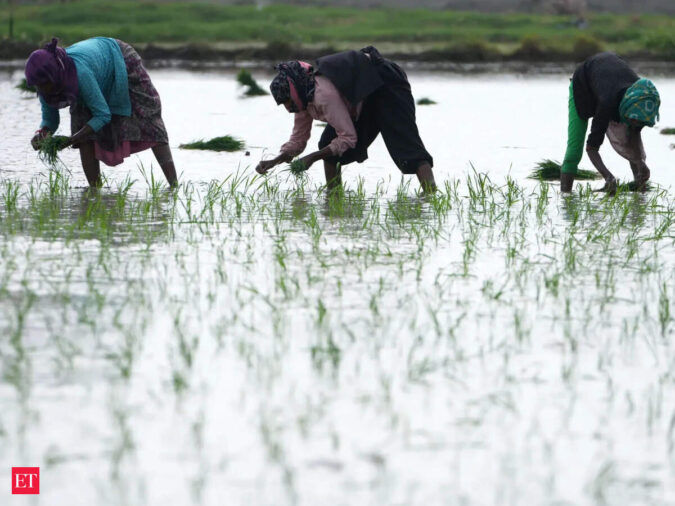
The deficient and uneven rains have already weighed on kharif sowing, which was 1.2 per cent below year-earlier levels by end-September, while depleted reservoir levels raise concerns over the upcoming rabi season, particularly in southern and some northern states, ICRA said in its monsoon wrap-up.
Also Read: Beyond the 7% headline: S&P maps the forces driving India’s next growth phase
“ICRA remains circumspect around the potential impact of the weak monsoon on crop output and farm incomes,” the agency said, warning that weaker farm incomes could dampen rural demand in the second half of FY27 and create upside risks to food inflation.
Rainfall during June-September was 87 per cent of the long-period average, with the season affected by the development of El Nino conditions. June rainfall was just 60 per cent of the LPA, while July saw 103 per cent, followed by 84 per cent in August and 93 per cent in September.
The rainfall distribution was also sharply uneven. The East and Northeast region received 74 per cent of LPA and the South Peninsula 76 per cent, both in the deficient category, while Northwest India received 94 per cent. Central India was the only major region to record normal rainfall at 97 per cent of LPA.
Kharif acreage stood at 110.7 million hectares at end-September, about 1.2 per cent below the year-earlier level but broadly in line with the historical average. Rice acreage fell 3.6 per cent and cotton acreage 1 per cent, partly offset by increases in pulses and coarse cereals.Several southern and central states recorded sharper declines in sowing. Karnataka’s kharif acreage fell 14.8 per cent from a year earlier, followed by Andhra Pradesh at 6.1 per cent, Telangana at 4.9 per cent and Maharashtra at 4 per cent.
ICRA said the uneven timing and distribution of rainfall could weigh on yields even where acreage remains close to normal, potentially reducing overall kharif output.
Reservoir storage stood at 71 per cent of full reservoir level as of September 24, compared with 90 per cent a year earlier and about 80 per cent of the historical average, ICRA said.
The shortfall was particularly pronounced in southern India, where storage was 36 percentage points below year-earlier levels and 24 percentage points below the historical average. Northern reservoirs were 29 percentage points below last year’s level and 17 percentage points below the historical average.
The lower storage levels could affect rabi sowing of irrigation-intensive crops such as rice and wheat. Southern states account for about 98 per cent of India’s rabi rice acreage and roughly 33 per cent of coarse cereal acreage, while Punjab and Rajasthan together account for about 31 per cent of wheat acreage.
Also Read: After S&P & Fitch, ADB raises India’s growth aim to 7% but El Nino clouds food story
The impact is likely to vary significantly by state. Uttar Pradesh, which accounts for about 28 per cent of India’s wheat acreage, had reservoir storage 14 percentage points above its historical average at end-September, supported by rainfall at 108 per cent of LPA, potentially offsetting some of the weakness elsewhere.
ICRA said the non-crop segments of agriculture, including livestock, forestry and fishing, could cushion the impact of weaker crop output. These segments have historically been less dependent on monsoon conditions and have recorded stronger growth than the crop sector.
The agency nevertheless lowered its FY27 agriculture, forestry and fishing GVA growth forecast to about 1 per cent, from 1.3 per cent, compared with 3.3 per cent growth in FY26.
Weak farm output and incomes could weigh on rural consumption in the second half of the fiscal year, ICRA said. Rural consumer sentiment deteriorated sharply in the July 2026 RBI survey, although spending intentions remained relatively resilient.
Rural labour-market conditions improved in August, with the rural unemployment rate falling to 4.1 per cent from 4.5 per cent in July. However, nominal rural wage growth slowed to 3.3 per cent in July, a 59-month low, while real rural wages contracted 1.6 per cent year-on-year.
ICRA expects rural inflation pressures to increase in the third quarter of FY27 amid higher food prices, West Asia-related cost pressures and a low base, potentially putting further pressure on real rural wages.
Government rice stocks stood at 39.1 million tonnes on September 1, 5.8 per cent above a year earlier and well above prescribed stocking norms. The government’s paddy procurement target for the 2026-27 marketing season is 70.86 million tonnes, below actual procurement of 72.84 million tonnes last year.
Wheat stocks were 48 million tonnes on September 1, up 44.1 per cent year-on-year and about 75 per cent above stocking norms. However, ICRA said the outlook for wheat output and prices would depend on the upcoming rabi sowing season and reservoir conditions.
The agency also flagged risks to the government’s fertiliser subsidy budget. It expects the fertiliser subsidy requirement to exceed the FY27 budget estimate of Rs 1.7 trillion by about Rs 900 billion, citing higher raw-material prices amid renewed tensions in West Asia.
Overall, ICRA expects the effects of the weak monsoon to remain uneven across crops and regions, with the greatest risks concentrated in southern India and parts of the north where reservoir levels are significantly below normal.