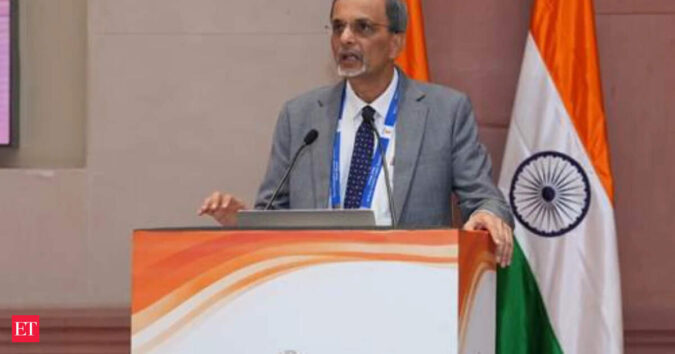
“Viksit Bharat depends on Viksit Rajya,” Nageswaran said at the concluding session of the two-day Conference on “Financing India’s Journey towards Viksit Bharat” on Saturday, calling for states to create conditions that can attract private investment while maintaining their own capital expenditure.
Also Read: Uday Kotak lays out 7 priorities for Viksit Bharat, warns against economic complacency
The conference, which brought together Union and state finance ministers, senior officials, economists, bankers and industry representatives, focused on how India can finance sustained and broad-based growth over the coming decades.
Nageswaran said the discussions had moved beyond questions of resource generation and sharing to the broader challenge of financing India’s development over the next two decades. He said India’s savings base was substantial but would need to grow further, while private capital would be critical to meeting the investment requirements of Viksit Bharat.
States urged to create investment-ready ecosystem
Nageswaran outlined three priorities for states: creating an enabling environment for private investment, improving the quality of investment proposals and strengthening their own capital expenditure despite fiscal constraints.
States need to ensure the availability of land, power and logistics, backed by effective single-window clearances, to make it easier for private investors to set up projects, he said.He also called for stronger project-preparation pipelines and credible project reports to help projects access domestic and multilateral financing. States should also direct credit towards underserved districts with growth potential, he said.
The CEA referred to a proposal by former Maharashtra additional chief secretary Sudhir Shrivastava to raise state capital outlay from about 2.4% of GSDP currently to 3% by 2031-32.
Nageswaran also called for the practices shared by states during the conference, ongoing deregulation efforts and recommendations from experts to be converted into partnerships with clear responsibilities and timelines.
The conference’s discussions also highlighted the need to increase domestic savings to support India’s growth ambitions. In his keynote address on the first day, N K Singh, chairman of the 15th Finance Commission, said India’s gross domestic savings rate of around 34% of GDP would need to rise towards 38-40% to sustain growth of 7-8% required for Viksit Bharat.
Singh also called for state-wise debt sustainability assessments and greater fiscal transparency, including accounting for off-budget borrowings, guarantees, arrears and borrowings through state-owned entities.
He said states could use information, artificial intelligence and machine learning along with existing tax databases to identify compliance gaps, broaden the effective tax base and improve revenue mobilisation.
Agriculture, energy and technology also in focus
The second day of the conference focused on financing agricultural transformation and the energy transition, alongside special sessions on technology and measuring gross state domestic product.
Discussions on agriculture covered reliable agricultural financing, market access, post-harvest marketing, logistics, infrastructure and food processing, as well as financial instruments that could be scaled up to support the sector.
The energy session examined financing for renewable energy and transmission assets, battery energy storage systems, pumped storage projects and other storage solutions. It also discussed financing carbon capture, utilisation and storage and the design of a carbon-credit framework aligned with India’s climate targets.
Special sessions examined the role of new-age technology in India’s development journey and the measurement of the Viksit Bharat journey from a GSDP perspective.
The conference also featured a session on banking-sector sources of finance, addressed by State Bank of India Chairman Challa Sreenivasulu Setty.
The government said working groups involving states will take forward the discussions and identify sector-specific financing requirements and actionable recommendations.
Nageswaran said the conference should be held annually, citing the quality of discussions and the openness with which states shared their perspectives. He stressed that India faces a dual task: sustaining its long-term development journey towards 2047 while accelerating resource mobilisation over the next five years, when global financing opportunities remain available.