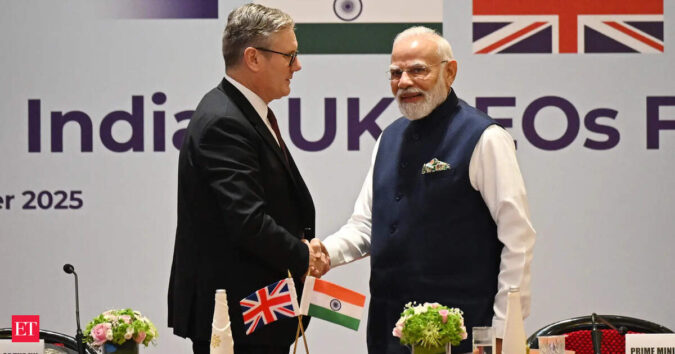
Just days before announcing his resignation outside 10 Downing Street in London on Monday, Starmer met Prime Minister Narendra Modi on the sidelines of the G7 Summit in France. During the meeting, the two leaders confirmed that the India-UK Comprehensive Economic and Trade Agreement (CETA) would come into force on July 15.
The agreement is expected to provide a major boost to the two countries’ £48-billion bilateral trade relationship. However, its implementation is now set to coincide with a change in leadership in the UK.
“It’s not just a piece of paper, it’s a launchpad for growth. With India set to be the third biggest economy in the world by 2028, and trade with them about to become quicker and cheaper, the opportunities waiting to be seized are unparalleled,” Starmer said, during his visit to Mumbai last October.
The 63-year-old MP for Holborn and St Pancras was widely credited with reviving Labour’s fortunes after the party’s crushing defeat in the 2019 general election. Under his leadership, Labour rebuilt public confidence and returned to power with a commanding mandate.
Starmer also worked to repair Labour’s strained relationship with the British Indian community, which had become disillusioned during Jeremy Corbyn’s leadership over the party’s perceived stance on Kashmir.
His government’s approach towards India was reflected in Labour’s 2024 election manifesto, which promised a “new strategic partnership with India, including a free trade agreement, as well as deepening cooperation in areas like security, education, technology and climate change”.“I have a clear message for you all today: this is a changed Labour Party,” he declared just before the general election.
During his election campaign, Starmer visited the Shree Swaminarayan Temple in Kingsbury, north London, where he assured British Hindus that there was “absolutely no place for Hinduphobia in Britain”. He continued to reiterate that message throughout his premiership, including during Diwali celebrations at 10 Downing Street.
Knighted by the late Queen Elizabeth II for his services to law and criminal justice, Sir Keir spent much of his career in the legal profession before entering politics. He was first elected as Labour MP for Holborn and St Pancras in 2015 after serving as the UK’s Director of Public Prosecutions.
Born in London to a toolmaker father, Rodney, and an NHS nurse mother, Josephine, Starmer grew up in Oxted, Surrey. He has often spoken about the influence of his parents, particularly his mother, who suffered from Still’s disease and died just weeks before he entered Parliament in 2015. Starmer has said her resilience shaped his determination, while his father’s work ethic influenced his belief in respecting working people.
Away from politics, Starmer has kept his family largely out of public life. He and his wife Victoria, an NHS employee, have two teenage children.
Unlike his predecessor Rishi Sunak, Starmer was often criticised for lacking charisma during televised debates, despite sharing a legal background and an education at the University of Oxford. Nevertheless, his experience as the country’s chief prosecutor helped him develop a reputation for methodical performances in Parliament, particularly during Prime Minister’s Questions.
After entering Parliament, Starmer became Shadow Brexit Secretary under Jeremy Corbyn and played a central role in shaping Labour’s Brexit strategy. Following Labour’s heavy defeat in 2019, he succeeded Corbyn as party leader and repositioned the party with a focus on economic stability, housebuilding, public services and reforming the NHS.
Although his government initially earned credit for bringing greater economic stability and rebuilding Labour’s electoral standing, a series of policy reversals and political missteps ultimately eroded support, leading to his resignation as Prime Minister.