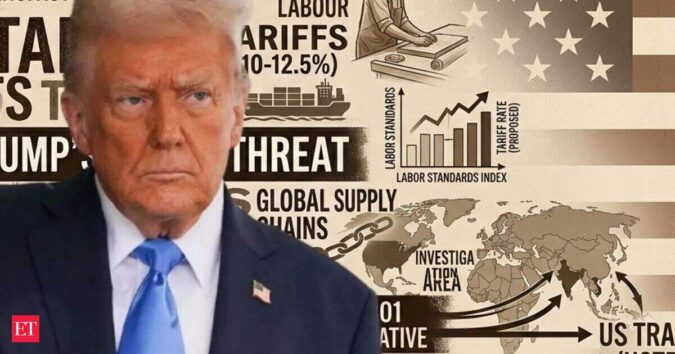
The revised tariff structure, which took effect immediately after the expiry of temporary Section 122 duties on July 24, applies to roughly 70% of India’s exports to the US.
Also read: Trump’s new tariffs prompt lawsuit from small businesses
According to an analysis by The Times of India’s Smriti Jain, the lower tariff follows India’s recent steps to tighten rules against imports made using forced labour and comes after discussions between New Delhi and Washington on labour practices.
Why India got a lower tariff
The revised duty stems from the US Section 301 investigation, which allows Washington to impose tariffs on imports linked to what it considers forced labour. India had initially been placed in the 12.5% tariff bracket when the proposal was announced in June.
However, according to an ANI report, Indian officials said constructive engagement with the US on labour practices, coupled with India’s decision to prohibit imports of goods produced using forced labour, helped secure the lower 10% rate.
The US Trade Representative has said the 10% tariff applies to economies that already prohibit imports of goods made using forced labour, have committed to doing so through reciprocal trade agreements, or have introduced measures that effectively block such imports.
The 10% rate also applies to 16 other economies, including Bangladesh, Pakistan, Canada and the United Kingdom, while many other economies under the probe will face a 12.5% levy.
Also read: Donald Trump finds a new way to impose tariffs but Asia isn’t buying the reason
What changes for Indian exporters?
The impact of the new tariff will vary across sectors.
According to the Global Trade Research Initiative (GTRI), products already covered under Section 232—including steel, aluminium, copper, auto components and certain derivative products, accounting for around 8% of India’s exports—will continue to face separate tariffs of 25% or 50% in addition to the normal US Most Favoured Nation (MFN) duty.
A limited list of exempt products will continue to attract only the regular MFN tariff.
The biggest impact falls on nearly 70% of India’s exports, including engineering goods, machinery, chemicals, plastics, leather products, gems and jewellery, furniture and several manufactured goods, which will now attract the 10% Section 301 tariff in addition to the applicable MFN duty.
GTRI noted, however, that India has not been included in the textile and apparel tariff-rate quota exemption granted to countries such as Bangladesh, Cambodia, Indonesia and Malaysia for specified exports made using US-origin cotton and fibre.
Also read: US imposes 10% tariff on India, Pakistan, Bangladesh, UK, others in forced labour probe
Competitive edge, but uncertainty remains
Trade experts believe the revised tariff gives India a modest competitive advantage rather than complete relief.
Manoj Mishra, Partner and Tax Controversy Management Leader at Grant Thornton Bharat, told ToI that India’s 10% tariff places it alongside exporters such as Bangladesh, Sri Lanka, Malaysia, Indonesia and Pakistan, while several advanced manufacturing economies—including Japan, South Korea, Switzerland, Vietnam, Thailand, Singapore and certain products from the European Union and Taiwan—could face effective tariffs of up to 12.5%.
According to Mishra, the differential could improve India’s competitiveness in sectors such as engineering goods, auto components, electronics, specialty chemicals, pharmaceuticals, medical devices, and textiles and apparel, where even relatively small tariff gaps can influence sourcing decisions by global manufacturers and retailers.
He added that although the additional tariff raises export costs, India’s improved relative position offers an opportunity to deepen its role in global supply chains while meeting evolving labour and environmental compliance standards.
Ajay Srivastava, founder of GTRI, argued that the US has not presented evidence showing India imports goods produced using forced labour. He said India’s Foreign Trade Policy already bans imports made with forced or compulsory labour, while domestic laws also prohibit forced labour.
Srivastava said the new levy appears aimed more at preserving the Trump administration’s broader tariff regime after the expiry of temporary Section 122 duties than addressing any proven forced-labour concerns involving India.
He also cautioned that the trade landscape remains fluid. According to GTRI, another ongoing Section 301 investigation into excess manufacturing capacity could result in additional tariffs on industrial products.
The think tank further warned that country-specific duties—similar to those recently imposed on Brazil and Canada—could eventually be extended to India over issues such as purchases of Russian oil or other geopolitical considerations.
(With inputs from ToI, GTRI & ANI)